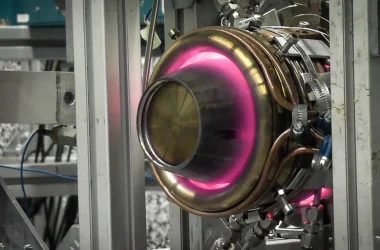
The European Marine Energy Centre (EMEC) has completed a hydrogen combustion engine trial at Kirkwall Airport in Orkney, demonstrating how hydrogen-powered combined heat and power (CHP) systems could transform energy infrastructure at commercial airports. The October 2024 trial marks the first instance in the UK where hydrogen technology has simultaneously met both electrical and thermal demands of an operational airport facility.
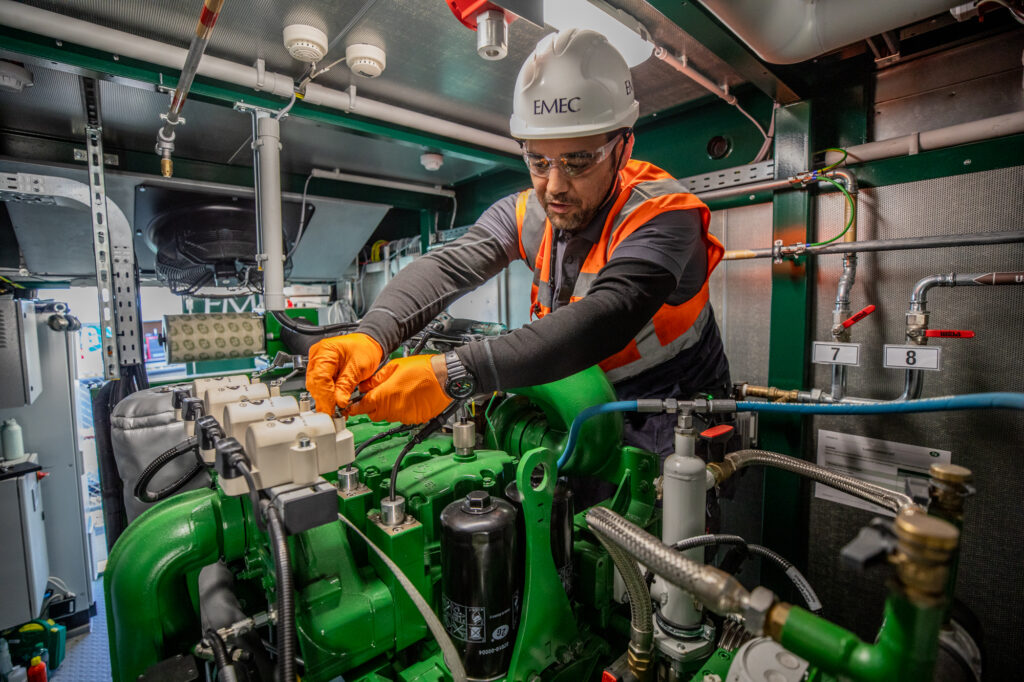
The trial deployed a hydrogen-fueled CHP unit positioned airside at Kirkwall Airport, where it was integrated with the airport’s existing heating infrastructure. During testing, the system successfully powered terminal buildings and runway lighting while providing sufficient heat output to eliminate the need for conventional boiler operations. This dual-function capability represents a significant advancement in practical hydrogen applications for critical infrastructure.
Technical Implementation and Performance
The CHP unit, supplied by the German specialist manufacturer 2G, operated at approximately 60% capacity throughout the trial period. Engineers deliberately activated additional electrical loads to test system responsiveness and stability under varying demand conditions. The integration process required careful coordination between EMEC technical staff and airport ground crews to ensure seamless coupling with existing infrastructure while maintaining normal airport operations.
The choice of hydrogen combustion technology, rather than fuel cells or other alternatives, reflects specific engineering considerations for airport applications. Combustion engines provide rapid response times to fluctuating power demands-essential for runway lighting systems that must maintain constant illumination levels to ensure safety compliance. Additionally, the high-temperature exhaust gases from combustion processes offer efficient heat recovery opportunities, making them particularly suitable for facilities that require substantial space heating.
Understanding Hydrogen Combined Heat and Power Systems
Combined heat and power systems represent an elegant solution to energy efficiency challenges that engineering students encounter in thermodynamics courses. Traditional power generation typically achieves an efficiency of 35-40%, with most energy lost as waste heat. CHP systems capture this thermal energy for productive use, pushing overall system efficiency above 80%.
In hydrogen CHP systems, the combustion process follows fundamental thermodynamic principles familiar to engineering students. Hydrogen gas (H₂) combines with oxygen in a controlled combustion chamber, producing water vapour and releasing energy according to the reaction: 2H₂ + O₂ → 2H₂O + energy. The combustion temperature reaches approximately 2,000°C, though engineers moderate this through excess air mixing to protect engine components.
Mechanical energy extraction occurs through a modified internal combustion engine, similar in principle to automotive engines but optimised for stationary power generation. The motor drives an electrical generator, typically producing three-phase alternating current at 400-480 volts. Engineers must account for hydrogen’s unique combustion characteristics: its wide flammability limits (4-75% in air), high flame speed (approximately 3.5 m/s), and low ignition energy (0.02 mJ).
Heat recovery presents interesting engineering challenges. The system captures thermal energy from two primary sources: engine coolant circuits operating at 80-90°C and exhaust gases at 400-500°C. Engineers employ shell-and-tube heat exchangers to transfer this energy to the building’s heating system. The temperature differential between these sources allows for cascaded heat recovery, maximising energy extraction at various temperature grades.
Material selection becomes critical when working with hydrogen. Engineers specify austenitic stainless steels for high-temperature components to resist hydrogen embrittlement, a phenomenon where hydrogen atoms penetrate metal grain boundaries, causing brittleness and potential failure. Sealing systems require special consideration, as hydrogen’s small molecular size makes it prone to leakage through conventional gaskets.
The control system represents a sophisticated integration of engineering. Programmable logic controllers continuously monitor combustion parameters, adjusting fuel-air ratios to maintain optimal efficiency while preventing knock-premature combustion that can damage engine components. Load-following algorithms predict demand changes and adjust engine speed accordingly, maintaining grid frequency stability within ±0.5 Hz as required by electrical standards.
The trial’s success relied on careful integration of the system with existing airport infrastructure. Engineers connected the CHP unit’s electrical output to the airport’s main distribution panel through synchronisation equipment that matched phase, frequency, and voltage with the grid supply. The thermal integration required retrofitting connection points to the existing heating network, allowing seamless switching between the hydrogen system and conventional boilers.
Monitoring systems tracked multiple performance parameters throughout the trial, including electrical output stability, thermal efficiency, and hydrogen consumption rates. These measurements will inform future deployments and optimisation strategies for the system. The ability to maintain steady output while responding to variable loads demonstrates the technology’s suitability for facilities with fluctuating energy demands.
Implications for Airport Decarbonization
If hydrogen CHP technology proves economically viable at scale, it could address one of aviation’s persistent challenges: ground operations emissions. While much attention focuses on aircraft emissions, airport facilities themselves consume substantial energy for lighting, heating, cooling, and ground support equipment. The Kirkwall trial suggests hydrogen systems could provide a pathway to reducing these emissions without compromising operational reliability.
The selection of Orkney as a trial location reflects strategic advantages beyond EMEC’s presence. The islands generate significant renewable electricity from wind and tidal sources, creating opportunities for green hydrogen production through electrolysis. This local production potential could establish a model for airport energy independence, particularly valuable for remote facilities where fuel transportation adds cost and complexity.
Should this approach gain wider adoption, engineers will need to address several implementation challenges. Hydrogen storage requires either high-pressure vessels (typically 350-700 bar) or cryogenic systems maintaining temperatures below -253°C. Both options demand specialised infrastructure and safety systems. Additionally, the lower volumetric energy density of hydrogen compared to conventional fuels means that storage facilities must be substantially larger to achieve an equivalent energy capacity.
The trial, funded through Scottish Government support via Highlands and Islands Enterprise, with additional backing from the Sustainable Aviation Test Environment and Rural Energy Hubs projects, demonstrates growing institutional interest in the development of hydrogen infrastructure. Highlands and Islands Airports Limited’s participation as facility operator provided essential operational context for evaluating real-world feasibility.
Future implementations explore scaled systems that serve multiple airport functions. Larger CHP units could power ground support equipment charging stations, terminal climate control, and cargo facility operations. The modular nature of CHP technology allows capacity additions as hydrogen availability increases, providing a gradual transition path from conventional energy sources.
The engineering community will closely analyse data from this trial to refine hydrogen combustion technologies for commercial applications. Key areas for optimisation include improving part-load efficiency, reducing nitrogen oxide emissions through combustion tuning, and developing cost-effective hydrogen storage solutions suitable for airport environments. As green hydrogen production costs continue to decline through improvements in electrolysers and the expansion of renewable energy, the economic case for hydrogen CHP systems should strengthen, potentially establishing them as standard equipment in future sustainable airport designs.
TLDR
- Historic milestone: First UK airport to successfully operate a hydrogen-powered combined heat and power (CHP) system
- Dual functionality: The System simultaneously provided electricity for runway lighting/terminals and heat for buildings
- Technical success: German-made 2G CHP unit operated at 60% capacity, eliminating the need for conventional boilers
- Strategic location: Orkney chosen for abundant renewable energy and green hydrogen production potential
- Future implications: Could revolutionize airport decarbonization and energy independence for aviation ground operations
- Engineering achievement: Demonstrated hydrogen combustion technology’s suitability for critical infrastructure with fluctuating demands