Energy & Environment
German engineers ran a compressorless hydrogen turbine for 303 seconds, beating NASA's record and cutting the energy lost to compression.
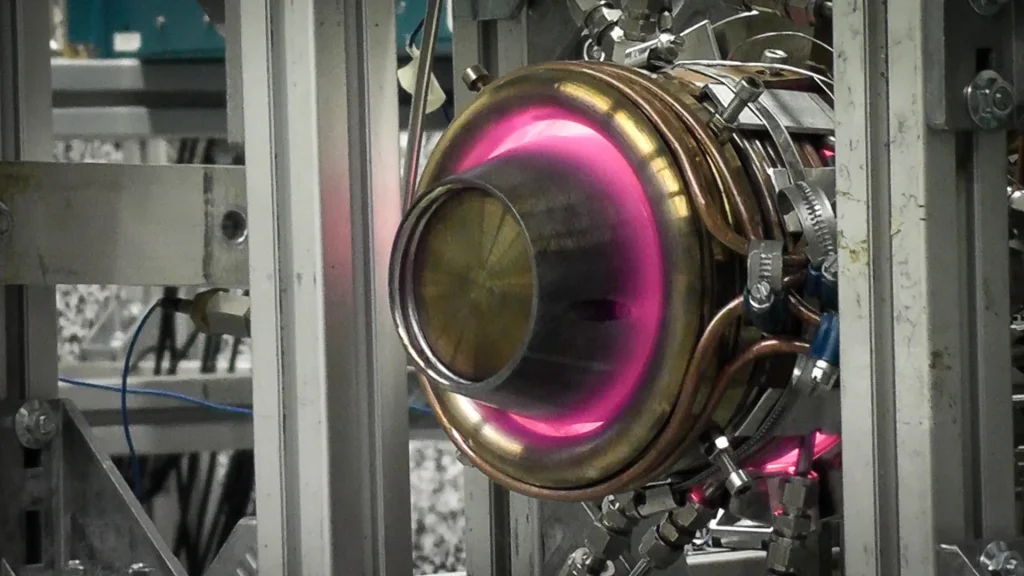
For more than five minutes, a small hydrogen-powered machine in a lab at the Karlsruhe Institute of Technology (KIT) achieved something which no compressorless hydrogen turbine had done before; it ran continuously for 303 seconds, producing electricity the entire time and thus exceeding the endurance record of 250 seconds which NASA had held since testing similar equipment.
On paper, an additional 53 seconds seems unimpressive; what is significant is the fact that the machine was operating without a mechanical compressor, without a bank of spinning blades burning fuel to draw in and compress the air, and without the amount of about 50 per cent of the power output of a conventional turbine which is normally used up before a single watt reaches the grid.
All conventional gas turbines - whether they are driving a jet or turning a generator at a power station - work on the same basic principle: they compress the air, add fuel, burn it, and then let the hot expanding gas carry out the work. The reason for having a compressor stage is that it is necessary to increase the air pressure before combustion, since conventional steady-burning engines need this to function efficiently. However, both the construction and operation of the compressor are expensive in every way; they demand precisely machined blades, careful cooling, and a large portion of the turbine’s own shaft power - often about half of all the power that the turbine generates - to keep the compressor running.
The researchers at KIT, under the direction of Professor Daniel Banuti, decided to get rid of the compressor altogether. Their machine is based on pressure-gain combustion, meaning that hydrogen and air are set off so as to create a detonation wave instead of a steady flame. A detonation wave is a supersonic pressure wave that has the combustion reaction of its own, and as it travels through the mixture it increases the gas pressure as a natural result of the burning. Rather than using energy to mechanically compress the air before combustion, the KIT design allows the chemical reaction to carry out the compression. As ScienceDaily pointed out, hydrogen is especially suitable for this since it reacts very quickly and produces pressure rises that are stable enough to make a turbine wheel turn continuously, rather than in short, violent bursts.
While on its record run, hydrogen was fed into the combustion chamber at a slow rate of between one and two grams per second, a small amount when compared to the fuel requirements of a full-sized industrial turbine. The combustion chamber is water-cooled, as this is a necessary measure since detonation waves burn both hotter and faster than the steady flames found in a conventional combustor. Banuti’s team believes there are two main applications for the technology: stationary power generation, in which the method could yield more usable power from the same quantity of hydrogen fuel, and eventually aviation, in which every kilogram saved on a compressor stage directly translates into increased range or payload.
It has always been difficult to get a detonation-driven turbine to operate smoothly for any length of time since the idea was first introduced into aerospace research many decades ago. Detonation waves are by their nature unstable: even a slight alteration of the fuel mixture, the shape of the chamber, or the time at which ignition occurs is enough to cause the wave to die out or to become irregular. Although NASA’s earlier achievement of 250 seconds proved that the concept was feasible, the fact that this run has now been extended beyond the five-minute mark indicates that the KIT team have discovered a method of keeping the detonation wave locked into a consistent, controllable pattern rather than having it be a single, one-off occurrence. It is this kind of stability that distinguishes a mere laboratory curiosity from something that an engineer could eventually approve for use in a power station or an aircraft.
Turbines based on the conventional approach operate using the Brayton cycle, which is the same closed cycle involving compression, the addition of heat and expansion that A-level students study when learning about thermodynamics and heat engines. The gas is compressed, which increases both its pressure and temperature; afterwards, fuel is burned at approximately constant pressure in order to add further thermal energy; then the hot gas expands through a turbine stage, turning the pressure and thermal energy into mechanical work on the turbine shaft. The issue, from a thermodynamic point of view, is that the energy required for compression has to be taken from the turbine’s own output. In an ideal, frictionless environment, that energy would be recovered during the expansion process, but real compressors and turbines are a long way from being ideal, and at each stage of the blades there are losses due to friction, turbulence and heat being transferred to the casing. When all these losses are taken into account, about half of the turbine’s mechanical output can be lost before it even reaches a generator or a propeller.
The principle used in KIT’s compressorless hydrogen turbine - pressure-gain combustion - challenges that assumption. Rather than burning the fuel at approximately constant pressure, as is illustrated in the typical textbook diagram of the Brayton cycle, the KIT design burns it in such a way that the pressure rises as part of the combustion process. This can happen because a detonation wave is not a flame in the ordinary sense. A flame front advances through a fuel-air mixture at a few metres per second, the movement being caused by heat conduction from the burning layer into the unburned gas in front of it. In contrast, a detonation wave travels at supersonic speed, usually exceeding a thousand metres per second in the case of a hydrogen-air mixture, and is caused by a shock wave which compresses and ignites the gas in front of it almost instantly. The shock wave is mechanically carrying out the function that compressor blades would normally perform by squeezing the gas, the difference being that it uses the energy released by the combustion reaction rather than energy drawn from the turbine shaft.
Hydrogen is especially well suited to detonation combustion due to the speed of its reaction. The ignition delay time, which is the period between a fuel-air mixture reaching ignition conditions and actually starting to burn, is much shorter than that of hydrocarbon fuels like kerosene or methane. Since detonation waves depend on the reaction keeping up with the shock wave that sets them off, a fuel that reacts slowly is likely to produce detonations that decouple, weaken or fail completely. The fast chemical reaction of hydrogen together with its wide flammability range makes it much more forgiving, and this is one of the reasons why KIT selected it for the first working demonstration rather than using a conventional aviation fuel.
All of this involves considerable engineering difficulties. The detonation waves subject the combustion chamber walls to repeated and rapid pressure and temperature spikes that are much more severe than the relatively mild, continuous heat load found in a conventional combustor, which is the reason why the KIT chamber is water-cooled rather than using the air-film cooling methods usual in jet engines. In order to keep the detonation wave fixed in the chamber and prevent it drifting, weakening or exploding, it is necessary to have precise control of the fuel injection timing and the mixture ratio, which is why the team is still working with modest hydrogen flow rates of one to two grams per second rather than with industrial-scale amounts. Scaling up a detonation combustor while at the same time maintaining wave stability is one of the main unresolved problems in the field, and that is why a five-minute run should be regarded as a real achievement rather than just a small improvement.
For students who are studying the thermodynamics section of A-level physics or engineering programmes, the compressorless hydrogen turbine provides a useful example of where real losses occur in an idealised cycle. Although textbook diagrams of the Brayton cycle usually treat compression as a simple and loss-free stage, in reality it is one of the most costly parts of the entire machine to construct, operate and maintain. Not only does eliminating the compressor reduce weight and the number of components, but it also fundamentally alters the energy balance of the cycle. Whenever engineers are able to make pressure-gain combustion reliable and scalable, the efficiency improvements will be applicable in any situation where a gas turbine is used, whether that be for decentralised power generation using green hydrogen or, even further ahead, for aircraft propulsion.
The team at KIT now intends to extend the run time and start testing higher hydrogen flow rates, thereby bringing the technology closer to one that might be suitable for use in a real power plant. For decades, detonation-driven turbines have been a promising concept but have never really moved out of the laboratory, mainly since it has been so difficult to keep the detonation wave stable for any useful length of time. Although a five-minute run by itself will not be sufficient to replace a single power station turbine, it does show that the physics of a compressorless hydrogen turbine can be made to behave in a predictable way rather than in a chaotic manner, which is a necessary condition for all that comes next.
Credit via sciencedaily.com
Energy & Environment
Aerospace, Defence & Marine
Energy & EnvironmentInnovation