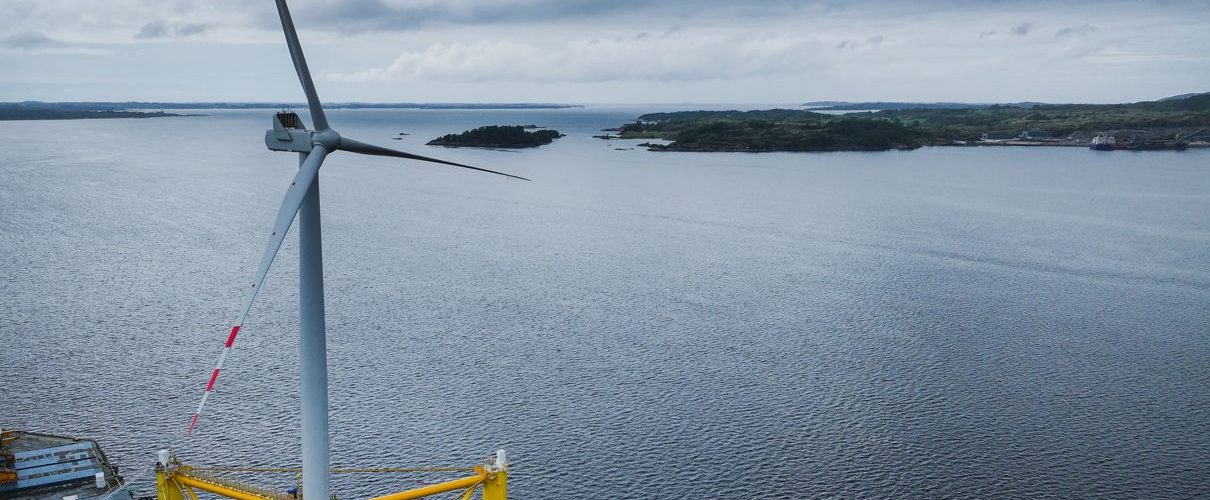
Scotland's long-awaited floating wind turbine now stands fully assembled, with its tower, nacelle, and blades fixed on an Ocergy semi-submersible foundation. It is currently moored at a quay, 220 kilometres from the gas platform it will eventually power. Before it can start generating electricity, the turbine must be towed across one of Europe's most challenging stretches of open water, all without anyone on board.
This is Culzean, and as of 31 July 2026 it has cleared its final assembly milestone. This turbine, called Culzean, reached its final assembly milestone on 31 July 2026 and is now ready to be towed to its offshore site off Scotland's east coast.
While a single 3 MW turbine may seem small compared to a gas platform's energy needs, it is expected to provide about 20% of Culzean's electricity, reducing emissions from the platform's gas-fired generators into a foundation designed to float rather than sit fixed to the seabed, was led by EPC contractor Archer, working alongside Global Maritime, Navitas Renewables, the Wergeland Group and Sarens, the heavy-lift specialist responsible for manoeuvring components too large and heavy for conventional cranes.
According to offshorewind.biz’s coverage of the milestone, the project is now led by NEO NEXT+ Energy and is one of thirteen projects under the INTOG scheme, Scotland’s programme for pairing offshore wind directly with oil and gas installations rather than the wider electricity grid.
Why a floating wind turbine Scotland project bypasses the seabed
Culzean is located in water that is too deep for a traditional fixed-foundation turbine, which would need to be anchored to the seabed. As water gets deeper, fixed foundations become much more expensive because the structure must reach all the way down. Floating foundations avoid this problem by staying on the surface and using mooring lines anchored to the seabed. This design keeps costs similar whether the water is 60 or 600 metres deep.
Ocergy's semi-submersible platform was chosen because it allows for modular construction and quick assembly. Different sections can be built at separate locations and then brought together at the integration site, instead of needing one large facility for the whole structure. This modular approach made it possible to fit the tower, nacelle, and blades onto the foundation in time for the July deadline.
Supplying just a portion of a gas platform's electricity may seem modest compared to large offshore wind farms, but it addresses a long-standing issue. Gas platforms usually generate their own power with gas turbines that use the same fuel they extract, which is expensive and produces a lot of carbon for a small electricity need. A single floating turbine next to the platform can reduce this reliance, without waiting for new grid connections or big wind farms.
Engineering Deep Dive: Keeping a Floating Turbine Upright in the North Sea
From an engineering perspective, fixed-bottom wind turbines are relatively easy to keep stable. Their foundations are anchored to the seabed and do not move, so the tower just needs to withstand wind and the turbine's rotation. Floating wind turbines face a tougher challenge. The whole structure, including the tower, nacelle, and blades, sits on a platform that moves with every wave. It must stay nearly vertical so the rotor can work safely and efficiently.
Ocergy's semi-submersible foundation uses buoyancy and ballast to keep the turbine stable, similar to how a ship stays upright. Instead of supporting a hull, it holds up a turbine about 100 metres tall. The design features several partially submerged columns connected by pontoons, which spread buoyancy over a wide area. This wide base increases the righting moment, or the force that returns the structure to upright when it tips, a concept familiar from basic mechanics.
Mooring lines help keep the floating structure stable by anchoring it to the seabed, but they also allow some movement to absorb wave energy. If the mooring system were completely rigid, every wave would hit the structure directly. A good mooring system, using either catenary or taut-leg setups depending on water depth, lets the platform move within safe limits while the anchors and chains take the strain. Finding the right balance - enough flexibility to prevent damage, but not so much that the turbine moves out of position - is a key challenge in floating wind engineering.
Towing the fully assembled turbine 220 kilometres across open water is a major engineering task. Unlike fixed turbines, which are built piece by piece at their site, floating turbines are put together onshore or in sheltered water and then towed upright to their final spot. The foundation must be stable enough to handle open-water conditions during the journey, relying only on its own buoyancy and ballast before the mooring system is attached. Tow speed, route, and towline setup all need to be carefully planned, since the tall structure can catch the wind like a giant sail while being moved.
Linking a floating wind turbine like Culzean directly to a gas platform, instead of the onshore grid, brings its own electrical challenges. The turbine's output changes with the wind, so it must be managed alongside the platform's own power generation and needs. Power electronics are used to smooth out these fluctuations and make sure wind power is used before gas turbines whenever possible. This setup is what allows the platform to cut its gas-fired generation by 20%.
The Culzean project may be just a single turbine compared to the huge offshore wind farms being built elsewhere in the UK, but its goal is different. It aims to show that gas platforms can reduce their own emissions directly, without waiting for new grid connections. If the tow and mooring are successful, NEO NEXT+ Energy will have a model for other INTOG projects to follow.
- The Culzean floating wind turbine completed final assembly on 31 July 2026
- It is mounted on an Ocergy semi-submersible foundation, ready for a 220km tow to its offshore site
- The single 3 MW turbine will supply around 20% of the Culzean gas platform’s electricity
- Integration was led by EPC contractor Archer with Global Maritime, Navitas Renewables, Wergeland Group and Sarens
- The project is one of thirteen offshore wind projects under Scotland’s INTOG programme, now led by NEO NEXT+ Energy