
Automotive & Transport
The JCB Hydromax hydrogen speed record now stands at 406.320mph after twin runs at Utah's Bonneville Salt Flats, doubling the old combustion mark.

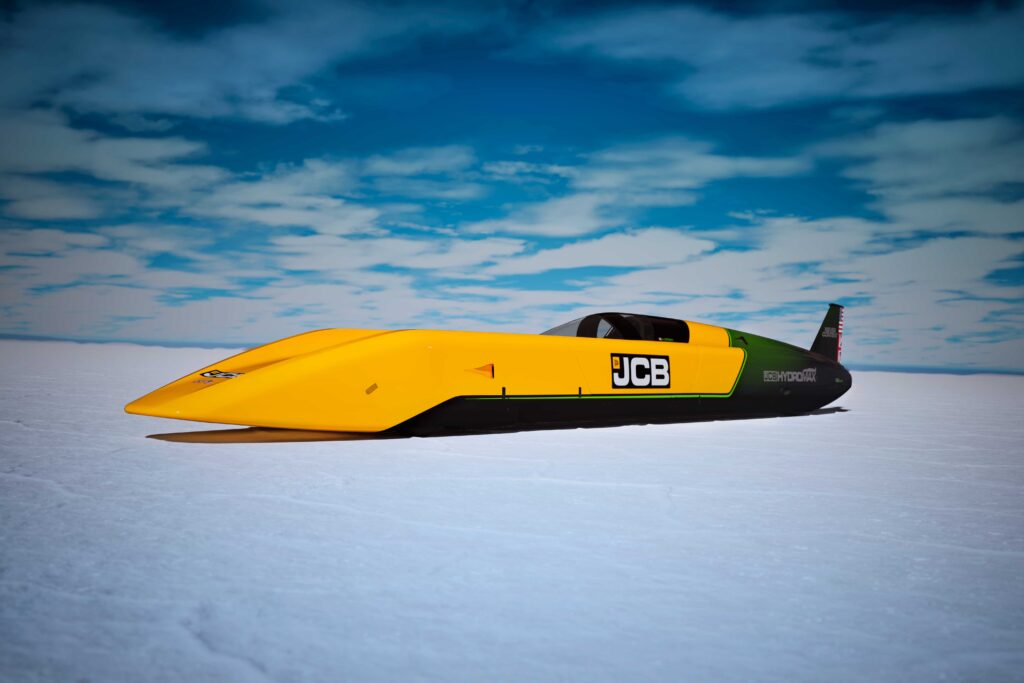
The official recognition of the JCB Hydromax’s hydrogen speed record will be secured when the relevant administrative procedures have been finished. On 11 August 2026 Wing Commander Andy Green entered a 32-foot streamliner that had been designed and constructed by the British digger manufacturer JCB and drove it two times across the white expanse of Utah’s Bonneville Salt Flats in one hour, attaining an average speed of 406.320mph; as Forbes’ report from Bonneville states, this is the highest speed ever recorded by a hydrogen-powered vehicle on land.
The speeds obtained on both sides of that average give an account of themselves: in the first run Green reached 400.623mph, and in the second - which was in the opposite direction so as to compensate for the effect of wind and gradient - he attained 412.135mph. The same twin-engine vehicle was used for both runs, this instance it being powered by two hydrogen combustion engines giving 1,600 bhp, the same engines having been taken from the same production line as those used in JCB’s diggers and backhoe loaders. Even though the record still has to be formally recognised by the FIA, the organisation which governs motorsport, it more than doubles the previous hydrogen combustion record of 185.5mph set by BMW’s H2R prototype in 2004.
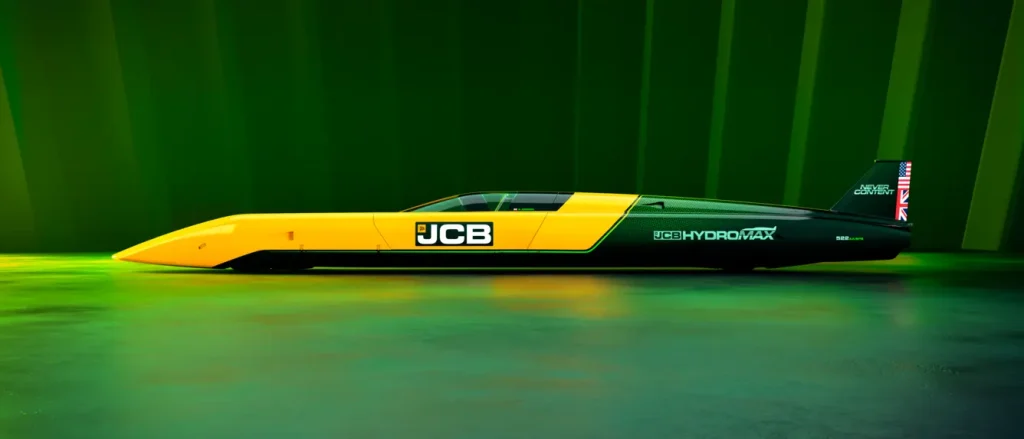
Most attempts to get hydrogen vehicles to high speeds have been directed towards fuel cells, which are devices that turn hydrogen into electricity in order to power an electric motor. Hydromax, on the other hand, takes a more direct route by burning the hydrogen just as a petrol engine burns petrol, the only difference being that water vapour comes out of the exhaust instead of carbon dioxide. This method also broke the previous hydrogen fuel cell speed record of 303mph, which had been set by a different vehicle based on battery-electric lines.
Although combustion is a less refined way of getting energy from hydrogen than by using a fuel cell, it is also a technology which JCB is very familiar with. Over many years the company has fitted hydrogen combustion engines to construction machinery, on the basis that contractors who had already been trained on diesel engines could easily make the switch to hydrogen engines with just a little retraining, instead of having to go entirely to battery power. It was the Bonneville site that was used to demonstrate that these engines could deliver real performance, not just torque when shifting earth.
The Bonneville Salt Flats have been the location for land speed records since the 1930s since they offer a feature which is very uncommon elsewhere-extensive areas of hard, flat, low-friction salt crusts left behind when an old lake dried up. In order to achieve speeds of hundreds of miles per hour, vehicles need a certain length of track, and even more is needed in order to stop safely, and the route at Bonneville can be over 10 miles long in a straight line. Anthony Bamford, who is the chairman of JCB, has earlier arranged speed record attempts at this site, including the JCB Dieselmax project in 2006, which at one time held the official diesel land speed record.
The fact that Hydromax has entered the market also serves as further evidence in the general debate concerning how heavy transport and off-highway machinery should achieve decarbonisation. Battery-electric solutions have difficulty meeting the weight and charging-time requirements of construction and agricultural equipment. Since it makes use of engine designs which manufacturers already know how to build and maintain, hydrogen combustion offers refuelling times similar to those of diesel, provided that a supply of hydrogen fuel is available to fill the tank.
Engineering deep dive
A hydrogen combustion engine is almost identical in terms of its mechanical structure to a petrol or diesel engine. The pistons still go up and down in the cylinders, the crankshaft still turns the linear motion into rotation, and the driveshaft still passes on the power to the wheels. The only difference lies in what is fed into the cylinder and what is exhausted from it. Instead of injecting petrol vapour and then igniting it with a spark, or squeezing the diesel until it catches fire on its own, the hydrogen engine injects hydrogen gas and burns it, either by means of a spark plug or by carefully adjusting the compression timing.
The chemistry involved is so clear it's almost embarrassing. In its ideal state, the combustion of hydrogen follows the equation 2H2 + O2 to 2H2O: two hydrogen molecules react with one oxygen molecule to give water and at the same time release energy in the form of heat. Since there is no carbon in the fuel there is no carbon dioxide produced as a result of burning it. The problem, and it is a real one, is that hydrogen burns at a higher temperature than petrol or diesel, and this heat causes the nitrogen and oxygen in the surrounding air to react and form nitrogen oxides, or NOx, a real pollutant which engineers have to deal with by means of exhaust after-treatment or by carefully controlling the air-fuel ratio.
That is the way in which Hydromax differs from a fuel cell vehicle, something that anyone examining energy transfer at A-level should understand. A fuel cell produces electricity by combining hydrogen and oxygen in an electrochemical reaction, without involving combustion, and this electricity then directly drives an electric motor. It is generally more efficient at turning the chemical energy stored in hydrogen into useful motion since it avoids the thermodynamic losses which are present in all heat engines - the same kind of losses that mean a petrol engine can only convert about one third of the energy in its fuel into motion, the rest being lost as waste heat, a limitation explained by the Carnot efficiency, which sets the maximum amount of work that any heat engine can obtain from a temperature difference. On the other hand, a combustion engine is generally able to deliver power more rapidly and at higher outputs than the current fuel cell stacks, which is one of the reasons why Hydromax was able to break both the 303mph fuel cell record and the previous combustion record.
Another key characteristic of hydrogen is that it takes up a lot of space. As a gas, hydrogen has a very low energy density by volume, even though its energy density by mass is extremely high, about three times that of petrol. In order to carry sufficient hydrogen for a high-speed journey, Hydromax's tanks must probably store the gas at a very high pressure, the pressure usually being 350 or 700 bar in hydrogen vehicles, the gas being held in carbon-fibre-wrapped cylinders built to withstand both the pressure and the vibrations caused by a car travelling at 400mph. The safe engineering of such tanks is in fact a major problem in the field of materials science: metals that are exposed to hydrogen over a long period can suffer from hydrogen embrittlement, a condition in which hydrogen atoms seep into the metal lattice and cause it to be more likely to crack, a phenomenon that is closely examined by engineers involved in hydrogen infrastructure, whether it be for cars or for pipelines.
There's also the question of aerodynamics, since the land speed record comes down more to the shape of the vehicle than to the amount of fuel used. At speeds above 400mph, air resistance is by far the most significant force acting on the car. Since drag is proportional to the square of the speed, increasing the speed from 200 to 400mph does not result in the aerodynamic resistance being doubled; rather it increases by about four times. The Hydromax has a long and slim shape measuring 32 feet and this reduces the frontal area while smoothing the flow of air around the body, thus minimising drag as much as possible without at the same time losing the necessary downforce to keep the car stable on the salt at high speed. Engineers who are constructing these record-breaking cars have to take into account the practical restrictions of the Bonneville track: if too much downforce is used, the rolling resistance goes up and there is a risk of the tyres digging into the salt crust.
When students are considering different specialisms in engineering, Hydromax involves a number of fields such as the thermodynamics of internal combustion, the chemistry of hydrogen combustion and NOx formation, the materials science of high-pressure gas storage, and the fluid dynamics of high-speed aerodynamics. It is rare for a single project to involve so many of the disciplines in mechanical and automotive engineering.
Links to the curriculum: A level, GCSE
The process of the FIA giving its approval will take a few weeks, as is the standard procedure for checking the timing equipment, the fuel samples and the course itself. Once it has been confirmed, 406.320mph will set the new standard for anyone who is designing the next hydrogen-powered combustion vehicle, regardless of whether the company in question is JCB itself attempting to achieve a higher speed or a competitor testing whether the same engineering can be applied to road or heavy-duty vehicles. Green, who already holds the official land speed record with the diesel- and jet-powered ThrustSSC, has now also set a hydrogen speed record, thus providing an additional data point for a technology that is still working out how high an altitude it can reach.
Credit via forbes.com
Automotive & Transport
Automotive & Transport
Automotive & Transport

Automotive & TransportBreakthroughs