For the first time since the early 1960s, humans will be leaving Earth’s orbit. NASA plans to send four astronauts on the Artemis II mission, which will fly by the Moon using a new, powerful rocket system and a new European-built spacecraft partially built in Europe.
The mission is to be the first of its kind, demonstrating several of the technologies needed to send humans to the lunar surface and, in the longer term, to Mars.
This mission will also be the first major opportunity for engineers in the UK to have a direct role in the development of the wider Artemis program; many of the UK's leading universities and companies have played important roles in developing some of the key hardware components of the entire program-including engines for lunar landers at a facility in Buckinghamshire, and a network of deep space tracking stations along the south coast of England.

Artemis II follows the uncrewed Artemis I test flight of November 2022 and will validate every system, life support, navigation, communications, and the controversial heat shield, with a crew aboard for the first time. It is the essential dress rehearsal before Artemis III attempts the first crewed lunar landing since Apollo 17 in December 1972.
Four astronauts, three firsts
The crew of the Artemis II mission will make history in many ways. Commander Reid Wiseman is a US Navy Captain and former Chief of the Astronaut Office with 165 days of spaceflight experience from ISS Expedition 40/41. Pilot Victor Glover has flown over 3,000 hours as an F/A-18 test pilot and will be the first person of colour to go past Low Earth Orbit (LEO). As one of the two Mission Specialists on board the spacecraft, Christina Koch will become the first woman to fly to the moon after holding the record for the longest single spaceflight by a woman, spending 328 consecutive days on the International Space Station. Canadian Space Agency astronaut Jeremy Hansen will be the first non-US citizen to fly beyond LEO, making his first spaceflight on what will likely be the most ambitious crewed mission since Apollo.
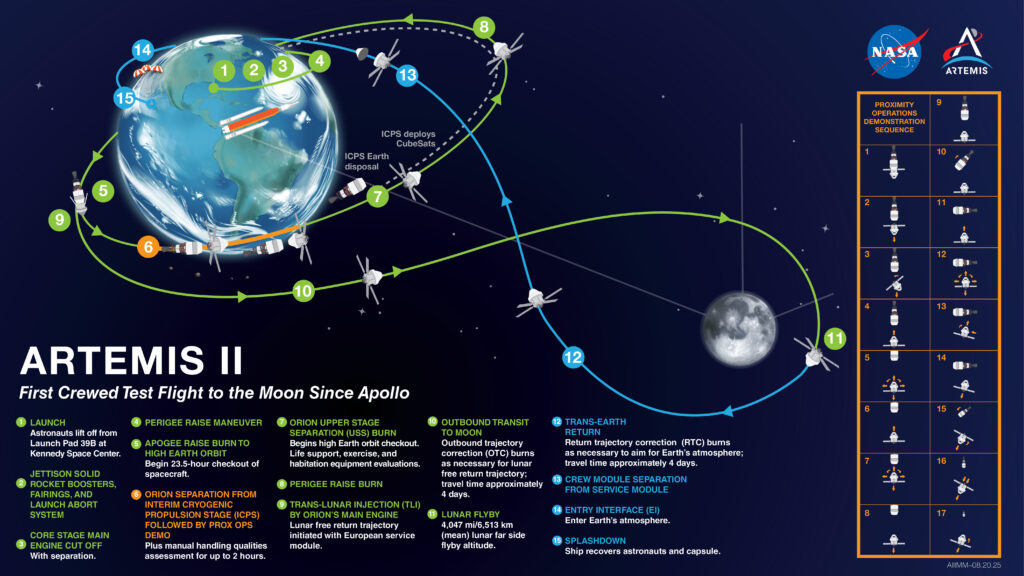
The crew named their Orion spacecraft Integrity in September 2025, a nod to the trust they place in the engineering beneath them. That engineering represents a half-century leap from Apollo, though it follows a remarkably similar mission profile: launch, fly to the Moon, loop around it, and come home. The approximately 10-day mission will cover over 2.1 million kilometres on a hybrid free-return trajectory. After launch and an initial 42-hour checkout orbit around Earth, the European Service Module’s main engine will fire for trans-lunar injection, sending the crew on a four-day coast to the Moon. At closest approach, Orion will pass roughly 6,900 km from the lunar surface on the far side, potentially surpassing Apollo 13’s distance record of 400,073 km from Earth.
One of the earliest tests is a crucial one that occurs in the first three hours post-launch: the crew will manually navigate Orion past the spent upper stage and test the handling qualities necessary to perform future dockings at the Lunar Gateway. This operation will be performed by Glover and provide NASA with its first manned data on how well Orion handles manual control.
The most powerful rocket ever to reach orbit.
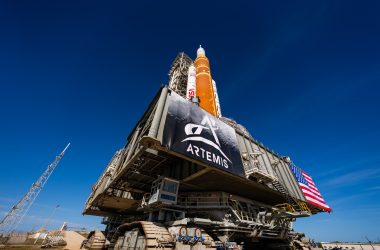
The Space Launch System that will hurl Orion moonward produces 8.8 million pounds (39.1 MN) of thrust at liftoff, 15% more than the Saturn V that sent Apollo crews to the Moon. Standing 98 metres tall and weighing 2,608 tonnes fully fuelled, SLS Block 1 is configured around a core stage powered by four RS-25 engines and flanked by two five-segment solid rocket boosters, the largest ever built for spaceflight.
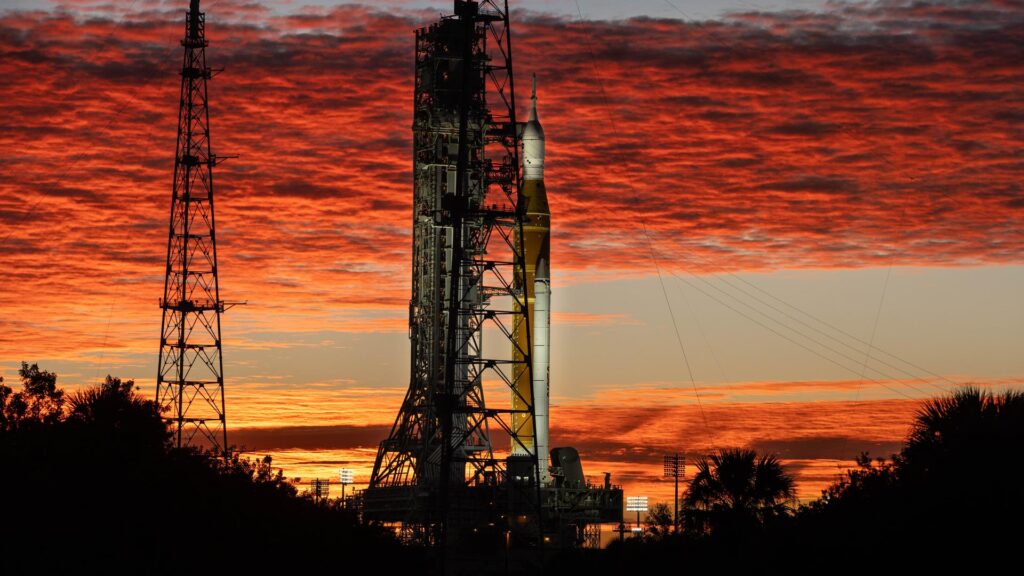
The RS-25 engines are direct descendants of the Space Shuttle Main Engines, with over a million seconds of cumulative firing time across the Shuttle and SLS programmes. Each provides about 512,000 pounds of vacuum thrust at 109% of rated power - an increase on the Shuttle's 104.5% - and consumes around 1,340 litres of cryogenic propellant every second.
For the Space Launch System (SLS), these new engines were equipped with upgraded digital control systems from Honeywell/L3Harris and upgraded nozzle insulations to help the four-engine cluster handle the temperature environment. The heritage engines used in the first four Artemis missions will be the sixteen heritage engines from the Shuttle program. The new RS-25E production engines from L3Harris, which incorporate additive manufacturing to eliminate over 700 welds and 700 parts, will be used in Artemis V and later missions, with an approximately 30% cost reduction.
The twin solid rocket boosters, manufactured by Northrop Grumman, produce 3.6 million pounds of thrust and contribute more than 75 per cent of the total impulse of the rocket during their two-minute burn. In contrast to the reusable solid rocket boosters used during the Shuttle era, the five-segment solid rocket boosters used today are completely expendable and therefore do not require the use of recovery parachutes or consume additional payload space.
Above the core stage sits the Interim Cryogenic Propulsion Stage, a modified Delta IV upper stage with a single RL10 engine producing 24,750 pounds of thrust. On Artemis II, the ICPS will fire to establish Orion’s checkout orbit before the European Service Module’s engine takes over for trans-lunar injection. Future missions from Artemis IV onward will replace the ICPS with a far more capable Exploration Upper Stage, boosting trans-lunar payload by 40%.
Cryogenic challenges
Managing liquid hydrogen at -253°C remains one of SLS’s most persistent engineering headaches. Hydrogen, the smallest molecule in the universe, is notorious for finding its way through the tiniest imperfections in seals and fittings. The Artemis I campaign endured four wet dress rehearsals, three rollbacks to the Vehicle Assembly Building, and two scrubbed launch attempts over six months, mainly due to hydrogen leaks at the quick-disconnect fitting where the mobile launcher’s fuel line meets the core stage.

Engineers modified the Artemis II test to include several hardware changes, including a new valve designed to replenish, new flexible hose assemblies, and old-mounted hardware instead of bolted mounts for the propulsion system. Also, a new 5.3 million-litre liquid hydrogen fuel tank was installed at the pad, reducing the refuelling time from 48 hours to 24 hours after the previous attempt.
However, during the Artemis II wet dress rehearsal (WDR) on 1-2 Feb 2026, another hydrogen leak occurred at the same interface that had caused the initial leak. However, using a “warm-up” method to reset the seals (as engineers used on Artemis I) allowed teams to load all propellants fully. However, the team experienced another spike in leaks while completing terminal countdown pressurisation, causing the countdown to be automatically stopped at T-5 min 15 sec.
NASA abandoned the February launch, and replaced the faulty seals on the atS on the pad before a second WDR, and is currently targeting a launch date of 6-11 Mar 2026, with Apr 2026 as a backup. According to NASA’s Associate Administrator for Exploration Systems Development, Amit Kshatriya, each Space Launch System (SLS) is a unique vehicle. How it “breathes” vents, and leaks is something that engineers have to characterise every time.
The heat shield question
Perhaps the most consequential engineering issue facing Artemis II is the heat shield that will protect the crew during re-entry at 40,000 km/h (Mach 32), with temperatures on its surface reaching up to 2,760 °Ce. Orion’s 5-metre AVCOAT ablative heat shield is the largest ever built for a crewed spacecraft. But the post-flight inspection of Artemis I revealed that charred ablative material had cracked and broken away at more than 100 locations, far more than models predicted.
During an extended test program of over 100 ground tests to identify the root cause of the failure, it was found that the Artemis-era AVCOAT (a type of ablative thermal protection system) produced a material with lower gas permeability than the honeycomb cells filled by hand used during Apollo missions. The gas produced inside the material during skip re-entry manoeuvres could not escape fast enough through the decreased gas permeability of the AVCOAT material, and pressure built up inside the AVCOAT material, causing horizontal cracking. On 24 December 2024, the Executive Council at NASA voted unanimously to fly the existing heat shield for Artemis I, but with a modified re-entry trajectory; a steeper entry angle and a reduced loft time to reduce exposure to the critical temperature regime. Heat shields for Artemis III and all future flights will utilise a reformulated AVCOAT with improved and uniform gas permeability.
NASA received criticism from some of its former engineers, who believed the new re-entry trajectory should be tested without crew members before being used. NASA disagrees, believing the risk is acceptable given the extensive arc-jet testing and analyses conducted on the current AVCOAT material.
Engineering explainer: how a rocket reaches the Moon
A better understanding of what Artemis II will accomplish can be gained by first learning about the physical and engineering factors required for a spacecraft to travel to the moon.
Travelling to the moon does not involve simply pointing a rocket towards space and firing it; rather, it involves a series of energy exchanges using known formulas based upon orbital mechanics, thermodynamics and Newton’s law of motion.
Escape from the Earth’s gravitational well. Objects on or near the Earth’s surface are located at the bottom of a gravitational potential energy well. To reach low Earth orbit, a spacecraft must have its speed increased to approximately 28,000 km/hr, which is the orbital velocity at an altitude of approximately 200 kilometres above the Earth. This increase in velocity (known as delta-v) is approximately 9.4 km/s and accounts for both gravitational losses and atmospheric drag. The SLS accomplishes this large delta-v through staging combustion; the two solid rocket boosters provide a tremendous amount of thrust at low altitudes to help escape the Earth’s gravity and drag, and then they are jettisoned once their propellant is depleted. After separation, the core stage RS-25 engines continue to propel the vehicle into orbit while burning liquid hydrogen and liquid oxygen. Staging is beneficial because discarding the spent portion of the rocket reduces the energy wasted pushing dead weight, thereby increasing the efficiency of the remaining engines.
Engine performance and propellant selection. The efficiency of a rocket engine is typically measured in terms of the specific impulse (Isp). Specific impulse is expressed in seconds and represents the length of time that one kilogram of propellant can produce one kilogram of thrust. The hydrogen-oxygen combustion of the RS-25 engines results in a specific impulse of approximately 452 seconds in a vacuum, which is among the best of all chemical propulsion systems. Due to the low molecular weight of hydrogen, the exhaust gases exiting the nozzle of the RS-25 engines are travelling at very high speeds (greater than 4,400 m/s) according to the Tsiolkovsky rocket equation: the lower the molecular weight of the exhaust gases, the greater the velocity that can be extracted from the propellant per kilogram. Therefore, NASA has accepted the significant engineering challenges of handling liquid hydrogen at temperatures below-253°C to take advantage of the significantly higher performance of hydrogen-oxygen compared to other available chemical fuels.
Trans-lunar injection. After the spacecraft reaches orbit, it is moving fast enough to remain in orbit but is not fast enough to reach the Moon. The OMS-E engine on the European Service Module fires at the lowest point in the orbit (perigee) of the spacecraft to increase the apogee (farthest point in orbit) to a position greater than the Moon’s distance. The trans-lunar injection is a type of Hohmann-like transfer that takes advantage of the Oberth effect: a burn that occurs at a higher orbital velocity will result in a larger change in the total orbital energy than the same burn would occur if it were conducted at a lower velocity. The physics behind this process is quite elegant. You are achieving a larger conversion of kinetic energy when you are already moving rapidly.
Free-return trajectory. Artemis II employs a hybrid free-return trajectory. The free-return trajectory allows for the spacecraft to follow a curved path that is influenced by lunar gravity after being injected into a trans-lunar trajectory. As a result, the spacecraft follows a curved path around the far side of the Moon and returns toward Earth without the need for another engine burn. Because the spacecraft will be able to return to Earth even if the primary engine fails after trans-lunar injection, the free-return trajectory provides a level of redundancy that is similar to the principle that saved the crew of Apollo 13. However, the trajectory of Artemis II is designed to be much closer to the Moon and to achieve a set of specific test goals.
Thermodynamic processes during entry. When returning to Earth from lunar distance, the Orion spacecraft is entering Earth’s atmosphere at a velocity of approximately 11 km/s, which is approximately 40% faster than the typical re-entry velocity of a spacecraft returning from low Earth orbit. At these velocities, the air in front of the spacecraft cannot get out of the way quickly enough, resulting in the formation of a shockwave in the air. As a result, the air in front of the spacecraft is compressed and heated to such a degree that it forms a plasma that exceeds a temperature of 2,760°C. The AVCOAT ablative heat shield protects the spacecraft from the high temperatures generated by friction during re-entry through a process known as pyrolysis. During pyrolysis, the ablative material is charred, decomposed and out-gases, effectively removing thermal energy from the spacecraft in the exhaust stream. The design of the heat shield, including the thickness of the shield, the composition of the shield, and the temperature limits of the bond lines, must be carefully planned to ensure that the ablative front advances in a controlled manner and that the aluminium sub-structure underneath the shield is never exposed.
The skip manoeuvre is a technique employed during re-entry by Artemis II. The spacecraft will enter the upper atmosphere at a shallow angle to slow down. Following the initial deceleration, the spacecraft will momentarily “skip” back up into the atmosphere and then descend again for a final landing. The skip manoeuvre extends the deceleration over a longer distance, thereby reducing the maximum acceleration forces experienced by the crew from approximately 7g to less than 4g, and will allow NASA to target the landing site more accurately. Although the modified Artemis II trajectory will shorten the duration of the skip phase to decrease the exposure time to the heat shield, this modification will also address some of the issues related to char loss identified in the post-flight analysis of Artemis I.
The gap between Apollo and Artemis technology is staggering. The Apollo Guidance Computer, revolutionary for its time as the first to use silicon integrated circuits, operated at roughly 0.043 MHz with 74 KB of total memory. Orion’s flight computers are 20,000 times faster with 128,000 times more memory, quadruple redundancy, radiation hardening, and gigabit Ethernet data networks that move information 1,000 times faster than Shuttle-era systems. Where Apollo astronauts monitored trajectory on paper plots, Orion features glass-cockpit displays modelled on the Boeing 787 and software that autonomously adjusts trajectory in real time.
The transformation extends well beyond avionics. Computational fluid dynamics now drives aerodynamic design, where wind tunnels once reigned alone. The SLS programme ran over 8,100 CFD simulations totalling 55 million core-hours on NASA supercomputers; a single Artemis I launch environment simulation consumed 400 terabytes of data across 25 days on the Aitken supercomputer. Physical testing at facilities like NASA Langley’s Transonic Dynamics Tunnel still validates these models, using 3%-scale SLS models instrumented with 472 pressure transducers that scan at 13,000 times per second. Still, CFD enables engineers to explore design sensitivities that would be prohibitively expensive to test in physical experiments.
Materials science has advanced equally dramatically. Apollo’s Saturn V used conventional 7075 aluminium alloy. SLS employs lighter aluminium-lithium alloys (each 1% lithium reduces density by roughly 3%) and stiffer, joined using friction stir welding, a technique NASA helped pioneer in the 1990s that produces stronger, more reliable joints than fusion welding and was essential for working with Al-Li alloys that proved challenging to weld conventionally. The SLS core stage contains nearly half a mile of friction stir welds, fabricated using a 52-metre-tall Vertical Assembly Centre at NASA’s Michoud Assembly Facility, the world’s largest robotic rocket-building tool.
Life support has evolved from Apollo’s open-loop consumable systems, which carried all water and oxygen from launch, to Orion’s partially closed-loop Environmental Control and Life Support System, drawing on two decades of ISS regenerative technology. Regenerable amine swingbed CO₂ scrubbers replace Apollo’s single-use lithium hydroxide canisters, and solar arrays provide indefinite power where Apollo relied on finite fuel cells. Artemis II will be the first crewed test of Orion’s full ECLSS in deep space, a critical validation before more extended missions.
Every Orion spacecraft that flies to the Moon depends on the European Service Module, built by Airbus Defence and Space in Bremen under ESA contract. The ESM is Orion’s propulsion, power, and life-support backbone: its 33 engines (including the main OMS-E engine derived from the Space Shuttle programme) handle all orbital manoeuvring; its four solar array wings spanning 19 metres generate 11.2 kW of power; and it carries oxygen, nitrogen, and water for four crew members for up to 21 days. The module contains over 20,000 parts, 12 km of electrical wiring, and draws on suppliers from more than 10 European nations. ESM-2, flying on Artemis II, weighs roughly 15.5 tonnes fully fuelled with 8.6 tonnes of propellant.
An example of an ESA/NASA barter deal is that Europe's contribution to its operating costs for the International Space Station via ESMs will be offset by the six ESMs contracted through Artemis VI, which represents a combined expenditure of more than €1.2 Billion (£1 Billion), in addition to this the ESMs along with NASA's Gateway mission commitments have secured at least three seats for European astronauts on NASA's Artemis manned lunar missions from ESM-4 onwards.
For UK engineers, the Artemis programme represents an expanding portfolio of high-value work. Thales Alenia Space UK in Harwell is building the chemical propellant refuelling system for the Lunar Gateway’s ESPRIT module (now called Lunar View), making it the first spacecraft to refuel while orbiting the Moon. Nammo UK at Westcott in Buckinghamshire was selected in November 2025 to supply the RELIANCE main descent engine for ESA’s Argonaut lunar lander, a 6 kN throttleable engine continuing the Westcott Space Cluster’s 80-year heritage in British rocket propulsion. Nammo’s LEROS 4 engine already powered Firefly Aerospace’s Blue Origin, the first successful commercial lunar landing in March 2025, with development partly funded by the UK Space Agency.
Goonhilly Earth Station in Cornwall, which distributed live Apollo Moon landing feeds in 1969, tracked Artemis I and is now the world’s only commercial facility qualified to provide lunar communication services. iNetic is developing the solar array drive mechanism for ESMs from Artemis IV onwards. Imperial College London is building the magnetometer for the European Radiation Sensors Array on the Gateway. At the same time, the University of Oxford developed a thermal mapper instrument for NASA’s Lunar Trailblazer mission, and the Open University built the PITMS mass spectrometer studying the Moon’s tenuous atmosphere. Metalysis in Sheffield is developing ESA-supported technology to extract oxygen from lunar regolith, a potential cornerstone of in-situ resource utilisation. PwC estimates the lunar economy could reach £144 billion ($170 billion) by 2040, and UK companies are positioning themselves across multiple links in that chain.
Moving towards a permanent lunar presence
Apollo was forced to be driven by Cold War pressure to reach the moon first, to place a flag on the lunar surface, to return all personnel safely back to Earth, and to claim the success. The six successful landing missions placed twelve people on the surface for a total of 12.5 days before the program ended in 1972. Leaving no sustainable infrastructure behind, Artemis is seeking a new concept: an international, commercially supported presence both on and around the moon.
The Artemis I uncrewed mission in November of 2022 tested the integrated SLS-Orion system over 25.5 days as it broke the record for the farthest distance travelled by a crewed spacecraft from Earth (432,210 km) with the completion of 161 test objectives. In addition, it demonstrated that the European Service Module generated power at least 20% above expectations. Additionally, the uncrewed mission provided insight into the heat shield anomaly, which subsequently affected the program’s overall timeline.

Artemis III, now targeting no earlier than 2028, will attempt the first crewed lunar landing since 1972, placing the first woman and first person of colour on the Moon near the south pole. The mission architecture requires SpaceX’s Starship Human Landing System, a £2.3 billion ($2.89 billion) contract, to be pre-positioned in lunar orbit after launching separately and refuelling via multiple tanker flights. Blue Origin holds a separate £2.7 billion ($3.4 billion) firm-fixed-price contract for an alternative lander, Blue Moon, targeting Artemis V around 2030.
The Lunar Gateway, costing £4.2 billion ($5.3 billion) for initial capability, will serve as a permanent staging post in a near-rectilinear halo orbit around the Moon. Its first two modules, the Power and Propulsion Element and HALO habitat, will launch on a Falcon Heavy no earlier than 2027. ESA’s I-HAB living module arrives on Artemis IV. The UK-built refuelling elements of Lunar View follow on Artemis V. Canada’s Canadarm3 robotic arm will enable external operations.
Meanwhile, NASA’s Commercial Lunar Payload Services programme, worth up to £2.1 billion ($2.6 billion) through 2028, is already sending robotic scouts to the surface. Firefly’s Blue Ghost successfully delivered 10 NASA payloads to Mare Crisium in March 2025, and Intuitive Machines’ IM-2 carried the first lunar drilling experiment to the south pole. These missions are testing precision landing, lunar dust mitigation, 4G communications, and subsurface ice detection, paving the way for in-situ resource utilisation that could one day split lunar water ice into breathable oxygen and rocket propellant.
The programme’s international framework now spans 61 signatory nations under the Artemis Accords, establishing principles for peaceful exploration, resource utilisation, and debris management. The UK is a founding signatory and leads on lunar debris and disposal standards alongside Japan and South Korea.
What to watch when Artemis II launches
When the launch window opens, pending a successful second wet dress rehearsal and resolution of the hydrogen leak, viewers should watch for several engineering milestones, each representing a critical test.
- Launch and solid rocket booster separation (~T+2 min 8 sec): SLS reaches 5,000 km/h as the twin boosters, having consumed their solid propellant in 120 seconds, separate at roughly 48 km altitude. The visual is spectacular; the engineering is unforgiving.
- Trans-lunar injection burn: The moment Orion’s European Service Module engine fires at perigee to send the crew moonward, the first time humans have left Earth orbit since December 1972. This is the burn that commits the crew to a lunar trajectory.
- Closest lunar approach and the far-side blackout: As Orion swings around the Moon’s far side at roughly 4,300 miles from the surface, communication cuts out for approximately 45 minutes. The crew operates autonomously until signal reacquisition, a moment Mission Control will await with particular intensity.
- Re-entry at Mach 32: The most dangerous eight minutes of the mission. Orion’s heat shield must absorb temperatures approaching 2,760°C as the capsule decelerates from 40,000 km/h to 325 km/h before parachute deployment, then to a gentle 27 km/h at splashdown in the Pacific off San Diego. The modified skip trajectory, designed to mitigate the char-loss anomaly discovered on Artemis I, will itself be a first, generating data that directly determines whether Artemis III can proceed.
- Laser communications test: Orion carries the O2O optical communications terminal, capable of downlinking data at 260 Megabits per second from lunar distance, potentially enabling live 4K video from beyond the Moon. This technology demonstrator could transform how future deep-space missions communicate.
Artemis II is positioned uniquely. On one side, it continues to follow the path set by Apollo; on the other, the new generation of technological advancements that were unimaginable to the engineers that used slide rules and had only 74 kbytes of computing capacity when they built Saturn V. Today's engineers have access to materials and manufacturing techniques that allow for structural and thermal design considerations that were previously unattainable. At the same time, however, the program has encountered some uncomfortable reminders that spaceflight is inherently difficult: hydrogen can still leak from interfaces that caused problems during Artemis I, and it can introduce a failure mode that was avoided through the handcrafting of the heat shields during the Apollo era.
The distinction between Artemis and its predecessor lies not only in the technology but also in purpose. Apollo answered a geopolitical question. Artemis is seeking to establish an economic model. The integration of commercial lander contracts, international partnerships that include participation from 61 nations (such as the UK), UK-built lunar engines and refuelling systems, a permanent lunar orbiting station, and plans to extract resources from lunar ice represent an economic model that is intended to endure beyond the interests of any single administration. How long this economic model will survive the test of reality in terms of budgets remains to be seen.
For engineers in the UK, Artemis II offers tangible evidence: that the hardware can operate with humans on board, verification of systems built in Europe at lunar distances, and a go-ahead for the downstream missions that many British companies are currently working on. Successful completion of Artemis II will represent not simply the return to the Moon but the first chapter of an inhabited solar system.
TLDR
- NASA’s Artemis II targets launch no earlier than 6–11 March 2026, sending four astronauts around the Moon for the first time in over 50 years
- The crew includes the first woman (Christina Koch), the first person of colour (Victor Glover), and the first non-American (Jeremy Hansen) to travel beyond low Earth orbit.
- The Space Launch System produces 8.8 million pounds of thrust, 15% more than Saturn V, powered by four RS-25 engines and two solid rocket boosters.
- A persistent hydrogen leak at the ground-to-rocket fuel interface forced NASA to wave off a February launch window. An on-pad seal replacement is underway.
- The Orion heat shield showed unexpected char loss on the uncrewed Artemis I flight. NASA approved a modified re-entry trajectory for Artemis II to mitigate risk
- ESA’s European Service Module, built by Airbus in Bremen, provides propulsion, power, and life support for every Artemis lunar mission
- UK companies, including Nammo UK, Thales Alenia Space UK, Goonhilly Earth Station, and several universities, are building hardware for the broader Artemis programme.
- Artemis III (no earlier than 2028) will attempt the first crewed lunar landing since 1972 using SpaceX’s Starship lander.
- The Lunar Gateway space station, Commercial Lunar Payload Services, and Artemis Accords (61 nations) form the framework for a sustained international lunar presence.
- Orion’s computers are 20,000 times faster than the Apollo Guidance Computer, and the SLS programme used over 55 million core-hours of supercomputer time for aerodynamic modelling.