Fifty-four years is a long time between visits. On 1 April 2026, NASA’s Space Launch System rocket lifted four astronauts off Pad 39B at Kennedy Space Centre and pointed them at the Moon, making the Artemis II moon mission the first crewed flight beyond low Earth orbit since Gene Cernan left his footprints in the lunar dust in December 1972.
The 10-day flight carried NASA astronauts Reid Wiseman, Victor Glover, and Christina Koch, along with Canadian Space Agency astronaut Jeremy Hansen, aboard the Orion spacecraft, which the crew named Integrity. Their trajectory took them around the far side of the Moon on 6 April, where they photographed a solar eclipse and captured an image of a crescent Earth sinking behind the lunar limb. It was, by any measure, a photograph for the ages.

But the mission was always about more than optics. Artemis II was a shakedown flight, designed to test whether the hardware that will eventually land astronauts on the lunar surface actually works with people on board. The SLS rocket, standing 98 metres tall, is the most powerful launch vehicle ever flown. Its core stage, powered by four RS-25 engines recycled from the Space Shuttle programme, produces 39.1 meganewtons of thrust at liftoff, enough to send a fully loaded Orion spacecraft on a trajectory that escapes Earth’s gravitational pull.
That escape, however, creates a problem that nearly derailed the programme. When Artemis I, the uncrewed test flight, returned to Earth in 2022, engineers found unexpected charring on Orion’s heat shield. The ablative material, called AVCOAT, had lost chunks during re-entry at speeds exceeding 40,000 kilometres per hour. For an uncrewed capsule, that was a concern. For a crewed one, it was unacceptable.
The investigation took more than two years. Engineers at NASA’s Johnson Space Centre ran hundreds of arc jet tests, subjecting heat shield samples to plasma flows that replicate the temperatures Orion encounters during re-entry, roughly 2,760°C. They traced the charring to the formation of gas pockets within the AVCOAT blocks during manufacturing, a subtle defect that only manifested under the specific aerodynamic conditions of a skip re-entry. The fix involved tighter manufacturing tolerances and a modified re-entry profile. Post-flight imagery from Artemis II confirmed the char loss was significantly reduced.
Then there was the life support system. The Environmental Control and Life Support System aboard Orion had to keep four humans alive in a cabin smaller than a transit van for ten days, recycling air, managing carbon dioxide, and regulating temperature while the spacecraft swung between the searing heat of direct sunlight and the cold of the Moon’s shadow. Engineers spent seven years designing the Orion Crew Survival System suits, which serve as a backup pressure garment in case of cabin depressurisation. Each suit is a bespoke piece of engineering, custom-fitted to its wearer and capable of sustaining life independently for up to six days.
Engineering Deep Dive: How the Artemis II moon mission spacecraft works
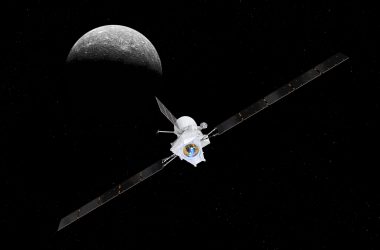
The Orion spacecraft is built around a two-module architecture. The crew module, manufactured by Lockheed Martin, is a truncated cone of aluminium-lithium alloy panels welded together and covered with the AVCOAT heat shield on its base. Behind it sits the European Service Module, built by Airbus Defence and Space for ESA, which provides propulsion, electrical power, and thermal control.
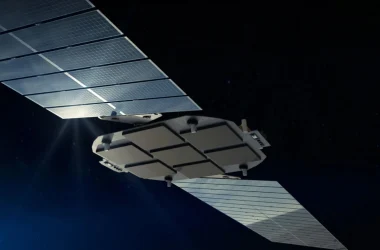
The European Service Module is, in many ways, the unsung engineering achievement of the programme. It carries 8.6 tonnes of propellant for the orbital manoeuvring engine, a 25.7-kilonewton thruster derived from the engine that powered the Automated Transfer Vehicle, ESA’s former cargo ship to the International Space Station. The module also carries 33 smaller reaction control thrusters for attitude adjustments and four solar array wings that span 19 metres tip-to-tip, generating approximately 11 kilowatts of electrical power.
Students studying A-level Physics will recognise several principles at work in the mission profile. The trans-lunar injection burn is a straightforward application of orbital mechanics. Orion used a free-return trajectory, meaning that if the main engine failed after the burn, the Moon’s gravity would sling the spacecraft back towards Earth without any further propulsion, a concept directly related to the conservation of energy and momentum covered in A-level syllabuses.
The heat shield problem connects to thermodynamics and materials science. AVCOAT is an ablative material, which means it absorbs heat energy by undergoing a phase change, charring and outgassing rather than conducting heat to the structure beneath. The process is endothermic. The energy absorbed per kilogram of ablated material is far greater than simple conductive cooling could achieve, which is why ablation remains the preferred approach for spacecraft re-entering at interplanetary speeds.
Re-entry itself is governed by aerodynamic heating. As Orion hits the upper atmosphere at around 11 kilometres per second, it compresses the air ahead of it so violently that the gas temperature exceeds 2,760°C. The relationship between velocity, air density, and heating rate is something students might explore in Further Maths through differential equations governing compressible flow.
The skip re-entry profile used by Orion is also worth understanding. Rather than plunging straight through the atmosphere like the Apollo capsules did, Orion dips into the upper atmosphere, bleeds off some speed, then skips back up before making a final descent. This reduces the peak deceleration forces on the crew from roughly 6g to around 4g, and gives mission controllers the ability to steer the landing point with greater precision because each skip can be adjusted. The trade-off is that the heat shield endures two heating pulses instead of one, which is precisely why the char loss issue from Artemis I demanded such careful resolution.
The life support system draws on chemical engineering principles. Carbon dioxide scrubbing aboard Orion uses lithium hydroxide canisters, which react exothermically with CO₂ to form lithium carbonate and water. The canisters are expendable, unlike the regenerable systems used on the International Space Station, because Orion’s missions are shorter and the mass penalty of a regenerable system was deemed too high for the available volume.
With Artemis II completed, NASA’s attention turns to Artemis III, which aims to land astronauts near the lunar south pole using SpaceX’s Starship Human Landing System. Hardware for that mission’s SLS rocket has already arrived at Kennedy Space Centre. The heat shield question is settled. The life support question is settled. What remains is the small matter of actually landing, and that is an engineering challenge of an entirely different order.
- Artemis II completed a 10-day crewed lunar flyby in April 2026, the first since Apollo 17 in 1972
- Engineers spent two years fixing unexpected heat shield charring discovered on the uncrewed Artemis I test flight
- The Orion spacecraft’s life support system kept four astronauts alive in a cabin smaller than a transit van
- The European Service Module provided propulsion, power, and thermal control via four solar array wings spanning 19 metres
- Post-flight analysis confirmed the heat shield fix worked, clearing the path for Artemis III’s planned lunar landing