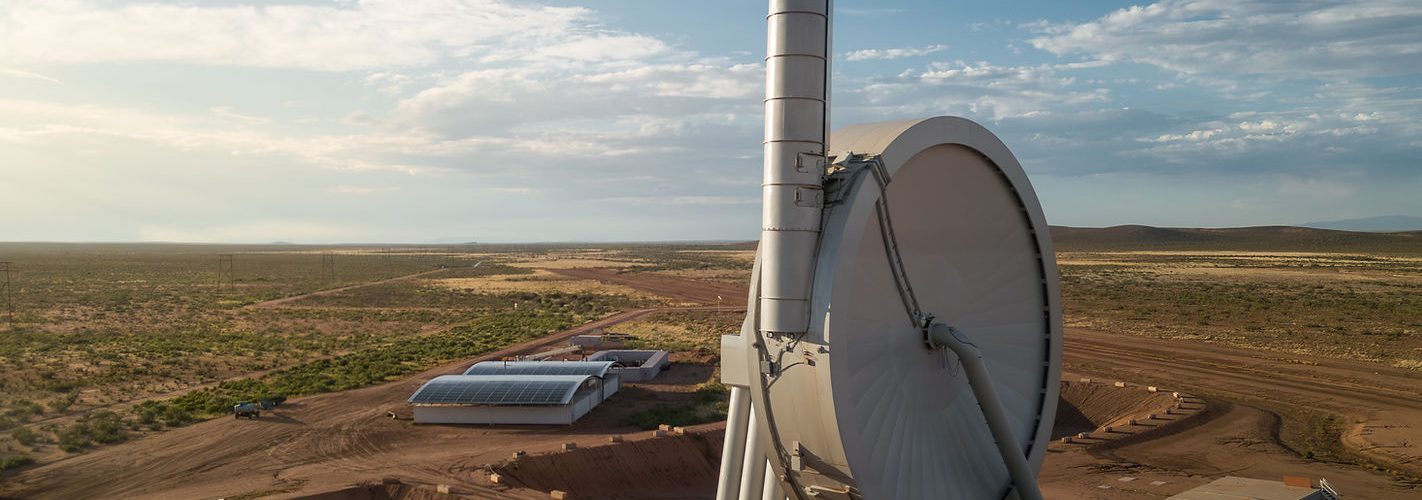
What if you could eliminate 70 per cent of a rocket’s fuel by spinning the payload up to 8,000 kilometres per hour before releasing it? That is the premise behind SpinLaunch, a California-based company that has built a suborbital prototype of what it calls an Orbital Accelerator and is now raising $30 million to deploy its own satellite constellation using the technology. The idea sounds absurd until you look at the physics. Then it sounds merely extremely difficult.
The system uses a vacuum-sealed steel chamber 100 metres in diameter, containing a rotating carbon-fibre arm. A launch vehicle carrying satellites is attached to the end of this arm. Electric motors spin the arm faster and faster, up to speeds exceeding 8,000 kph, before releasing the vehicle through an upward-pointing launch tube. The vehicle exits the chamber carrying most of the velocity it needs to reach low Earth orbit. A small rocket motor fires at altitude to provide the remaining delta-v and circularise the orbit.

As reported by SpaceNews, SpinLaunch plans to develop a broadband constellation called Meridian Space using satellites built by Kongsberg NanoAvionics, with first customer links expected in the second half of 2026. The company argues that kinetic launch could make sovereign satellite constellations financially attainable for countries that currently lack the resources to compete with SpaceX’s Starlink.
Conventional rockets carry all their propellant with them. This creates a punishing mass fraction problem: most of the rocket’s launch mass is propellant needed to lift the propellant needed to lift the payload. The Tsiolkovsky rocket equation, which A-level Further Maths students may encounter, describes this exponential relationship. Any velocity you can add before the rocket ignites its engines dramatically reduces the propellant mass required.
SpinLaunch claims its accelerator provides a 4x reduction in required fuel, a 10x reduction in cost per kilogram (projecting $1,250 to $2,500 per kg versus SpaceX Falcon 9’s roughly $6,000), and the ability to launch multiple times per day. The suborbital prototype at Spaceport America in New Mexico has completed test flights, though the full orbital-scale system remains under development.
The approach has inherent limitations. The enormous g-forces during spin-up (tens of thousands of g) mean the technology is suitable only for payloads that can withstand extreme acceleration, hardened satellites and supplies rather than humans or delicate scientific instruments. The vehicle must also survive the transition from vacuum inside the chamber to full atmospheric pressure at the chamber exit, an aerothermal environment roughly equivalent to re-entry.
Engineering Deep Dive: The physics of kinetic launch
To understand SpinLaunch, start with orbital mechanics. Reaching low Earth orbit (approximately 400 km altitude) requires a velocity of about 7.8 km/s relative to Earth’s surface. A rocket starting from rest must provide all of this velocity through propulsive thrust, plus additional velocity to overcome gravity losses and atmospheric drag during ascent. The total delta-v budget typically reaches 9-10 km/s.
SpinLaunch’s accelerator provides an initial velocity of roughly 2.2 km/s (8,000 kph). This is substantial, about 22 per cent of orbital velocity. The Tsiolkovsky rocket equation (Δv = v_e × ln(m_initial/m_final)) shows that reducing the required Δv by even 20 per cent has a disproportionate effect on the mass ratio. If the exhaust velocity is 3 km/s (typical of solid rocket motors), providing 9 km/s of Δv requires a mass ratio of approximately 20:1 (the rocket must be 20 times heavier at launch than at orbit). Providing only 7 km/s reduces the mass ratio to about 10:1. The rocket becomes half the size for the same payload.

The centripetal acceleration in the accelerator is enormous. For a 50-metre radius arm spinning to produce a tip speed of 2,200 m/s, the centripetal acceleration is v²/r = (2200)²/50 = 96,800 m/s², or roughly 9,900 g. Any satellite launched this way must withstand forces approaching 10,000 times Earth’s gravity. This eliminates conventional satellite designs that rely on deployable solar panels, delicate optics, or flexible antennas. SpinLaunch’s Meridian satellites are specifically designed for this environment, with hardened electronics, solid-state components, and compact, rigid structures.
The vacuum chamber is essential for two reasons. First, at 8,000 kph in the atmosphere, aerodynamic heating would destroy the vehicle and arm. Air resistance would also require enormous power to maintain speed. By evacuating the chamber to near-vacuum, both problems are eliminated. Second, the chamber exit presents the reverse problem: the vehicle must transition from vacuum to sea-level atmosphere instantaneously. At 2.2 km/s, this creates a shock wave and extreme aerothermal heating on the vehicle’s nose. The launch vehicle must therefore incorporate a thermal protection system similar to a re-entry vehicle’s heat shield.
The structural engineering of the arm itself is fascinating. A carbon fibre composite arm 100 metres across, rotating at speeds that produce tip velocities above Mach 6, must withstand centripetal loads while remaining balanced to extraordinary precision. Any imbalance at these rotation rates would produce vibrations that could destroy the system. The arm must be manufactured and balanced to tolerances comparable to jet engine turbine blades.
Power requirements are considerable but manageable. The kinetic energy stored in the rotating arm and payload at launch speed is ½mv². For a 200 kg launch vehicle at 2,200 m/s, that is approximately 484 megajoules. This energy must be input gradually during spin-up (over minutes rather than seconds) through electric motors, requiring average power inputs in the tens of megawatts range. This is large but achievable with grid power, and the energy cost per launch is remarkably low compared to chemical rockets.
Students encountering circular motion in A-level Physics will recognise the fundamental concepts here: centripetal force (F = mv²/r), angular velocity, and the relationship between linear and angular speed. SpinLaunch is essentially a physics problem scaled up to industrial dimensions, taking textbook equations on rotating bodies and building hardware to match them.
Whether SpinLaunch’s full orbital system reaches operation depends on solving several remaining engineering challenges at scale. But the company has hardware, test flights, and now funding for its own satellite constellation. If it works, the economics of small satellite deployment change fundamentally. Space access becomes less about expensive combustion chemistry and more about spinning things very, very fast.
- SpinLaunch’s Orbital Accelerator spins payloads to 8,000 kph using a carbon fibre arm in a 100m vacuum chamber
- Eliminates 70% of rocket fuel by providing initial velocity before rocket ignition
- Projected cost of $1,250-2,500 per kg to orbit versus $6,000 for SpaceX Falcon 9
- Company has secured $30 million to develop its own Meridian broadband constellation
- Payloads must withstand approximately 10,000 g during spin-up