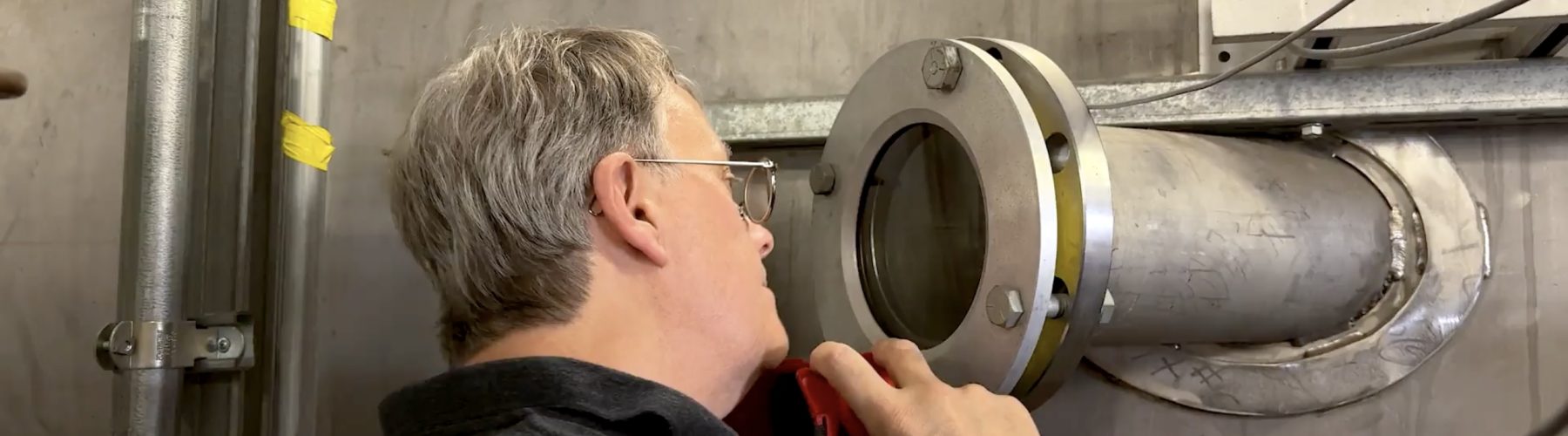
A tungsten electrode reached 2,800 degrees Celsius. Inside a vacuum chamber at NASA’s Jet Propulsion Laboratory in Pasadena, California, a prototype engine ignited and expelled ionised lithium. The engine completed five ignition cycles.
The test, conducted on 24 February 2026, marked the first time in years that a lithium-fed magnetoplasmadynamic thruster had been fired in the United States, and it did so at power levels no American electric propulsion system had reached before. The prototype hit 120 kilowatts, more than 25 times the output of the thrusters currently pushing NASA’s Psyche spacecraft toward a metal-rich asteroid between Mars and Jupiter. If this technology scales as intended, it could shave months off a crewed journey to Mars.
Electric propulsion is not new. NASA’s Deep Space 1 demonstrated it beyond Earth orbit back in 1998. The principle is straightforward enough: instead of burning chemical fuel in a violent burst, you use electricity to accelerate a propellant at comparatively gentle speeds, producing a low but continuous thrust that builds velocity over time. Psyche’s Hall-effect thrusters use xenon gas and solar panels to do exactly this. They are efficient, proven, and already hurtling through space at upwards of 200,000 kilometres per hour.
But xenon thrusters top out at a few kilowatts. For a crewed Mars mission, you need something far more powerful. The magnetoplasmadynamic, or MPD, thruster takes a different approach. It feeds lithium metal into a chamber, vaporises it, then drives enormous electrical currents through the resulting plasma. Those currents interact with a magnetic field, and the plasma gets flung out the back of the engine at tremendous speed. The physics owes more to electromagnetic railguns than to conventional rocketry.
The team’s near-term goal is to push power levels to between 500 kilowatts and 1 megawatt per thruster. A human Mars mission might require 2 to 4 megawatts total, meaning a cluster of these engines working in tandem. Each would need to run for more than 23,000 hours without failure, a durability challenge that the group at JPL, alongside collaborators at Princeton University and NASA’s Glenn Research Centre, will be testing methodically over the coming years.
Why lithium? It is light, abundant, and easily stored as solid metal. Crucially, when it condenses on the walls of a vacuum test chamber, it forms a clean film rather than contaminating surfaces the way some other propellants do. JPL’s condensable metal propellant vacuum facility, a one-of-a-kind national asset, was purpose-built for exactly this kind of test.
Lithium Thruster for Mars
To understand why the MPD thruster matters, it helps to think about the fundamental trade-off in space propulsion. Chemical rockets produce enormous thrust but burn fuel wastefully. Electric thrusters use propellant with extraordinary efficiency, measured by specific impulse, but they produce so little thrust that they can only accelerate slowly. For robotic probes with years to reach their destination, that is fine. For astronauts carrying months of food, water, and radiation shielding, it is not.
The MPD thruster sits in a sweet spot. It delivers higher thrust than existing electric engines while retaining much of their fuel efficiency. The Lorentz force governs the physics behind it, a concept that A-level Physics students encounter when studying charged particles in magnetic fields. In a standard classroom problem, you might calculate the force on a single electron moving through a uniform field. Scale that up to a dense plasma carrying thousands of amperes of current, and you get the MPD thruster.
The engine works in stages. First, solid lithium metal is heated until it vaporises. The vapour enters a cylindrical chamber between two coaxial electrodes, one at the centre and one forming the outer wall. A massive current, on the order of tens of thousands of amps, is driven between these electrodes through the lithium gas. This current ionises the lithium, creating a plasma. Simultaneously, the current generates its own magnetic field, in accordance with Ampere’s law. The interaction between the current flowing through the plasma and the self-generated magnetic field produces an electromagnetic body force that accelerates the plasma out of the nozzle.
If you have studied Fleming’s left-hand rule for motors, the principle is the same. The current direction and the magnetic field direction are roughly perpendicular, so the resulting force pushes the plasma axially out of the thruster. The exhaust velocity can reach tens of kilometres per second, far higher than that of any chemical rocket, yet at a thrust level meaningful for large spacecraft.
One of the most pressing engineering challenges is thermal management. During the JPL test, the central tungsten electrode exceeded 2,800 degrees Celsius. Tungsten was chosen precisely because it has the highest melting point of any metal, at 3,422 degrees Celsius, but operating continuously near that limit for thousands of hours will demand materials science breakthroughs. The team is exploring advanced refractory alloys and ceramic composites that could survive these temperatures while maintaining structural integrity under repeated thermal cycling.
The power source is another consideration. At 120 kilowatts, the test already demanded more electrical power than any solar array currently flown could provide at Mars distance, where sunlight is roughly 43 per cent as intense as at Earth. The solution will almost certainly be a space-rated nuclear fission reactor. NASA’s Space Nuclear Propulsion project, which funds this work, is developing compact reactors specifically for this purpose. The combination of nuclear power and electromagnetic propulsion, known as nuclear electric propulsion, could reduce the transit time to Mars from roughly nine months on a chemical trajectory to as little as three or four months, and it would cut the total launch mass by eliminating the need for hundreds of tonnes of chemical fuel.
For students considering aerospace or electrical engineering, this project sits at the intersection of electromagnetism, thermodynamics, materials science, and nuclear physics. It is a reminder that real engineering rarely fits neatly into a single discipline.
The road from a laboratory prototype to a flight-qualified engine is long, and the team at JPL is realistic about the timeline. Proving that the thruster components can survive tens of thousands of hours of operation at extreme temperatures remains the central hurdle. But the February test showed that the underlying physics works at the power levels that matter. Whether a crewed Mars mission happens in the 2030s or the 2040s, the engine technology now exists beyond theory.
- NASA tested a lithium-fed magnetoplasmadynamic thruster at 120 kilowatts at JPL, the highest-power electric propulsion test in US history
- The engine uses electromagnetic forces to accelerate lithium plasma, producing higher thrust than existing electric propulsion while using 90% less fuel than chemical rockets
- The team aims to scale to 500 kW–1 MW per thruster, with a crewed Mars mission needing 2–4 MW total from a cluster of engines
- Paired with a nuclear power source, these thrusters could cut Mars transit time from nine months to as little as three
- Key challenges remain in thermal durability, with components needing to survive 23,000+ hours at extreme temperatures