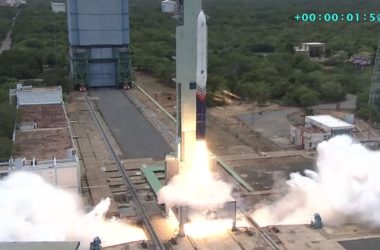
On 5 June 2026, a Long March 8 rocket lifted off from the Wenchang Space Launch Site on Hainan Island and deployed 18 flat-pack satellites into low Earth orbit. It was the second Chinese launch in two days. The day before, a Long March 6A had done the same from Taiyuan, 1,700 kilometres to the north. When the second batch of satellites separated and spread into their orbital slots, China’s Qianfan satellite constellation surpassed 200 spacecraft in orbit.
Qianfan, also known as Spacesail, is operated by Shanghai Spacecom Satellite Technology (SSST), backed by the Shanghai Municipal People’s Government and the Chinese Academy of Sciences. The numbers behind the constellation are worth considering. The target is 324 satellites by July 2026, enough for regional broadband coverage across Asia. Beyond that, the plan calls for more than 15,000 satellites by 2030. At that point, Qianfan would offer global internet coverage and rank as one of the largest orbital infrastructure projects ever built.
SpaceX’s Starlink currently operates more than 12,400 active satellites and holds roughly 60 per cent of active satellite slots in low Earth orbit. Under international rules administered by the International Telecommunication Union, orbital slots and radio frequencies are allocated on a first-come, first-served basis. China filed applications for 203,000 satellites with the ITU in late 2025. The size of that number and the speed of Qianfan’s deployment signal that the race for orbital position is intensifying.
Engineering the Flat-Pack Satellite
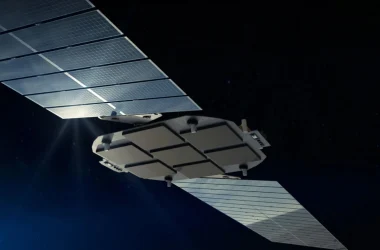
Each Qianfan satellite weighs about 300 kilograms and uses a flat-pack design, stacked compactly inside the rocket fairing like oversized circuit boards in a server rack. That form factor is not an aesthetic choice. It solves a manufacturing and launch economics problem.
Getting 18 satellites out of a single rocket requires a deployment mechanism that does not rely on complex individual ejection systems. The approach is elegant in its simplicity: the upper stage of the rocket spins before release, and the satellites separate by centrifugal force, fanning out from the stack like water from a spinning bicycle tyre. Each then uses its own propulsion system to drift into its assigned orbital slot.
That propulsion system is a Hall-effect thruster burning krypton gas. Hall-effect thrusters work by ionising the propellant, trapping electrons in a magnetic field, and then accelerating the resulting ions out of the spacecraft at high velocity. The physics is the same principle you meet in A-level mechanics when studying momentum: ejecting mass at high speed in one direction pushes the spacecraft in the other. Krypton is denser than the xenon used in many competing systems, so more propellant mass fits in the same tank volume. The specific impulse of 1,385 seconds, a measure of propellant efficiency, is high enough to make meaningful orbital adjustments over the satellite’s seven-year operational life. The thrust itself is modest at 20 millinewtons, roughly the force of a sheet of paper resting on your fingertip, but in the frictionless environment of orbit, even small sustained forces produce significant velocity changes over time.
Each satellite carries a built-in de-orbiting system. At the end of its seven-year life, it uses its remaining propellant to lower its orbit until atmospheric drag pulls it into a re-entry trajectory within a few years. The design is intended to burn up completely, leaving no long-lived debris. With 15,000 satellites eventually planned, the credibility of that end-of-life system matters enormously for the long-term sustainability of low Earth orbit.
The cost reduction figures associated with Qianfan are impressive. Manufacturing costs per satellite have fallen by more than 96 per cent, from roughly 300 million yuan (approximately £33 million at current exchange rates) for a traditionally built spacecraft down to around 10 million yuan per unit. That is not a modest efficiency gain. It represents a structural shift in large-scale satellite manufacturing.
The approach borrows heavily from consumer electronics and automotive production. Modular design means subsystems, the power unit, the propulsion module, and the communications payload are standardised and assembled in sequence rather than custom-built for each mission. Fast iteration means design changes are incorporated quickly across the production line rather than going through years of redesign and requalification. The result is a factory model that is closer to assembling smartphones than to building spacecraft.
Hu Haiying, president of the Innovation Academy for Microsatellites at the Chinese Academy of Sciences, has identified this manufacturing philosophy as the key driver of the programme’s pace. The ability to produce satellites quickly and cheaply is what makes two launches in two days operationally sensible rather than wasteful.
The dual-launch milestone for the Qianfan satellite constellation comes at a point where the engineering choices made early in the programme are beginning to compound. Each launch adds 18 satellites. Each satellite is cheaper than the last as production volumes increase. The centrifugal deployment mechanism means no complex robotic arms or individual spring ejectors to maintain. The krypton thrusters share propellant tanks and valve designs across the fleet. Standardisation at every level reduces cost and failure modes simultaneously.
Engineering Deep Dive: Hall-Effect Thrusters, Orbital Mechanics, and the Logistics of Building a 15,000-Satellite Fleet
The engineering of a large satellite constellation involves decisions that interact across three very different timescales: the minutes of launch and deployment, the years of operational life, and the decades of orbital debris management. Qianfan’s design choices reflect careful thinking at all three levels.
Start with the hall-effect thruster. Conventional chemical rockets burn a fuel and oxidiser to produce thrust through combustion. The high energy density is why chemical propulsion is used for launches, but the reaction chemistry limits the exhaust velocity. Ion propulsion works differently: it uses electrical energy, supplied by solar panels, to accelerate ions to much higher velocities than any chemical reaction can achieve. The specific impulse, which is effectively a measure of how much thrust you get per kilogram of propellant consumed, is typically four to ten times higher for electric propulsion than for chemical systems.
In a hall-effect thruster, specifically, propellant gas, in this case krypton, is injected into a cylindrical chamber. A magnetic field traps electrons, forcing them into circular orbits rather than streaming straight through. Those trapped electrons then collide with incoming propellant atoms, stripping away electrons to create positive ions. An electric field accelerates these ions out of the thruster at velocities of 15 to 30 kilometres per second, producing thrust in the opposite direction. The process is quiet, smooth, and extraordinarily fuel-efficient.
Krypton has advantages over the more common xenon. It is roughly five times cheaper per kilogram, and its higher density in liquid form means you can store more propellant mass in the same tank volume. The trade-off is slightly lower performance: krypton ions are lighter than xenon ions, so for the same electrical power input, a krypton thruster produces marginally less thrust and slightly lower specific impulse. For a satellite constellation where per-unit cost matters enormously, and manoeuvre requirements are modest, krypton is the sensible choice.
The quoted specific impulse of 1,385 seconds for Qianfan’s thrusters is high but not exceptional for hall-effect systems. For context, a chemical thruster might achieve a specific impulse of 200 to 450 seconds. The difference translates directly to how much propellant mass a satellite must carry to perform a given velocity change. Using the Tsiolkovsky rocket equation, delta-v equals the exhaust velocity multiplied by the natural logarithm of the initial-to-final mass ratio. A satellite with a specific impulse of 1,385 seconds can achieve the same orbital manoeuvres as a chemical-propelled satellite with a fraction of the propellant mass. That mass saving either reduces launch cost or frees up volume for more capable hardware.
The deployment mechanism deserves attention. Low Earth orbit constellations need satellites distributed across many orbital planes, not clustered in one spot. Getting 18 satellites into their correct positions from a single launch requires either multiple rocket firings to reach different inclinations, which is expensive and limits payload mass, or a deployment strategy that allows the satellites to spread out using their own propulsion after release. Qianfan uses the latter: the upper stage spins before releasing the satellites, giving each one a slightly different ejection velocity, and the satellites then use their krypton thrusters to walk into their assigned slots over days or weeks. The centrifugal release avoids the need for individual pyrotechnic ejectors on each satellite, reducing complexity and potential failure points.
Orbital slot allocation is another engineering-adjacent challenge that the Qianfan satellite constellation must navigate carefully. Low Earth orbit is not infinite. The usable altitude range for broadband internet satellites, roughly 500 to 1,200 kilometres, is finite, and the radio frequencies needed for high-throughput communications are also limited. The ITU’s first-come, first-served allocation system means that the operators who file and occupy spectrum and orbital positions earliest have priority rights. China’s filing of applications for 203,000 satellites is partly a strategic manoeuvre to secure spectrum rights before other operators take them.
The space debris picture is where the engineering stakes are highest. The Kessler syndrome, proposed by NASA scientist Donald Kessler in 1978, describes a cascade scenario in which a collision between two objects produces debris that causes further collisions, generating more debris, until certain orbital altitudes become unusable. At the population levels being contemplated, 12,400 Starlink satellites, 15,000 Qianfan satellites, plus hundreds of other constellation plans, the probability of collisions over a 10-to-20-year horizon is non-trivial. Qianfan’s design addresses this with a mandatory de-orbit capability: remaining krypton propellant is used at the end of life to lower the orbit, after which natural atmospheric drag at altitudes below about 400 kilometres completes the re-entry within a few years. The satellite then burns up in the atmosphere. Whether that system works reliably at scale, across 15,000 individual spacecraft managed over seven-year cycles, is a question the programme will need to answer convincingly as deployment continues.
The manufacturing economics are genuinely instructive from a systems engineering perspective. The 96 per cent cost reduction achieved by the Qianfan programme did not come from a single innovation. It came from applying modular design principles consistently across every subsystem, standardising interfaces so that components can be swapped and upgraded without redesigning adjacent systems, running production lines at volume to drive down unit costs through learning curves, and adopting a fast-iteration philosophy that accepts some early-generation inefficiencies in exchange for speed of deployment and rapid improvement. That combination of strategies, borrowed from terrestrial manufacturing and applied to spacecraft, is the engineering story behind the headline number.
Two hundred satellites are a milestone, not a destination. The Qianfan satellite constellation still has most of its planned fleet to deploy, most of its technical challenges to prove out at scale, and a well-established competitor in Starlink to contend with. What the programme has demonstrated so far is that the manufacturing and launch economics of large-scale satellite internet have changed fundamentally. Whether 15,000 krypton-powered flat-pack spacecraft in low Earth orbit can be operated, maintained, and eventually retired without leaving a lasting mark on the orbital environment is the harder question, and the one that will define whether this engineering achievement ages well.
- China’s Qianfan satellite constellation reached 200 satellites in orbit after dual launches on 4 and 5 June 2026
- Manufacturing costs have been slashed by over 96% through mass production and modular flat-pack satellite design
- Each satellite carries a krypton-fuelled hall-effect thruster and a built-in de-orbiting system for end-of-life disposal
- The constellation aims for 324 satellites by July 2026 and over 15,000 for global broadband by 2030