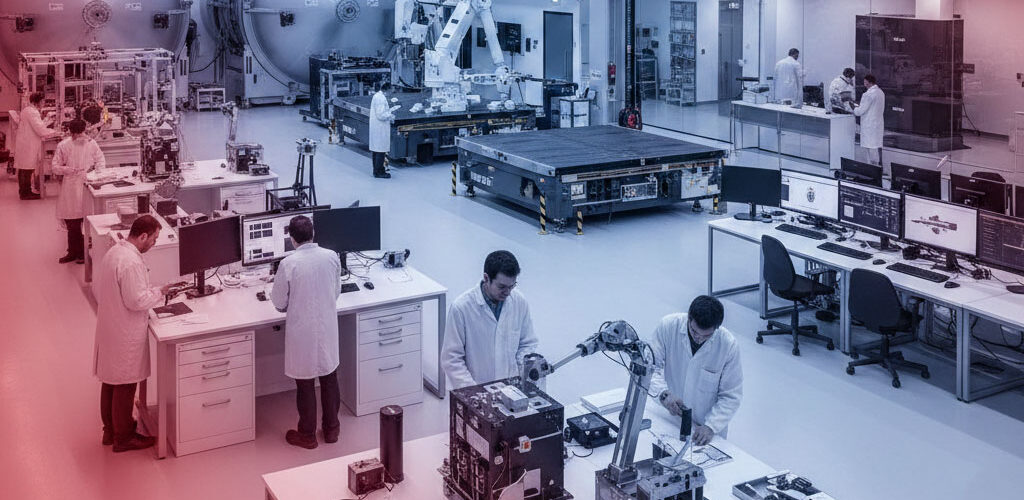
Airbus Defence and Space has created a technology innovation incubator at their Stevenage location, developing an environment that fosters collaboration among emerging space firms. These emerging companies will have the ability to utilize the company's high-quality testing infrastructure and benefit from the company's expert technical knowledge without having to endure the typical financial barriers. The facility is called the Airbus Launchpad, it was developed with a £7.8m investment by the UK Space Agency and Airbus and was created to enhance the nation's aerospace supply chain through direct industry collaboration.
The incubator has been built with the capacity to accommodate fifty people. It offers laboratories, dedicated office space, and most importantly access to Airbus' already-established testing infrastructure. These resources are not within the financial means of many early-stage aerospace ventures. Three organizations (Applied Atomics, Spintex and Stars Edge) will be the first three companies to participate in the incubator's residency program in February, which may represent a new model of growth for the aerospace industry if the Launchpad model results in quantifiable successes.

The structure of the Launchpad was based upon a deliberate attempt to address a very specific gap in the aerospace development pipeline. In general, small and medium sized enterprises within the aerospace development sector struggle with a basic engineering problem; that of obtaining the specialized testing equipment necessary to verify designs under extreme conditions. Vacuum chambers used for thermal cycling, vibration tables that simulate the vibrations of a rocket during launch, and electromagnetic compatibility testing chambers all cost millions of pounds and generally create significant barriers to entry for innovative, but financially constrained, companies.
By eliminating rental costs and allowing direct access to these types of facilities, the Launchpad eliminates the “valley of death” identified by aerospace engineers as the critical phase when prototypes must undergo the transition to flight-ready hardware. Aerospace engineers have long recognized this as the point in time when innovative prototypes are required to be extensively tested to determine whether they meet the necessary standards to proceed into production. Smaller companies are often unable to afford the costs associated with the type of testing that is required during this phase of the product development cycle. As such, many companies must rely upon simplified computer-based models of testing rather than physically testing their products. Unfortunately, the tests conducted using computer models do not always identify the failure modes that only occur while the product is in use.
Understanding Aerospace Testing Infrastructure: An Engineering Perspective
To provide a real-world example of how contemporary spacecraft hardware is transitioned from conceptualization to orbit for aerospace system engineering students, the Airbus Launchpad can serve as a practical example of the testing framework available to engineers working on modern spacecraft hardware. The testing frameworks available at test facilities such as those located in Stevenage, represent the tangible embodiment of the verification and validation processes typically taught in systems engineering classes.
Thermal vacuum testing is one example of a testing method used to qualify spacecraft. To survive the extreme environmental conditions found in space, spacecraft hardware must endure temperatures ranging from -150 degrees C to +120 degrees C while operating within a nearly perfect vacuum. Thermal vacuum chambers are utilized by engineers to generate the required temperature extremes and vacuum conditions. These large sealed containers utilize high-powered vacuum pumps to create vacuum conditions below 10^-5 Pascals and then utilize specialized heating and cooling systems to create the extreme temperature variations needed to simulate the environment found in space. However, creating the appropriate thermal and vacuum environments is not the only engineering challenge presented to engineers. In addition, instruments must be created to measure the performance of components during thermal vacuum testing. Therefore, data acquisition systems are needed to acquire performance data from all of the sensors placed in the thermal vacuum chamber, and all of the measurement systems must be accurately calibrated to provide reliable measurement values, even under extreme environmental conditions.
Another type of testing presented to engineers is vibration testing. Vibration testing simulates the mechanical loading that occurs to a spacecraft during launch. Spacecraft are subjected to extremely high mechanical loading, including accelerations greater than 10 g and vibrations over a wide range of frequencies (from 5 Hz to 2000 Hz). Electrodynamic shakers are the most common device used by engineers to simulate these types of vibrations. These devices utilize voice coil technology that is analogous to the technology used in audio speaker systems. However, instead of producing sound, the voice coils produce forces that are measured in kilonewtons. Control systems for the electrodynamic shakers must be able to accurately reproduce launch vibration profiles while simultaneously measuring the response of the structure being tested using hundreds of accelerometers. Engineers can then determine the natural frequency of the structure that may cause catastrophic failure.
The testing infrastructure for electromagnetic compatibility (EMC) provides yet another critical testing capability for engineers. As mentioned above, spacecraft contain sensitive electronic components that must function reliably in spite of the electromagnetic interference generated by internal sources (such as switching power supplies, data buses) and external sources (such as solar radiation and Earth’s magnetic field). The primary purpose of the EMC test chamber is to create an anechoic condition by utilizing specialized materials and geometries that absorb electromagnetic energy and eliminate reflection of electromagnetic waves that would otherwise distort the measurements taken by the sensors. Additionally, engineers must confirm that no individual sub-system generates excessive electromagnetic interference or that any sub-system fails due to exposure to anticipated levels of electromagnetic interference. This testing process is made possible by sophisticated spectrum analysis systems and highly calibrated antenna systems.
In addition to providing students with hands-on examples of the application of theoretical concepts learned in their course work in materials science, the testing infrastructure of the Launchpad facility demonstrates the direct correlation between theory and practice. A prime example of this is the testing of materials for out-gas emissions. Specifically, the primary goal of the out-gas testing process is to verify that the materials used to construct the spacecraft will not release volatile compounds in a vacuum that could contaminate sensitive optical surfaces. This testing process is performed using mass spectrometers to detect trace amounts of volatile compounds at parts per billion concentration levels. The testing process also utilizes specialized sample chambers that can maintain ultra-high vacuum pressure while accelerating the out-gas emission process by heating the material samples.
Finally, the integration of the various test capabilities of the Launchpad facility represent the systems engineering principles. As mentioned earlier, the output of every test produces large quantities of data that must be analyzed to verify the design margins of the component(s) tested and to determine the potential failure mode(s) of the component(s) tested. Today's modern test facilities utilize digital twin technologies to create virtual representations of the test articles, which directly correlates to the physical test results obtained during testing. Utilizing digital twin technologies enables engineers to refine the simulation processes and enhance the predictive capabilities for future design iterations.
Understanding the Supply Chain
The selection of Applied Atomics, Spintex, and Stars Edge as the first residents of Launchpad indicates a focus on companies developing the “enabling” technologies that are used by larger vehicle integrators to construct their spacecraft, rather than focusing solely on companies that are building complete spacecraft systems.
This is consistent with the historical trend of the aerospace industry being comprised of many specialized supplier companies (e.g., reaction wheel providers, star tracker manufacturers, etc.) who produce critical component parts that are then combined by larger, general-purpose vehicle integrators into complete vehicles.
Launchpad is establishing a residency model that does away with the traditional landlord/tenant relationship in favor of technical collaboration and potentially accelerates product development cycles through informal sharing of information/knowledge between experienced Airbus engineers and the early stage startup teams.
In particular, if the startups have difficulty integrating their products together with those developed by other startups or with legacy Airbus products, having access to each other at Launchpad may allow them to work through these issues more quickly.
The £3.9m government investment via the Space Clusters Infrastructure Fund is only one part of a longer term plan to create a distributed aerospace capability throughout the U.K. and is consistent with recent announcements regarding the opening of the Westcott Space Hub which has also been supported by the Space Clusters Infrastructure Fund and is focused on the testing of propulsion systems, a capability that is complementary to the testing of spacecraft and is likely indicative of a well-coordinated effort to avoid duplication of capabilities throughout the country and ultimately establish a comprehensive testing infrastructure for the entire U.K. aerospace sector.
If Launchpad is successful, it should be able to help alleviate some of the persistent difficulties associated with the development of aerospace supply chains.
Historically, traditional aerospace procurement processes have favored large, established suppliers with a proven track record of previous flight experience over smaller, innovative companies with new technologies; this creates barriers to entry for the newer companies to enter the aerospace marketplace.
By providing these smaller companies with access to qualification testing, Launchpad could enable them to obtain the test data they need to compete for aerospace contracts and could potentially introduce new technologies that would otherwise be limited to laboratory demonstrations.
Although the lack of rental fees at Launchpad is a major advantage for small companies, it also raises questions regarding the long-term viability of the Launchpad model.
Should the Launchpad model successfully accelerate technology development, strengthen aerospace supply chains and provide the United Kingdom with a competitive advantage in the rapidly expanding commercial space market, the model could transition to a hybrid model where successful companies graduate from the Launchpad program and contribute to the cost of supporting subsequent generations of companies using the Launchpad.
However, the early introduction of fees at Launchpad could be counterproductive and could reduce the accessibility of the Launchpad to deep-technology companies with extended development timelines.
The timing of the Launchpad initiative is consistent with the current increase in commercial space activities and the growing demand for specialized components such as satellite communication transceivers, power generation units, solar panels, antenna systems, etc.
Satellite constellations consist of thousands of identical components that are manufactured to aerospace standards and there exists a growing market opportunity for companies that can demonstrate both a strong technical capability and a scalable manufacturing capability.
Access to the Airbus testing infrastructure at Launchpad should enable rapid iteration through design-test-redesign cycles and should potentially enable companies to compress development timelines from years to months for certain types of aerospace components.
As an experiment in alternative innovation models for the aerospace engineering community, the Launchpad represents an opportunity to determine whether hybrid approaches that combine elements of traditional aerospace development (i.e. the use of formal documentation, formal reviews, etc.) with the benefits of a fast-paced, agile innovation process can be effectively implemented.
Ultimately, the success of the Launchpad will be measured through the use of quantitative metrics including: the number of technologies that transition from prototype to flight-ready hardware, the decrease in development time/cost associated with utilizing the Launchpad versus traditional methods, and the ability of the companies that utilize the Launchpad to sustain themselves as viable businesses and compete in the global aerospace marketplace.
If the Launchpad model is demonstrated to be effective, it could serve as a model for other countries seeking to develop their own domestic space capabilities without the necessity of duplicating the large-scale, multi-billion-dollar infrastructure investments of existing space powers.
TLDR
- Airbus launches £7.8M space technology incubator at Stevenage facility, funded equally by UK Space Agency and Airbus
- Provides 50-person capacity hub with laboratory spaces and access to professional-grade testing infrastructure
- Eliminates financial barriers by offering free access to expensive equipment like vacuum chambers and vibration tables
- Three inaugural companies (Applied Atomics, Spintex, Stars Edge) begin residency program in February
- Addresses \”valley of death\” phase where prototypes must transition to flight-ready hardware
- Focus on developing specialized component suppliers rather than complete spacecraft systems
- Co-location enables knowledge transfer between established Airbus engineers and start-up teams
- Success will be measured by technologies transitioning to flight hardware and sustainable business creation