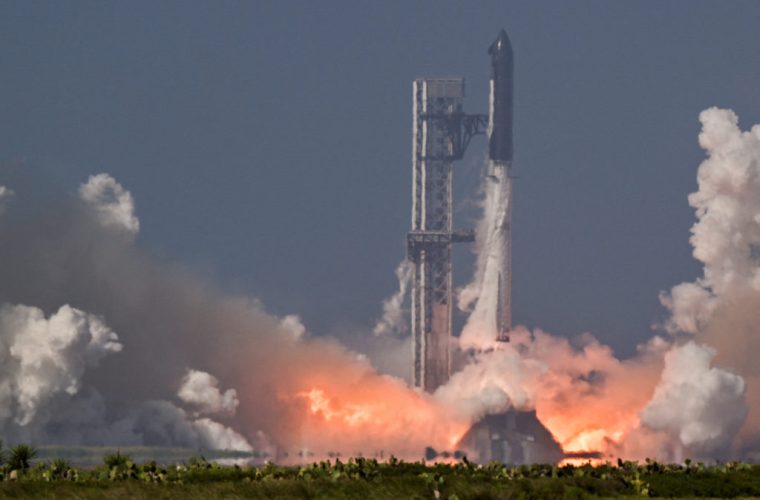
At twenty past midnight on 20 March, a 322-foot rocket began creeping along a concrete crawlerway in Florida at a top speed of 0.82 miles per hour. Eleven hours later, NASA’s Space Launch System arrived at Launch Pad 39B at Kennedy Space Center, carrying the Orion spacecraft that will take four astronauts around the Moon on the Artemis II moon mission. It was the rocket’s second trip to the pad. The first, in January, had been cut short when engineers discovered a fault in the helium system after a fuelling test.
The problem was specific but serious. Helium regulates the pressures inside the rocket’s fuel tanks, and a faulty seal on the upper stage was preventing the gas from flowing where it needed to go. Technicians rolled the entire stack back to the Vehicle Assembly Building, a cathedral-sized structure where rockets are assembled vertically, and replaced the seal. While they had the rocket indoors, they also refreshed the flight termination system batteries, swapped batteries on the upper stage, core stage, and solid rocket boosters, replaced a seal on the core stage liquid oxygen feed line, and retested the oxygen tail service mast umbilical plate to confirm a tight interface.
What engineers had to fix before the Artemis II moon mission could proceed
The helium issue emerged during the wet dress rehearsal on 21 February, a full fuelling test where engineers load the rocket’s tanks with liquid hydrogen and liquid oxygen, run through the countdown sequence, and stop just before ignition. Everything worked except the helium. In a rocket this complex, a single leaking seal can ground the entire vehicle.
NASA astronauts Reid Wiseman, Victor Glover, and Christina Koch, along with Canadian Space Agency astronaut Jeremy Hansen, began crew quarantine on 18 March in preparation for a launch window opening on 1 April. The approximately 10-day mission will follow a free-return trajectory around the Moon, swinging behind the far side before using lunar gravity to arc back toward Earth. No crew has made this journey since Apollo 17 in 1972.
The crawl from the VAB to the pad is itself a piece of engineering theatre. Crawler-transporter 2, the vehicle that carries the rocket, weighs 2,700 tonnes empty and has been in service since the Apollo era. It runs on eight crawler tracks, each with 57 shoes, and is powered by diesel generators driving electric motors. The four-mile journey took 11 hours, with high winds causing a brief delay early in the transit.
Engineering Deep Dive: The engineering systems that make Artemis II fly
The Space Launch System is the most powerful rocket ever built, generating 8.8 million pounds of thrust at lift-off. That figure is worth pausing on. The thrust-to-weight ratio at launch needs to exceed 1.0 for the rocket to leave the ground, but only just. Too much acceleration in the lower atmosphere would subject the structure and crew to excessive g-forces and aerodynamic loads. The engines are throttled to manage the balance between getting off the pad quickly and keeping structural loads within safe margins.
SLS uses a combination of four RS-25 engines burning liquid hydrogen and liquid oxygen in the core stage, plus two solid rocket boosters strapped to the sides. The RS-25s are evolved versions of the engines that powered the Space Shuttle, running at 111 per cent of their original rated thrust. Each generates roughly 500,000 pounds of force. The solid boosters, each 54 metres long, add another 3.6 million pounds of thrust each for the first two minutes of flight. A-level physics students calculating resultant forces and free body diagrams will appreciate the challenge of managing these numbers: the net upward force at launch is the difference between total thrust and the rocket’s weight, roughly 2,500 tonnes fully fuelled.
The helium system that caused the delay might seem like a minor component, but it performs a function that is anything but trivial. As liquid hydrogen and oxygen are consumed during the burn, the volume of gas above the liquid surface (the ullage space) increases. Without pressurisation, the liquid could slosh, vapour could enter the feed lines, and the pumps could cavitate, ingesting gas bubbles that cause them to lose suction and potentially disintegrate at the 30,000 rpm they operate at. Helium, an inert gas that will not react with either hydrogen or oxygen, is fed into the tanks to maintain steady pressure above the liquid surface. A seal failure anywhere in this system risks catastrophic pump failure during flight.
The Orion capsule sitting atop the rocket is engineered for a very specific challenge: re-entering Earth’s atmosphere at lunar return velocity, approximately 40,000 kilometres per hour. That is significantly faster than a return from low Earth orbit (around 28,000 km/h) and generates far more heat on the heat shield. Orion’s shield is made from Avcoat, an ablative material that chars and erodes in a controlled way, carrying heat away from the capsule. The shield must survive temperatures exceeding 2,700 degrees Celsius during the roughly 10-minute re-entry. For context, that is hot enough to melt steel.
The free-return trajectory planned for Artemis II is a specific orbital path that uses the Moon’s gravity to redirect the spacecraft back toward Earth without requiring a large engine burn. If the main engine fails after the translunar injection, the crew can still return home by following this natural gravitational path. It is a safety feature baked into the mission design, the same approach used by Apollo 13 when an oxygen tank explosion forced the crew to abort their lunar landing. The physics relies on the three-body problem, the gravitational interaction between Earth, Moon, and spacecraft, a concept that sits at the intersection of A-level mechanics and first-year university orbital dynamics.
With the rocket now at the pad, NASA engineers will spend the coming days connecting ground support systems and running final checks. The mission, if it launches on 1 April, will be the first time humans have travelled beyond low Earth orbit in over half a century. Every seal, every battery, and every line of flight software will need to work.