A 2.6-kilometre stretch of Victorian stonework, located somewhere off the coast of the North Sea where the River Tees flows into the open sea, has been preventing the sea from advancing since 1884. The South Gare breakwater is not something people generally consider, even when they think about coastal engineering. However, in the absence of this structure, the shipping channel leading to Teesport would become silted up within a few years, thereby cutting off a port that handles millions of tonnes of cargo each year and supports thousands of jobs in the North East.
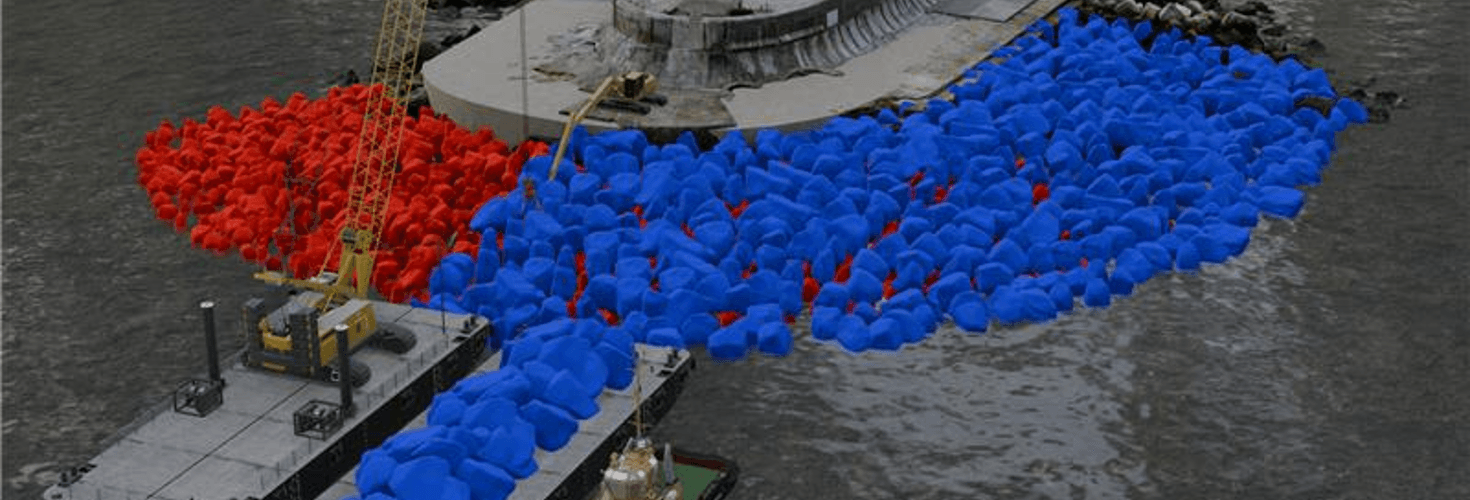
Following the damage caused by Storm Babet to the structure in October 2023, the engineers are now working quickly to strengthen it ahead of the next severe storm. PD Ports, the statutory harbour authority for the River Tees, has begun placing 15,000 tonnes of Norwegian granite along the most exposed parts of the breakwater, as first reported by New Civil Engineer. The individual boulders are as large as 2.5 metres across and can weigh up to 30 tonnes. They are mainly positioned below the waterline and together form a rock armour layer intended to take in the wave energy before it hits the original masonry.
The design had not been based on guesswork. Engineers at HR Wallingford, a hydraulic research laboratory in Oxfordshire which has been testing coastal structures since 1947, constructed a physical model of the breakwater and its surroundings on a scale of one to fifty. This model was then exposed to conditions that simulated a one-in-200-year storm event, involving wave heights of 9.2 metres. To be more specific, this is about the same as the height of three double-decker buses placed one on top of the other.
Mark Pearson, who is the director of project engineering at PD Ports, said that the arrangement had been carefully engineered. “The rocks are being placed in a carefully engineered arrangement so as to reduce the force of the waves before they reach the structure,” he stated. The first phase alone requires 15,000 tonnes. A second phase, scheduled for summer 2027, will add an additional 40,000 tonnes, bringing the total amount of imported Norwegian granite used to wrap the seaward face of the breakwater to 55,000 tonnes.
The installation is being carried out by McLaughlin & Harvey and Herbosch-Kiere, two contractors who have considerable experience in marine civil engineering. It is not enough to drop 30-tonne rocks off the side of a barge in order to get them into the correct positions; each boulder has to be placed so that its weight and shape fit together with those of the neighbouring stones, forming a permeable yet stable structure which dissipates wave energy instead of reflecting it.
The significance of the project extends beyond the Teesside area; as storm intensity increases along the UK coastline, many Victorian-era coastal defences are coming under similar stress. The engineering method used in this case - combining physical modelling with the use of large quantities of rock armour - provides a model for protecting heritage infrastructure that was not designed for the climate it now has to cope with.
Engineering Deep Dive: How Rock Armour Protects Coastal Structures
Rock armour, which is also known as riprap, is one of the oldest and most reliable techniques for protecting coastal areas. The basic principle is simple, but the engineering aspect is by no means.
If a wave hits a solid, impermeable wall, most of its energy is reflected, and this reflected energy can erode the seabed in front of the wall, ultimately weakening the foundations. Rock armour functions differently: the spaces between the randomly placed boulders allow water to enter and pass through the armour layer, where its kinetic energy is dissipated by turbulence and friction. When the wave finally reaches the original structure behind it, much of its destructive power will have been expended.
There is no reason why the size and weight of the rocks should be arbitrary. To determine the minimum amount of stable rock needed for a given wave height, wave period, slope angle, and rock density, coastal engineers use various formulae, most notably the Hudson equation and the Van der Meer equations. The Hudson equation, developed at the US Army Corps of Engineers’ Waterways Experiment Station in 1959, shows that the required weight of rock is proportional to the cube of the design wave height; if the wave height is doubled, the amount of rock needed is approximately eight times as much. It is this cubic relationship that causes the South Gare project to call for 30-tonne boulders rather than, for example, a pile of gravel.
Norwegian granite was selected for a sound reason. While limestone has a density of about 2,300 kg/m³, granite is considerably denser at approximately 2,650 kg/m³. Because it is denser, a smaller boulder can withstand the same wave force, and granite is particularly resistant to both abrasion and chemical weathering in seawater. Students studying A-level Physics will see a clear example of Newton’s second law here: the more mass an object has, the greater the force required to accelerate it. Thus, a 30-tonne granite boulder placed on a slope would require a massive wave force to be moved.
Physical modelling is an important part of the design process at HR Wallingford. By using scale models in wave flumes, engineers can examine how various armour arrangements perform under controlled conditions. The scale employed here is 1:50, so each dimension of the model is 50 times smaller than in reality. Froude scaling, which maintains the ratio of inertial to gravitational forces, determines how wave heights, periods, and velocities are transferred from the model to the actual structure. A wave that is 9.2 metres high in real life corresponds to a wave of 184 millimetres in the flume. The model rocks are scaled according to their weight, not just their length, since gravity-driven processes are the main factor in the interaction between waves and structures.
A problem particular to placing rocks underwater is the lack of visibility. The divers and the remotely operated vehicles show the crane operator where to aim so that each rock comes down in about the correct position. Unlike above-water construction, there is no way to use a tape measure to check the work. In its place, multibeam sonar is used to scan the finished armour layer to check both coverage and profile, producing a three-dimensional map of the rocks, which the engineers then compare with the design template.
The link to A-level studies is straightforward, since fluid dynamics, wave mechanics, gravitational forces, and materials science all come together in one project. Those students taking Further Maths will observe that the Van der Meer equations use statistical distributions to account for the random characteristics of ocean waves, a real-life application of the probability and statistics covered in their course.
In the second phase, the amount of rock armour shielding South Gare is expected to increase by nearly fourfold. It will be unclear whether 55,000 tonnes will be sufficient, depending on how the North Sea behaves in the coming decades. Since climate predictions indicate that storms will become more frequent and more severe, it may eventually be necessary to undertake further reinforcement or adopt entirely new methods of protecting the Tees estuary. For the moment, the granite will be installed one 30-tonne boulder at a time.
- PD Ports has begun placing 15,000 tonnes of Norwegian granite boulders to protect the 150-year-old South Gare breakwater on the River Tees
- Each boulder weighs up to 30 tonnes and is positioned below the waterline to absorb wave energy before it reaches the Victorian masonry
- Engineers at HR Wallingford tested the design using a 1:50 scale physical model simulating 9.2-metre waves, equivalent to a one-in-200-year storm
- A second phase in summer 2027 will add another 40,000 tonnes of rock armour, bringing the total to 55,000 tonnes
- The project responds to damage from Storm Babet in 2023 and worsening storm conditions along the UK coastline