Construction & Infrastructure
The Menai Suspension Bridge anniversary celebrations mark 200 years since Thomas Telford's wrought-iron masterpiece connected Anglesey to mainland Wales.
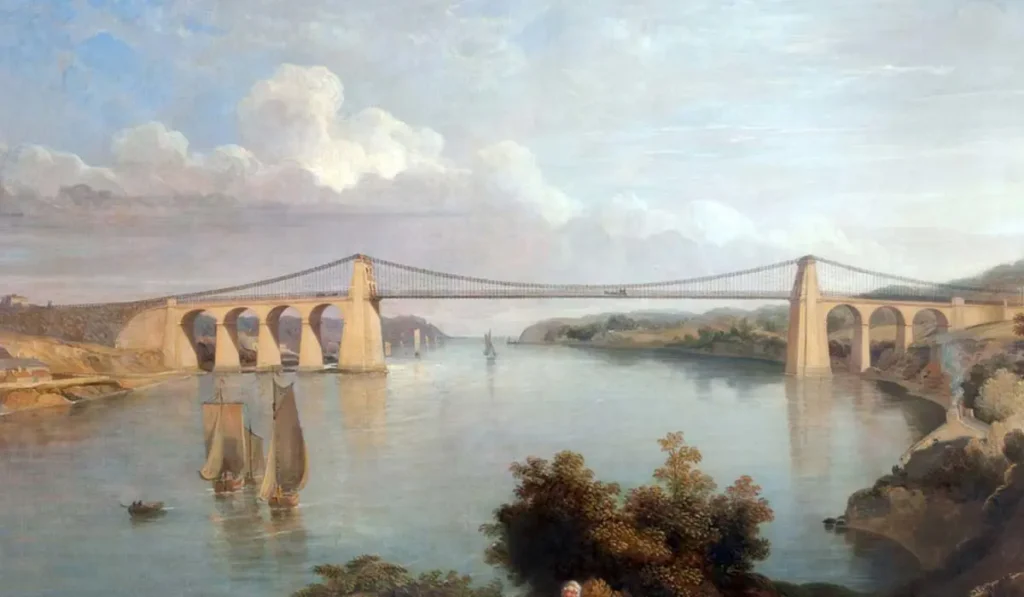
On the cold morning of January 1826, a mail coach made its first crossing of the Menai Strait without getting wet. It rolled over a deck consisting of iron plates which were hung from wrought-iron chains, 30 metres above the tidal race that lies between Anglesey and the Welsh mainland. The water below went on churning as it had done for thousands of years, while above a new thing had appeared in the world: a bridge that hung from chains instead of one that stood on arches.
The bridge is still there two hundred years later. To mark its bicentenary in August 2026, the Menai Suspension Bridge-which was designed by Thomas Telford-held a festival that closed the road to traffic and had people filling it instead. According to New Civil Engineer, a procession, live music, walking tours and stalls were all present on the bridge. To the visitors, commemorative coins were given out, the coins having been minted from the wrought-iron hangers taken out during previous restoration work. Half a million people use the bridge each year and on one day in August they were invited to stop on it.
Telford’s problem was genuine. The Menai Strait has strong tidal currents and is the principal shipping route to the port of Caernarfon. The Admiralty required that any bridge built acrose the strait should have a clearance of at least 30 metres above high water, a requirement which made a traditional stone arch bridge impossible. An arch with enough headroom would need approach slopes that were both too long and too steep for horse-drawn coaches to climb, and the foundations for piers placed between the ends were thought to be impractical given the technology available at that time.
Telford’s solution was radical in that he suggested hanging the road surface from chains consisting of wrought-iron eye-bars, the chains in turn being supported by stone towers erected on each bank. The main span would be 176 metres long, making it longer than any bridge that had ever been built before. There had been no previous attempt of this kind. Although there were small suspension bridges in the form of chains and ropes, they were either footbridges or used as conveyances in mining and not designed to carry loaded coaches.
Construction started in 1819 and lasted for seven years. The stone towers, which rose approximately 46 metres above the water, were built first. Next, the chains were constructed. Each chain was made up of iron eye-bars, with the individual links being about 2.7 metres long and joined together by bolts that passed through the looped ends. Sixteen chains, arranged in four groups of four, were used to support the deck. On 26 April 1825 the first chain was lifted across the strait in front of a crowd of spectators. The workers pulled it from a raft in the water to the top of the towers using a block and tackle, a operation which took less than two hours.
The bridge was opened on 30 January 1826 and housed the A5 road, which was Telford’s major highway route from London to Holyhead; it had the effect of transforming the economy of Anglesey by substituting a hazardous and unreliable ferry crossing with a permanent connection.
Engineering deep dive
Suspension bridges function by transforming the vertical loads caused by traffic and the weight of the bridge itself into tension within the cables or chains. This is a straightforward example of a principle taught at A-level Physics, namely the resolution of forces along a curved member. Although the chains take on a catenary curve when hanging under their own weight, when the load on the deck is spread out evenly the curve becomes approximately parabolic. Telford's engineers would not have put it that way, but the mathematics involved is the same.
The way the load is carried is as follows: the traffic exerts a downward force on the deck; the deck then passes this load on to the vertical hangers; the hangers in turn pull down on the chains; since the chains are under tension, they pull inward and downward on the towers; the towers, being in a state of compression, push down on their foundations; at the anchorages located behind the towers, the chain tension is transmitted into the rock via embedded anchor plates; all the forces are balanced, and if you draw a free-body diagram of any one of the elements, the total of the forces will be zero, which is the equilibrium condition that A-level Mechanics is based on.
He decided to use wrought iron for the chains rather than cast iron and this choice most likely prevented the bridge from collapsing. Cast iron is strong when being compressed but is brittle when under tension; if a cast-iron chain link is overloaded it will break suddenly. Wrought iron, on the other hand, is ductile and deforms before it breaks, providing a clear warning and enabling the loads to be redistributed to the adjacent links. The difference between brittle and ductile failure is a basic principle in structural engineering and is included in the A-level materials section.
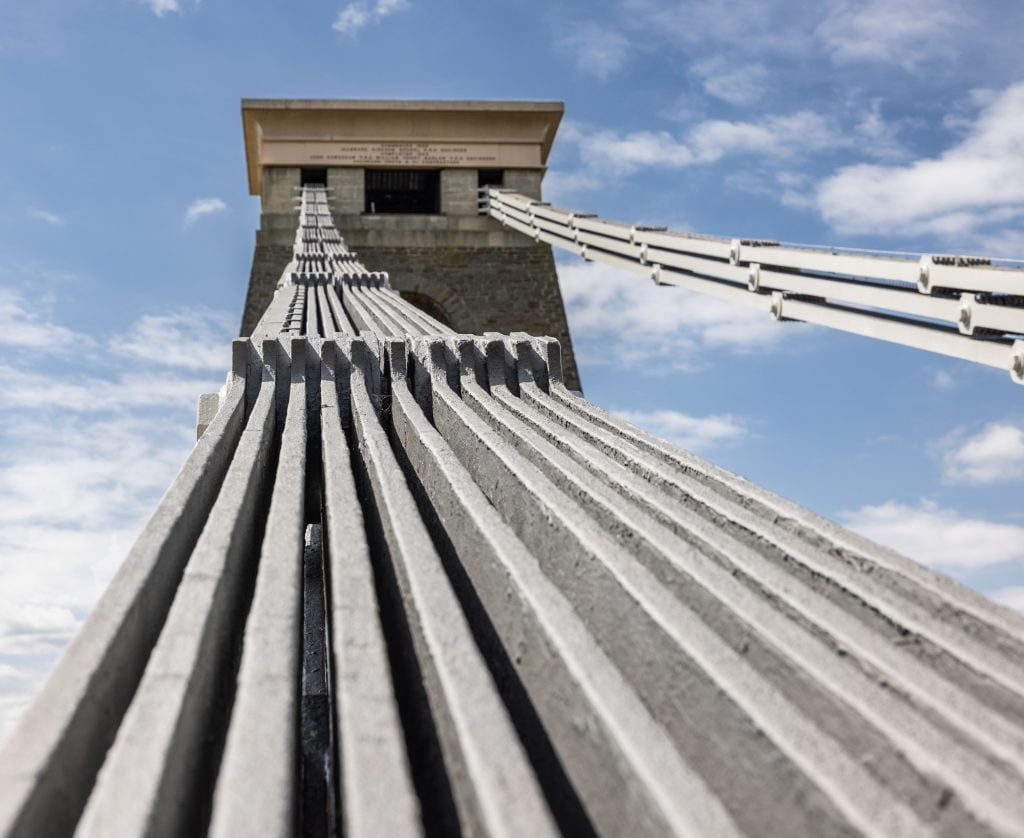
The eye-bar chain design is worth looking at. The links consist of a flat piece of wrought iron with a large circular eye formed at each end. A pin goes through the eyes of neighbouring links to join them together. Because of its geometry, the load is carried along the central axis of each bar, which reduces the bending stresses. The pin joints also permit a certain amount of rotation, so the chain can alter its shape as the loads shift across the deck. This is in contrast to modern suspension bridges, which make use of wire cables composed of thousands of separate steel wires bundled together. Wire cables are stronger for their weight, but the eye-bar chain was the best technology available in the 1820s and it worked.
The force of the wind was the one that Telford failed to take into account. In January 1839 a severe storm caused damage to the deck, lifting and twisting the timber roadway. The original flat deck lacked torsional stiffness and therefore was unable to resist the twisting forces produced by asymmetric wind loads. It was then rebuilt using deeper timber beams and a stiffer structure, which was an early example of the principles of aeroelastic behaviour a lesson that would be rediscovered in a more dramatic way at the Tacoma Narrows in 1940.
Since then, the bridge has undergone a number of modifications. In the 1930s the original wrought-iron chains were substituted by steel chains, in the 1940s the timber deck was replaced with a steel one, and substantial restoration work has gone on into the 2020s. With each change the bridge's function has been kept while its materials have been updated. The stone towers, though, are still original and have carried a load continuously for 200 years.
For anyone who is interested in civil or structural engineering, the Menai Bridge provides a perfect example when it comes to force resolution, material selection, and the need to take into account all possible load cases, including those which were not anticipated. Although structural analysis at that time was mainly based on intuition rather than calculation, Telford managed to get the main points correct. The bridge's continued use for modern traffic is not due to chance; it is the result of good engineering.
Links to the curriculum: A level, GCSE
The A5 now runs on the Grade I listed bridge together with the Britannia Bridge, which is on the A55 and takes most of the heavy traffic. Restoration work is still being carried out to deal with corrosion and to maintain the structure. During the bicentenary celebrations interest was generated not only regarding the bridge’s history but also about the principle which it showed in 1826, a principle that is still valid today - that at times the most daring engineering solution is also the most durable one.
Credit via newcivilengineer.com
Construction & Infrastructure

Construction & InfrastructureInnovation
Construction & Infrastructure

Construction & InfrastructureInnovation