The Clifton Suspension Bridge Trust announced on 1 October 2026 that the most extensive refurbishment in the bridge’s history had been finished. The project had lasted for two and a half years. Specialist engineers manually painted more than 4,000 iron chain links, including many that were over 180 years old, and a new lighting system has now been installed, which is capable of changing colour for special events. During the work, the bridge remained open as much as possible.
The more interesting aspect is how you look after a Grade I listed building that spans 700 feet across a tidal gorge in salty air, given that you aren’t permitted to alter its appearance. This article goes beyond the press release to explain why the chains required attention, how the work was carried out, what the lights actually do, who financed it, and what it reveals about the types of engineering jobs available around a bridge of this sort.
A word about the sources. The facts mentioned here are taken from the Trust’s announcement, the Trust’s refurbishment pages, case studies of the contractors and designers, and the Institution of Civil Engineers. In instances where the sources give differing information, we will indicate this towards the end.
The bridge in brief
It took Clifton 33 years to go from the first design to opening, and its chains were not founded in Bristol. The key dates:
| Date | What happened |
|---|---|
| 1829 | A competition was started for the purpose of building a bridge over the Avon Gorge, and Thomas Telford rejected every entry. |
| March 1831 | Brunel’s design triumphs in the second competition. |
| 1831 | Construction starts, then stalls after the Bristol riots hit confidence and funding. |
| 1843 | Only the unfinished stone towers stand. Money runs out. |
| 1859 | Brunel dies. Members of the Institution of Civil Engineers champion the completion of the bridge as a memorial. |
| 1860 | Brunel's Hungerford Bridge in London is demolished. Its chains are reused. |
| 1862 | Work restarts on a revised design by William Henry Barlow and John Hawkshaw. |
| 8 December 1864 | Clifton Suspension Bridge opens. |
| 2000 to 2001 | Previous chain repainting. |
| April 2024 | The refurbishment begins. |
| 1 October 2026 | Trust announces completion. |
The information about the history comes from Grace's Guide and the Institution of Civil Engineers; the Trust states that the last repaint took place in 2000 and 2001, which shows you the pattern involved. This amounts to maintenance carried out on a cycle of about twenty-five years.
The chains are made of wrought iron; this type of iron is more durable than most people think, but it does rust and rusts more quickly in the presence of water. The section of the Avon below Clifton is tidal, and both the Trust and its contractors refer to the site as being in a marine environment in which the salt in the air corrodes the metal. The general process is the same in all cases: iron, oxygen and moisture combine to produce rust, and the presence of salt accelerates this reaction. The purpose of the paint is to keep both water and oxygen from coming into contact with the metal.
So a coating system is not decoration. It is the bridge's skin, and like skin it wears out. Bristol 247 reported in 2024 that chain painting occurs every 20 to 25 years, and the Trust's completion message says this round should protect the ironwork for the next quarter-century. Taziker, the contractor, also estimates the target at 20 to 25 years.
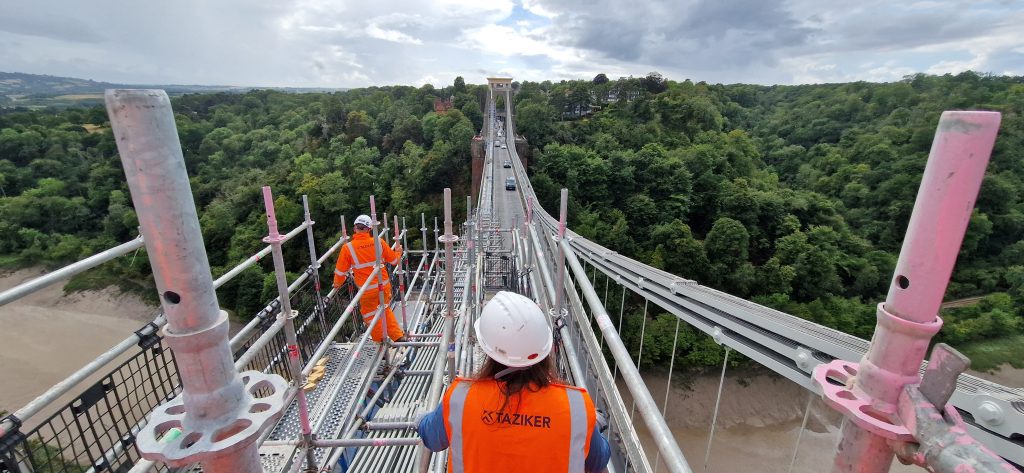
The section worth considering is that no one is aiming to restore the bridge to its original condition. Since it has Grade I listed status, the aim is to keep the original Victorian iron in use. According to Taziker's proposal, mechanical preparation will be carried out in order to remove the old coatings ‘back to the Victorian iron’, after which new protective coatings will be applied, the final finish to be matched to the existing flake grey. One of the most skilled aspects of conservation is generally ensuring that no one can detect that work has been done.
At the beginning, Brunel had planned to use double chains; however, the new design prepared by Barlow and Hawkshaw involved triple chains, a broader and stronger deck, and ironwork taken from the Hungerford Bridge. The Trust states that most of the links are around 180 years old and were originally made for Brunel’s Hungerford footbridge, which opened in 1845, and Hawkshaw reused them at Bristol following the demolition of the London bridge.
Imagine that a suspension chain is made up of a number of flat iron bars joined together end to end and placed side by side. There are narrow spaces between these bars, and each had to be accessed. This is the reason why the work was carried out by hand. The Trust states that the paint was brushed on rather than sprayed in order that it might be applied evenly, and that special tools were designed to match the gaps between the chains at Clifton; loose paint was removed, and the surface corrosion was rubbed down before repainting, with three coats being applied.
Multi-coat systems are standard practice for protecting steel and iron because each layer serves a different purpose: one bonds to the metal, one builds thickness, and a final one resists weather. We have not seen Clifton's exact paint products published, so treat that as the general principle rather than a specification for this bridge.
You can’t just paint a chain from the ground. The Trust and Taziker describe a three-lift tower scaffold at each end, independent scaffolding along the footway for the chain work, and temporary access platforms with traffic management in place. Bristol 247 mentions painters working from pods on the scaffolding. Contractors also abseiled from the tops of the towers to install high-level lighting, and the team worked in all four anchorage pits and beneath the deck.
The other work packages were substantial. Taziker's project summary lists the removal, inspection, refurbishment and reinstatement of 96 hangers, the vertical rods that carry the deck from the chains, along with the replacement of three parapet stanchions. The Trust's updates also mention a new footway surface, non-slip coatings on hatches and bench refurbishment at the tower bases.
Environmental constraints shaped the method. The gorge includes protected woodland and a Site of Special Scientific Interest, and Taziker says the working methodology was approved by Natural England and the Marine Management Organisation before work started. Some 15 to 20 workers were on site each day, according to the Trust. The project was managed with the bridge engineering consultancy COWI, and Taziker employs more than 350 people across the UK.
All of this happened with a bridge in service. One footway was closed during the works, and lane closures were possible, but the Trust says the bridge remained open wherever possible, which matters because both toll income and the connection between Bristol and North Somerset depend on it.
This is what three coats of flake grey look like when the job is done. Notice that the repaint has not tried to hide the structure. The individual bars, the gaps and the bolted connections are all still readable. That is a deliberate choice under Grade I listing rules, and it is quietly impressive.
Clifton Suspension Bridge: new lights
The press release describes the lighting as designed to enhance the bridge's appearance at night while minimising light pollution and improving energy efficiency. The detail comes from the designers and suppliers.
Hoare Lea, the engineering and lighting consultancy, designed the scheme, with Harriet Davis named as principal lighting designer. GDS, the controls supplier, says its Drive Hub platform provides distributed power and control, with linear RGBW fittings along the chains and towers and equipment installed inside both towers. RGBW means red, green, blue and white LEDs in each fitting, so the bridge can show colours as well as a clean white.
The Trust says this is the first permanent lighting on the bridge capable of displaying colour. In normal operation, it shows warm white light from dusk until midnight, with pedestrian safety lighting on throughout the hours of darkness. Colour is used sparingly and under a published Enhancement Lighting Policy: historic milestones for the bridge, STEM, museum and heritage themes, and major Bristol events. The Trust adds that the installation was informed by ecological surveys to limit the impact on wildlife and has a designed lifespan of at least 20 years.
The scheme premiered at the Bristol Light Festival in February 2026, running a 10-minute cycle themed around the seasons and the ecology of the Avon Gorge, according to Hoare Lea. The Trust's announcement adds that light displays were also seen during British Science Week.
This is the detail that makes Clifton unusual. The bridge is privately owned by a charitable trust, receives no local or national Government funding, and is funded entirely by tolls. The Trust's website lists a £1 contactless toll for vehicles, with pedestrians and cyclists crossing free. The bridge is staffed 24 hours a day, every day.
Bridge Master Tristan Ralph put it this way: "Every person who crosses the bridge has therefore played a direct role in funding this vital conservation work."
The Trust describes the cost only as multi-million-pound and has said that reserve funds were used. Bristol 247 reported £8 million in 2024, a figure we cannot confirm with the Trust.
What this means if you want to be an engineer
Notice how many different jobs are involved in one repaint. There is a bridge engineer at the Trust, a project manager at the contractor, an independent consultancy managing the works, a lighting designer, a controls specialist, scaffolders who design access around a listed structure, and rope-access technicians abseiling off a tower. Few of them would call themselves "a civil engineer" in the narrow sense.
Heritage engineering is based on a different principle from new-build work; assessment is made on the amount of change made and on how long the work lasts. If this kind of thing interests you, then consider structural and conservation engineering together with the maintenance aspects of bridges and railways, since these areas have steady employment and don’t often get reported in the news. The discipline guide can help you to compare the various options, and the section on degrees versus degree apprenticeships looks at the different routes available.
What to actually do
- Visit the museum. The Trust's museum on the Leigh Woods side is free, open daily from 10am to 5pm, and tells the story of the bridge's design, construction and maintenance. It closes on Christmas Eve, Christmas Day and New Year's Day.
- Book a vault tour. The Trust runs hard hat tours of the hidden vaults from Easter to October, so this season has now ended. Free weekend tours run at 2pm on Saturdays, Sundays and bank holidays, according to the Trust's website, so check cliftonbridge.org.uk for current availability.
- Look up after dark. The lights are on from dusk until midnight. Any colour display will be tied to an occasion, so check the Trust's news before you travel.
- Use it for your application. If you are applying for engineering, a specific project like this makes strong material for a personal statement, because you can explain the problem, the constraint and the solution. Our work experience guide lists how to ask local firms and heritage organisations for a day on site.
- Clifton Suspension Bridge Trust says the biggest refurbishment in its history finished on 1 October 2026, after two and a half years
- Engineers hand-painted more than 4,000 iron chain links, many about 180 years old and reused from Brunel’s Hungerford footbridge, to protect them for 20 to 25 years
- A new RGBW lighting system, designed by Hoare Lea, is the bridge’s first permanent lighting that can show colour
- The work was paid for entirely by tolls, with no government funding, and the bridge stayed open wherever possible