Construction & Infrastructure
A £13 million flood alleviation scheme in Skinningrove, North Yorkshire, will replace manual flood gates with a raised bridge and redesigned channel to protect over 100 homes.
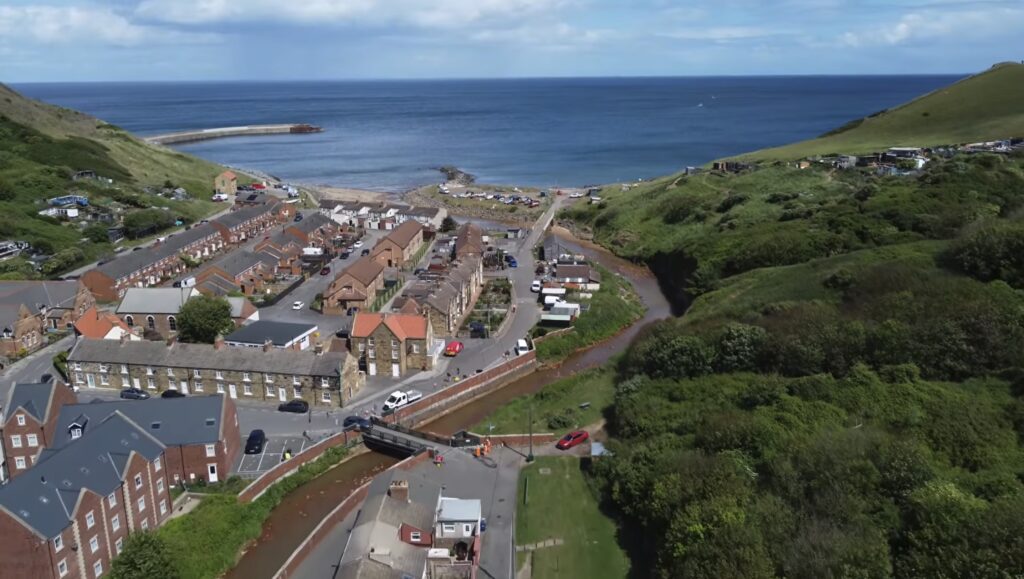
Skinningrove is a small village situated in a steep valley on the North Yorkshire coast, with Skinningrove Beck flowing through the middle of it before emptying into the sea. When heavy rain falls on the moors above, the beck can rise quickly. For many years the village’s flood defences have relied on manually operated gates which have to be physically closed by someone when the water levels go up. If no one gets there in time then the water enters.

The current situation is about to be brought to an end; the Environment Agency in cooperation with Redcar and Cleveland Borough Council has begun work on a £13 million scheme at Skinningrove aimed at protecting over 100 houses and which does not require anyone to turn up with a key at two in the morning.
The scheme’s main feature is simple and neat. The present Stone Row Bridge, which currently crosses the beck at a low level, will be torn down and replaced by a new one with a deck that is at a higher level than the existing flood walls. Since the bridge is now higher than the walls, there will be no need for flood gates at the bridge opening. The water can reach the top of the walls, and the bridge will remain clear. Residents will have continuous 24-hour vehicle access to their homes, no matter what is happening with the back.
The construction of the new bridge is planned to take place from September 2026 until the end of 2027. Piled foundations and abutments will first be put in place on both sides of the beck before the crane lifts the new deck into position close to the Riverside Building. The existing bridge will be demolished between December 2027 and early 2028, during which the flood walls will be filled in to close the remaining gaps.
The scheme also provides for improvements to the channel upstream in order to increase the beck’s capacity and lessen the risk of blockages caused by debris, something which has in the past been a major cause of flooding; fallen trees, shopping trolleys and accumulated sediment can turn a modest flow into a destructive one within a matter of minutes. This is addressed by widening and clearing sections of the channel.
The relief of floods is one of the oldest specialities within civil engineering, but the modern approaches make use of hydraulic modelling, geotechnical investigation, and structural design in a manner that Victorian engineers would have neither recognised nor understood.
The Skinningrove scheme was planned after hydraulic modelling of the beck’s catchment area. To do this, the engineers constructed a computer model of the whole watercourse, extending from the moorland above the village to the point where it empties into the sea, and they simulated rainfall events of various intensities and durations. The model is able to predict water levels, flow velocities, and the extent of flooding for storms with return periods of 1 in 20 years, 1 in 100 years, and 1 in 100 years with adjustment for climate change. A-level Maths students will be familiar with the idea of probability distributions in this instance: a “1 in 100 year” storm has a 1 per cent chance of happening in any one year, not a certainty that it will occur once every century.
The piles used in the bridge design were driven into the bedrock which lies beneath the alluvial deposits along the beck. Skinningrove is situated on Jurassic mudstone and ironstone, and the distance to solid rock varies across the site. During the site investigation phase, boreholes were drilled to establish the soil profile, the groundwater level, and the bearing capacity of the underlying rock. The piles carry the bridge loads through the soft alluvium down to the rock, ensuring the structure remains stable even if the surrounding ground becomes saturated during a flood.
A difficult part of this project is carrying out the work over a running watercourse since the beck can’t be switched off during construction. In order to obtain dry working areas, the engineers construct temporary cofferdams supported by sheet-pile walls which are driven into the riverbed, thereby allowing the beck to flow along a controlled channel. Care must be taken with the sequence of operations: work begins on one side of the bridge, and then the cofferdam is transferred to the other side. At all stages, the beck must have sufficient capacity to cope with a storm without water overflowing the temporary structures.
The choice to raise the bridge instead of installing automated flood gates is part of a wider trend in UK flood defences. Such automated gates need power, telemetry, maintenance, and a dependable communication link to close them, and they are capable of failing. A passive system-one which works simply as a result of its geometry-eliminates these possible failures. The higher bridge deck is a passive system because it does not need to take any action to prevent flooding, as it does not initially obstruct the flood wall.
Climate change projections are taken into account when the defences are being designed. According to the Environment Agency’s present guidelines, new flood defences must provide for higher peak river flows, these being typically 20 to 40 per cent above present levels according to the period in question. The Skinningrove scheme makes use of these allowances so that the freeboard of the bridge and the height of the walls stay sufficient all the way up to the 2080s.
It is expected that the work will be completed by early 2028. For a village which has for decades had to live with the anxiety caused by rising water and the insecurity of having to rely on manual defences, the engineering is not something abstract; it makes the difference between being able to sleep through a storm and having to stand in a flooded kitchen. Sometimes the most important engineering is the kind that enables people to stop worrying.
Credit via newcivilengineer.com
Construction & Infrastructure
Construction & Infrastructure
Construction & InfrastructureInnovation
Construction & Infrastructure