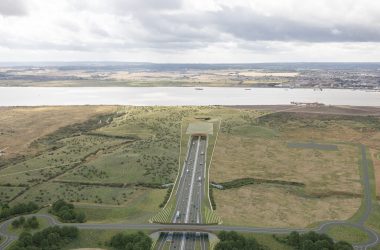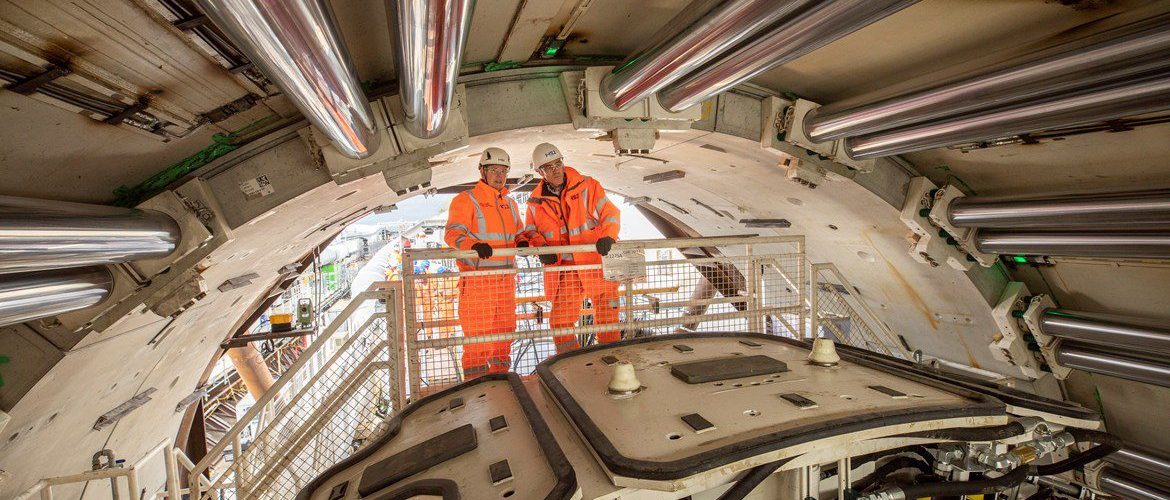
Forty-eight metres below the Essex marshes, a 271-tonne machine named Caroline has started chewing through chalk. Her destination: the Kent shore, 2.2 kilometres away on the far side of the River Thames. When she arrives, sometime around November, the tunnel she leaves behind will carry 400,000-volt cables linking two substations, replacing an ageing power corridor that has been running since 1969.
Caroline is a Mixshield tunnel boring machine, built by German manufacturer Herrenknecht and assembled at the base of a shaft so deep you could stack four double-decker buses on top of one another and still not reach the surface. The shaft at Tilbury measures 48.7 metres from ground level to its floor. A second shaft at Gravesend, 46.3 metres deep, is being excavated using a Vertical Shaft Sinking Machine, a technique that automates what would once have been slow, dangerous hand-dug work. When both shafts and the tunnel are complete, engineers will thread high-voltage cables through the bore to create one of the most important power links in the south-east of England.
How the machine works
The TBM was lowered into the Tilbury shaft in sections, beginning as a 12-metre assembly. Over the coming months, additional segments will be bolted on through a process engineers call a “flying launch,” which uses a steel portal frame and hydraulic jacking system to nudge each new piece into position without craning it from the surface. Once fully assembled, Caroline will stretch to roughly 100 metres, about the length of a football pitch, and cut through the chalk formation beneath the riverbed at a target rate of 23.3 metres per day. Early progress will be slower, at around 0.9 metres per day, as the crew calibrates pressures and aligns before ramping up.
The tunnel itself will have an internal diameter of about four metres, enough to walk through upright, but sized primarily for the cable infrastructure that will follow. It passes roughly 15 metres below the riverbed, deep enough to avoid interference with shipping channels and river sediments but shallow enough to keep the route efficient. The chalk geology helps. Chalk is relatively predictable to bore through, soft enough to cut cleanly, but firm enough to hold its shape while precast concrete segments are bolted into place behind the advancing machine.
Energy Minister Michael Shanks attended the launch ceremony on 12 March, reflecting the project’s significance within National Grid’s Great Grid Upgrade, described as the largest overhaul of Britain’s electricity transmission network in generations. The upgrade is designed to support the country’s shift toward renewable energy by expanding the capacity and resilience of the grid. The Grain-to-Tilbury link is one piece of that puzzle, but it is a piece that sits directly on a bottleneck: the Thames crossing.
The name Caroline was chosen through a public competition. It honours Caroline Haslett, an electrical engineer born in 1895 who spent her career campaigning for women’s participation in engineering and for the electrification of homes across Britain. Haslett became the first secretary of the Women’s Engineering Society in 1919 and later served as a member of the British Electricity Authority. The contractor delivering the tunnel, the Ferrovial Bemo Joint Venture, has employed 76 local workers and engaged 15 local businesses so far.
Engineering Deep Dive: How Tunnel Boring Machines Work
A tunnel boring machine is, at its simplest, a rotating cutting head mounted on a cylindrical steel body that inches forward under hydraulic pressure. But that simplicity is deceptive. Every TBM is a self-contained factory that excavates, supports, and lines a tunnel in a single continuous operation.
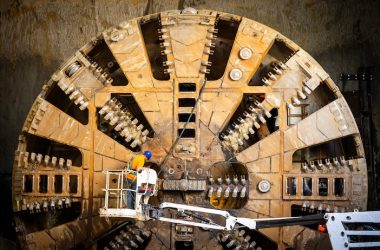
Caroline is a Mixshield TBM, a type designed for mixed or variable ground conditions. A Mixshield machine maintains a pressurised chamber directly behind the cutting head, filled with a slurry of water and bentonite clay. This pressurised slurry serves two purposes: it supports the tunnel face against collapse, and it suspends the excavated material so it can be pumped to the surface through a pipeline. At the surface, separation plants filter out the rock and soil particles, recycling the slurry back to the machine. This is called a closed-loop system, and it means very little waste material needs to be handled at the shaft.
The cutting head itself is a rotating disc studded with cutting tools, their arrangement tailored to the geology. In chalk, the tools are typically drag bits, which scrape the rock rather than crushing it. The head rotates slowly, usually between one and three revolutions per minute, while hydraulic rams push it forward against the face. As the machine advances, a device called an erector arm picks up precast concrete segments from a supply train running through the completed tunnel and positions them in a ring against the tunnel wall. Each ring is bolted to the one before it, creating a continuous lining.
Navigation is handled by a laser guidance system mounted behind the head. A fixed laser at the shaft sends a beam along the tunnel’s centreline, and sensors on the TBM compare its actual position against the planned alignment. Corrections are made by adjusting the thrust on individual hydraulic rams, nudging the machine left, right, up, or down in increments of millimetres. Over 2.2 kilometres, the cumulative tolerance is typically less than 50 millimetres.
The “flying launch” technique used at Tilbury is worth understanding. Normally, a TBM is fully assembled before it starts boring. But the Tilbury shaft is not large enough to accommodate the entire 100-metre machine. Instead, the first 12 metres were lowered in, and boring began. As the machine advances, new sections, including conveyor systems, power distribution modules, and crew facilities, are added to the rear using a steel portal frame and jacking system. This is a logistical challenge as much as an engineering one: every component must arrive at the shaft in the right order, at the right time, and be connected without stopping the machine.
For A-level Physics students, the pressure balance at the cutting face is a direct application of fluid statics. The slurry pressure must exceed the combined hydrostatic pressure of groundwater and the overburden pressure of soil and rock above the tunnel, but not by so much that it fractures the ground ahead. This is a live calculation, adjusted in real time as the machine encounters changing conditions. The concept links directly to Pascal’s principle and pressure in fluids, topics covered in the A-level specification.
The 400kV cables that will eventually occupy the tunnel represent another engineering story entirely. High-voltage transmission reduces current for a given power output (P = IV), which in turn reduces resistive losses in the cable (P_loss = I²R). The decision to use 400kV, rather than a lower voltage, reflects the need to move large quantities of electricity across the Thames crossing with minimal waste. Students studying A-level Physics will recognise this as a direct application of the transformer principle and the national grid topic in their specification.
If the project runs to schedule, the tunnel will be complete by late 2026, with full commissioning and energisation expected in 2028. The old 1969 tunnel will remain in place as a backup during the transition. For the grid, the new link adds capacity at precisely the point where the network is most constrained. For the Thames estuary, it means a critical piece of energy infrastructure will sit safely beneath the riverbed for decades to come.
• A 271-tonne tunnel boring machine named Caroline has launched from a 48.7m-deep shaft at Tilbury, Essex, to bore a 2.2km power tunnel beneath the River Thames.
• The tunnel will carry 400kV cables linking National Grid substations at Grain and Tilbury, replacing infrastructure dating from 1969.
• The Herrenknecht Mixshield TBM will reach a tunnelling speed of 23.3 metres per day once fully assembled at 100 metres long.
• The project forms part of National Grid’s Great Grid Upgrade, the largest overhaul of Britain’s electricity transmission network in generations.