Engineers at Glasgow University have developed a prototype heat pump that could achieve up to 10 per cent efficiency improvements over conventional designs.
The new system centres on integrating thermal storage directly into the heat pump system, addressing performance limitations that have so far stopped broader adoption of this crucial decarbonization technology.
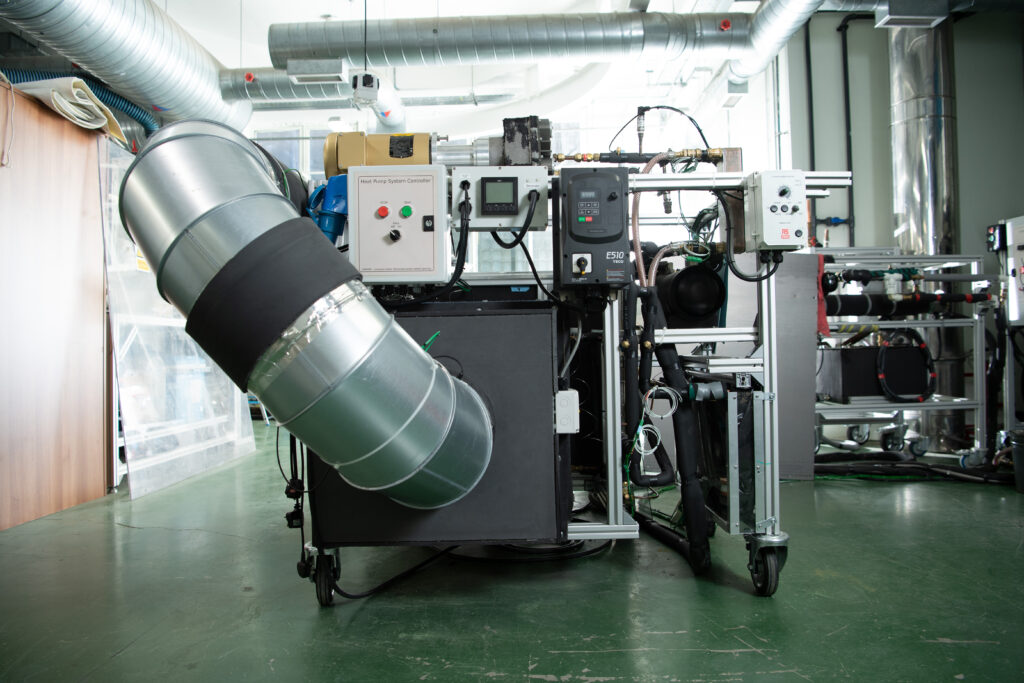
The design modifies traditional air-source heat pump architecture by incorporating a compact water tank and copper tubing coil that captures and stores excess thermal energy generated during regular operation. This stored heat, being significantly warmer than ambient air temperatures, can then supplement the system’s heating capacity when needed, potentially reducing overall energy consumption.
Initial testing of the prototype, constructed entirely from commercially available components, demonstrated a 3.7 per cent efficiency improvement compared to standard heat pumps when operating at a relatively low supply temperature of 35°C.
The engineering team’s analysis suggests that an optimised system could achieve efficiency gains approaching 10 per cent at operating temperatures around 65°C, where the amount of recoverable thermal energy increases substantially.
Heat pumps represent a critical technology for decarbonising residential and industrial heating, which currently accounts for approximately 40 per cent of global carbon emissions. These devices work by extracting thermal energy from outdoor air and concentrating it for indoor heating, operating on the same thermodynamic principles as refrigerators but in reverse. However, their efficiency decreases significantly in cold weather when the temperature differential between source and output becomes larger, requiring more electrical input to achieve the same heating effect.
The Glasgow team’s approach addresses this fundamental limitation by essentially creating a thermal battery within the system. During periods when the heat pump operates efficiently, excess heat that would typically dissipate gets captured and stored. This stored thermal energy then becomes available to pre-warm the system’s working fluid, reducing the temperature lift required from the compressor and thereby decreasing electrical consumption.
Engineering Deep Dive: How Integrated Thermal Storage Enhances Heat Pump Performance
To understand why this design shows such promise, we need to examine the thermodynamic cycle that governs heat pump operation. In a conventional air-source heat pump, refrigerant undergoes four main stages: evaporation (absorbing heat from outdoor air), compression (raising temperature and pressure), condensation (releasing heat indoors), and expansion (returning to low pressure). The efficiency of this cycle, expressed as the Coefficient of Performance (COP), depends heavily on the temperature difference between the heat source and sink.
The Glasgow design introduces thermal storage at a strategic point in this cycle. The water tank and copper coil assembly captures waste heat from two sources: excess thermal energy from the condenser during partial-load operation and recoverable heat from the compressor’s discharge line. This stored energy typically ranges from 40°C to 60°C, considerably warmer than winter ambient temperatures that might hover near freezing.
When the system calls for heating, this stored thermal energy pre-heats the refrigerant entering the evaporator, effectively raising the source temperature. From a thermodynamics perspective, this reduces the compression ratio required to achieve the target condensing temperature. Since compressor work increases exponentially with compression ratio, even modest reductions in this parameter yield significant energy savings.
The copper tubing configuration serves a dual purpose in the design. Its high thermal conductivity ensures rapid heat transfer between the refrigerant and storage medium, while the coiled geometry maximises surface area within a compact volume. Engineering calculations show that optimal coil design must balance heat transfer effectiveness against pressure drop-too many coils increase thermal exchange but also raise pumping power requirements.
Perhaps most significantly, the thermal storage enables continuous operation during defrost cycles. Conventional heat pumps must periodically reverse their operation to melt ice that accumulates on outdoor coils in cold, humid conditions. During these defrost periods, which can occur every 30-90 minutes and last 5-10 minutes, the system cannot provide heating. The Glasgow design draws from its thermal store during defrosting, maintaining indoor comfort while simultaneously improving overall system efficiency by eliminating the stop-start cycling that degrades component life and performance.
The choice of water as the storage medium reflects careful engineering trade-offs. Water’s high specific heat capacity (4.18 kJ/kg·K) means it can store substantial thermal energy in a relatively small volume. Its low cost and non-toxic nature make it practical for residential applications. The engineering team likely considered phase-change materials that could store even more energy per unit volume, but water’s simplicity and reliability ultimately proved more suitable for near-term commercialisation.
The innovation also solves a persistent operational challenge: defrosting. Ice formation on outdoor heat exchanger coils during cold, humid conditions forces conventional heat pumps to reverse their operation to melt accumulated frost periodically. During these defrost cycles, heating stops entirely.
The prototype’s reliance on standard, off-the-shelf components means we could soon see commercialisation of the design. Unlike many lab innovations requiring exotic materials or complex manufacturing processes, this design modification could be integrated into existing production lines with some retooling. The cost of adding a small water tank and copper coil assembly appears modest compared to the potential energy savings over the system’s operational lifetime.
The efficiency improvements become more pronounced at higher supply temperatures, which aligns well with retrofitting existing buildings. Many older structures with radiator-based heating systems require water temperatures around 60-65°C, precisely where this technology delivers its most significant benefit. This could make heat pump conversions more viable for properties previously considered unsuitable for low-temperature heating systems.
From a thermodynamic perspective, the concept parallels the evolution from non-condensing to condensing boilers, where recovering waste heat from exhaust gases improved efficiency by 15-20 percent.
The timing couldn't be better, with urgent policy pressures to accelerate heat pump deployment. The UK Government’s target of 600,000 annual installations by 2028 faces significant challenges due to high upfront costs, installation complexity, and consumer scepticism about performance. Any tech that improves efficiency while potentially reducing operating costs could help address these adoption barriers.
However, several technical questions remain before widespread deployment becomes feasible. The long-term reliability of the thermal storage system needs validation, particularly regarding potential issues like stratification in the water tank or fouling of heat exchange surfaces. The control algorithms governing when to charge and discharge the thermal store must be optimised for varying climate conditions and usage patterns. System sizing also presents challenges-a system that is too small limits benefits, while excessive capacity adds cost and space requirements without proportional efficiency gains.
The integration of thermal storage with heat pump systems represents an incremental but potentially significant advancement in sustainable heating technology. If field trials confirm the laboratory results and manufacturing costs remain reasonable, this approach could accelerate the transition away from fossil fuel heating. The engineering principles are sound, the components proven, and the efficiency gains measurable. Whether this translates to widespread commercial adoption will depend on factors beyond pure technical merit, including regulatory support, installer training, and consumer acceptance of new heating technologies.