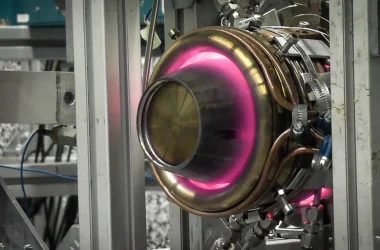
On 16 September a drill bit reached the basalt at a location one and a half kilometres below the surface of the Pacific Ocean, at a spot on the slopes of an active undersea volcano some 500 kilometres west of the Oregon coast, and came into contact with rock that was heated to 250°C. Ten days afterwards the Adélie, a 100-kilowatt generator, began to operate on the sea floor, transforming the heat into electricity. This marks the first instance in which a power system has been linked to a geothermal well drilled under the ocean.
The Seattle-based startup Endurance Energy is not at this stage pretending that this is a commercial power plant. The Adélie unit supplies the electricity needed to run its own monitoring sensors and any extra energy is lost as heat to the surrounding water. What is important is that it functions. For the first time, as reported by IEEE Spectrum, the engineering needed to drill, install plumbing, and generate electricity in one of the most severe environments on Earth (at a depth of 1,500 metres on a volcanic ridge) has been carried out.
What is there to gain from using geothermal energy offshore?
The production of electricity from geothermal energy on land began in 1904, when a plant in Larderello, Italy, first managed to light five lamps by using steam from beneath the ground. Iceland gets almost all of its energy from geothermal heat. However, suitable locations on land are generally limited in terms of geography and are mostly situated along tectonic plate boundaries. On the other hand, the ocean floor contains thousands of kilometres of mid-ocean ridges at which magma rises near the seabed, heating the rock and causing superheated water to circulate through cracks in the crust.
There was a good reason why Endurance selected Axial Seamount on the Juan de Fuca Ridge: it is by far the most extensively studied submarine volcano globally and benefits from decades of data collected by the Ocean Observatories Initiative of the National Science Foundation. This established infrastructure offered two practical benefits. The first was the presence of baseline environmental measurements against which any effects of the drilling could be evaluated. The second was the availability of an existing cabled fibre-optic network lying on the seafloor, which Endurance used to transmit real-time data to land without having to install its own submarine cables.
To access hydrothermal fluid within the ideal temperature range of 250 to 350°C, CEO Andrew Redd’s team drilled a shallow well that was only 60 metres deep. The well is narrow, having a diameter of just 5 centimetres, unlike the 20 to 30 centimetre diameter wells which are normal in onshore geothermal operations. Flexible piping extends approximately 20 metres from the wellhead to the Adélie generator, which is located on the seafloor within its own housing.
The schedule ahead is ambitious since Endurance plans to run its Oregon pilot for around a year, gathering temperature and flow-rate data, before putting into operation a 2-megawatt commercial unit off Tonga by the end of 2027; if the deployment off Tonga is a success, it could supply baseload electricity to an island country which at present relies on imported diesel fuel.
Engineering Deep Dive: The Organic Rankine Cycle and Subsea Power Generation
The Adélie generator is unlike a conventional power station in that it does not use steam turbines; instead it uses an organic Rankine cycle, or ORC. The fact that it is different is important and is the reason why this technology can function on the seafloor when a conventional geothermal plant could not.
In the ordinary Rankine cycle, water is heated until it becomes steam, this steam then drives a turbine, and the steam that is exhausted is condensed back into liquid form before being recycled. This cycle is the one used by coal-fired power stations, nuclear power stations and onshore geothermal power stations, and A-level Physics students will know it as a real-world heat engine which operates between a hot source and a cold sink.
In an organic Rankine cycle, water is substituted with an organic working fluid, usually a refrigerant or hydrocarbon having a considerably lower boiling point. This is beneficial in cases where the temperature of the heat source is moderate (below approximately 300°C) or when it is necessary to have a compact system; the organic fluid vaporises at a lower temperature and as a result the cycle is able to obtain useful work from heat sources which would not generate enough steam pressure to drive a conventional turbine efficiently.
The Adélie system functions as a closed loop. Geothermal fluid from the well is used to heat the organic working fluid in a heat exchanger. The working fluid then vapourises and causes a small turbine linked to a generator to turn. The exhaust vapour subsequently flows through a condenser, where the ocean water surrounding it, which is about 2°C at this depth, serves as an effectively infinite cold reservoir. The fluid after having been condensed is pumped back to the heat exchanger so that the cycle can start once more. Nothing of the geothermal fluid is discharged into the ocean; the two fluid circuits stay separate.
The thermodynamic efficiency of any heat engine cannot exceed the Carnot limit, which A-level students are able to calculate by subtracting the ratio of the cold reservoir temperature to that of the hot reservoir (with both temperatures being in Kelvin). In the case of Adélie, with a hot source of about 523 K (250°C) and a cold sink of about 275 K (2°C), the Carnot efficiency would be approximately 47 per cent. Actual ORC systems, however, attain an efficiency of only about 10 to 15 per cent because of irreversibilities, heat exchanger losses, and mechanical friction. Nevertheless, even at 10 per cent, a well that is producing a sufficient amount of thermal power can produce a significant amount of electricity.
Choosing the right materials for use in a subsea environment presents a special difficulty. At a depth of 1,500 metres the surrounding pressure is about 150 atmospheres (that is roughly 15 MPa). Each seal, flange and housing has to be capable of withstanding that external pressure while at the same time containing the hot, pressurised working fluid inside. Additional problems arise due to corrosion from seawater. In subsea oil and gas equipment marine-grade stainless steels, titanium alloys and specialised polymer seals are normally used, and Endurance probably makes use of that existing supply chain.
The 5-centimetre narrow borehole presents an engineering limitation with thermodynamic effects. If the borehole is made narrower then the flow rate of the geothermal fluid is reduced and this in turn limits the amount of thermal power that can be fed into the ORC. In order to achieve a larger scale operation it would be necessary to use wider boreholes or a number of wells. Moreover, drilling on the seafloor brings with it problems which do not arise when drilling on land; the drill rig has to be operated remotely or from a surface vessel through the use of a riser, and the cutting fluids must be handled so as not to contaminate the surrounding water column.
Students who are studying Design & Technology or engineering at university will observe the systems-engineering approach being applied. None of the individual elements of this project - the well, the generator, the data link, the materials - is in any way particularly original. What is novel instead is the fact that these components have been combined to form a working system at a depth of 1,500 metres. The difficulty involved in this integration - getting proven components to function together in an environment that is entirely new - is generally where the most difficult engineering problems are to be found.
Offshore geothermal won’t be able to take the place of onshore wind or solar anytime in the near future since the costs are high, the conditions under which it operates are harsh, and the regulatory frameworks are barely in place. However, if Endurance’s project in Tonga shows that the economics work out, the vast geothermal resources available beneath the seafloor could become a viable option for island nations and coastal areas which at present have very limited clean energy choices. The well is open and the turbine is running. What will happen next will depend on whether the figures add up.
- Endurance Energy has deployed the first geothermal power system on the ocean floor, 1,500 metres beneath the Pacific off Oregon’s coast
- The 100-kilowatt Adelie generator uses an organic Rankine cycle to convert 250C hydrothermal fluid into electricity on the seafloor
- The well is drilled into Axial Seamount, the world’s most studied submarine volcano, using the NSF’s existing fibre-optic network for data
- A 2-megawatt commercial unit is planned for deployment off Tonga by end of 2027, potentially replacing diesel imports for island power
- The 5cm borehole is far narrower than typical land-based geothermal wells, reflecting the constraints of subsea drilling