Somewhere near junction 4 of the M6, in the flat sprawl of land between Birmingham and Solihull, a 1,250-tonne section of weathering steel sits on a row of concrete piers. On 11 April, a hydraulic jack will begin pulling it sideways, inching the structure 102 metres across the motorway in a manoeuvre that sounds more like a magic trick than civil engineering. Below it, traffic will keep moving.
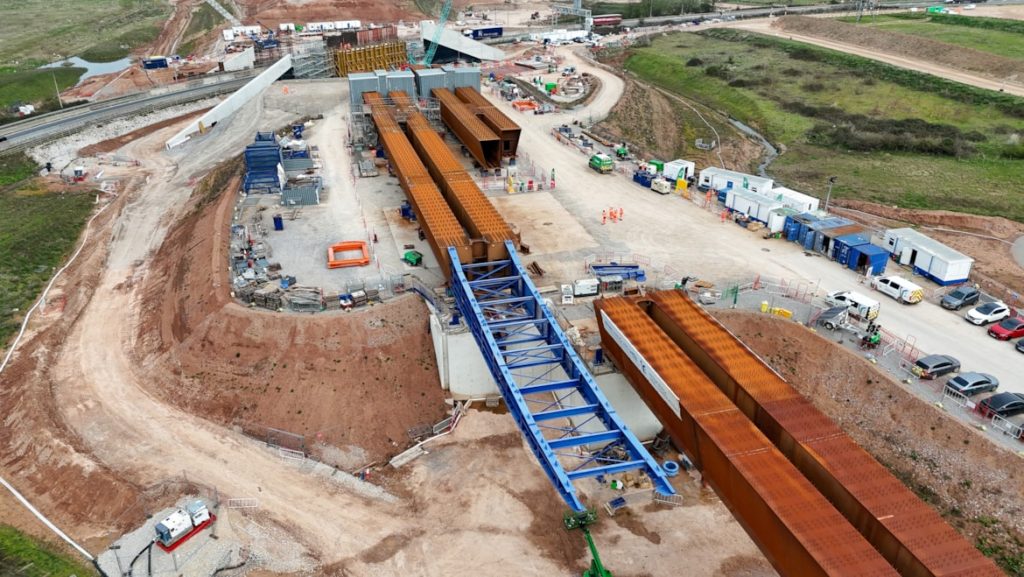
The HS2 M6 viaduct slide is the latest in a series of operations that have turned the M6 South viaduct into one of the most technically demanding structures on Britain’s new high-speed railway. This section, the first of four that will form the 320-metre west deck, must be assembled on a temporary platform beside the motorway and then pushed into its final position on permanent piers. The east deck, installed across three separate slides in 2025, proved the method works. But the west deck is trickier. A curved alignment and staggered abutments near the junction’s loop road mean the launching platform is shorter, forcing engineers to break the structure into four pieces rather than three, as reported by New Civil Engineer.
How do you slide a viaduct?
The technique is called incremental launching, and it works on a deceptively simple principle. The steel deck is assembled on a casting bed beside the motorway, welded together, and fitted with a temporary launching nose that reduces bending forces as the front edge crosses the gap between piers. A cable-and-jack system then pulls the entire assembly forward along greased or Teflon-coated bearing pads sitting on the pier tops. The hydraulic jack provides a slow, controlled pull. Think of sliding a heavy drawer along a well-oiled runner, except the drawer weighs as much as a small ship.
Russell Luckhurst, a civil engineer with Balfour Beatty VINCI, the joint venture delivering this section of HS2, described the preparation as months of careful staging. “Building on the success of installing the east deck viaduct last year, we’re gearing up for the first launch,” he said. A 45-person crew will manage the slide, with the M6 junction 4 southbound slip road closing from 5 AM on Saturday, 11 April. If everything goes to plan, the road will reopen at 10 PM on Sunday following safety checks.
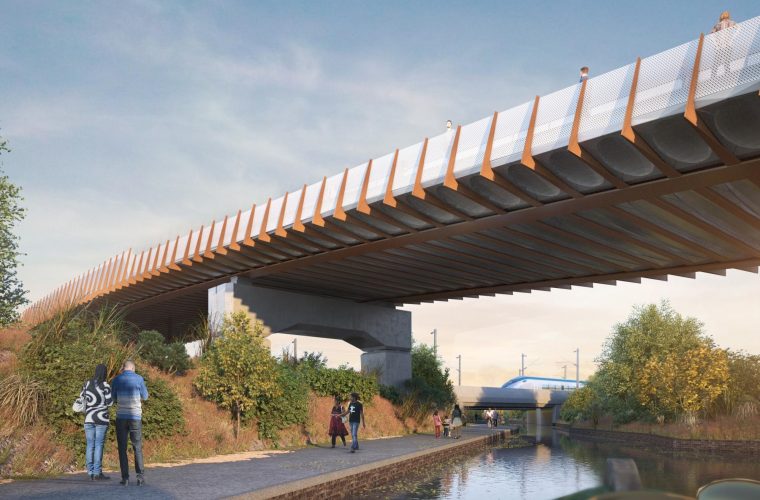
The choice of weathering steel is deliberate. Unlike painted structural steel, weathering steel forms a stable, rust-coloured patina when exposed to the atmosphere. That patina acts as a protective layer, eliminating the need to repaint the structure over its lifetime. For a viaduct that will carry high-speed trains for decades, the long-term maintenance savings are substantial. The material also gives the structure its distinctive orange-brown appearance, something you may already have noticed if you have driven beneath the east deck.
A second slide is planned for June, when a longer section will be launched over the live M6 carriageway itself. The east deck operation in 2025 set a UK precedent by keeping the main carriageway open while the structure passed overhead, and the west deck programme will build on that experience. Further works across the M6 and M42 corridors are scheduled for summer 2026.
Engineering Deep Dive: The mechanics of an HS2 M6 viaduct slide
Incremental launching has been used in bridge construction for decades, but every application brings site-specific challenges that demand fresh engineering. The M6 South viaduct is no exception.
The fundamental problem is one of structural mechanics. A steel beam being pushed across a series of supports behaves differently at each stage of the launch. When the leading edge extends beyond the last pier, it acts as a cantilever, subject to large bending moments that increase with the square of the overhang distance. Left unchecked, those moments would cause the front of the deck to sag dangerously. The solution is the launching nose: a lighter, tapered steel structure bolted to the front of the main deck. It reduces the effective weight of the cantilever tip, lowering the bending moment and allowing the nose to reach the next pier before the main deck follows.
Students familiar with A-level Physics will recognise this as an application of moments and equilibrium. The principle is identical to balancing a ruler on the edge of a table: the greater the overhang, the greater the required turning force. By reducing the mass at the front, the launching nose shifts the balance point and keeps stresses within safe limits.
The bearing system on the pier tops is engineered to minimise friction. In typical incremental launches, engineers use PTFE (polytetrafluoroethylene, the same material as non-stick frying pans) pads sitting on polished stainless steel plates. The coefficient of friction between PTFE and steel is roughly 0.05, meaning the horizontal force required to slide the deck is about 5 per cent of its weight. For a 1,250-tonne section, that comes to a pull force of around 62 tonnes, well within the capacity of the hydraulic jacks used on site.
The curved alignment introduces an additional complication. A straight launch follows a single axis, but a curved deck must follow a precise arc. This means the bearing pads must accommodate lateral forces, and the jack system must apply a carefully controlled combination of longitudinal pull and lateral guidance. Engineers use real-time survey monitoring, typically with total stations and GPS, to track the deck’s position during the slide and make corrections if it drifts off line.
The four-section assembly strategy is a direct consequence of site geometry. The loop road at junction 4 curves close to the viaduct alignment, limiting the length of the casting bed. With only so much space to assemble steel, the west deck must be launched in shorter segments. Each segment is welded to the previous one after launch, building up the full 320-metre span incrementally. The connection points between segments are designed as full-penetration butt welds, inspected using ultrasonic testing to ensure the joint is as strong as the parent material.
Weathering steel itself is an interesting material choice. Its corrosion-resistant properties come from a specific alloy composition, typically including small amounts of copper, chromium, nickel, and phosphorus. These elements encourage the formation of a dense, adherent oxide layer that slows further corrosion to a negligible rate. In the UK climate, the patina typically stabilises within two to five years. The trade-off is that weathering steel cannot be used in environments with persistent moisture or salt spray, such as coastal sites or areas where water pools on the surface. The M6 viaduct’s elevated, well-drained position makes it an ideal candidate.
For students considering structural or civil engineering, this project illustrates how first-year concepts, beam theory, friction, material properties, and surveying methods combine on a real site. The difference between a textbook problem and a live motorway is that the textbook never has traffic underneath.
The M6 South viaduct is one of roughly 130 bridges and viaducts on the HS2 Phase One route between London and Birmingham. The west deck, once complete, will carry southbound high-speed trains towards the city at speeds that the current West Coast Main Line cannot match. Whether the broader HS2 programme delivers on its promises of faster, greener inter-city travel remains to be tested in operation. For now, the engineering on the ground, or rather above it, is proceeding one 1,250-tonne slide at a time.