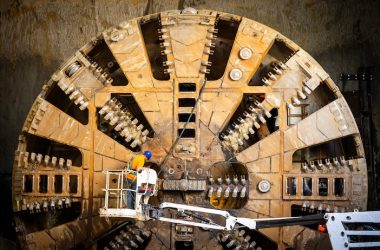
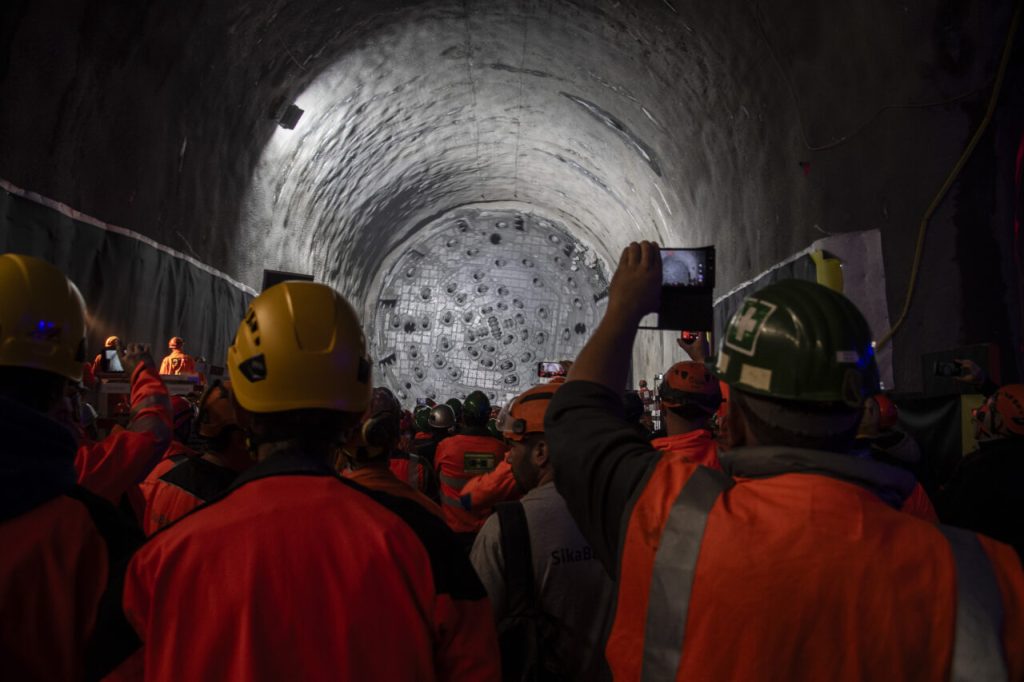
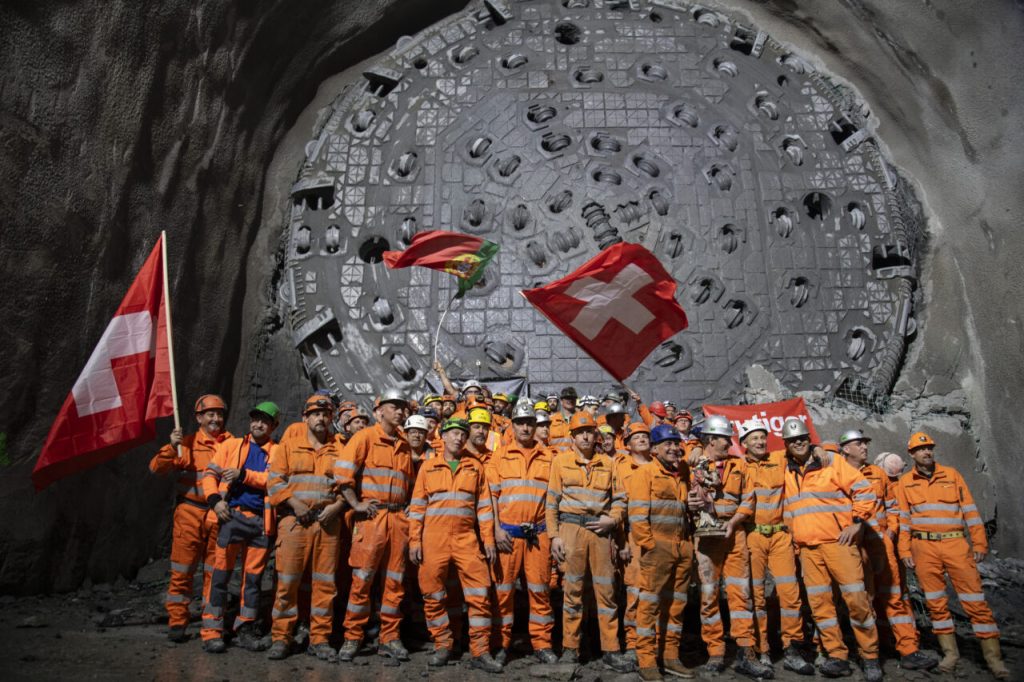
Somewhere beneath the Swiss Alps, on 29 April 2026, a 100-metre-long tunnel boring machine punched through into a pre-excavated cavern after chewing through 3.8 kilometres of some of the hardest rock in Europe.
The crews working on the second tube of the Gotthard Road Tunnel had hit their target with millimetre precision, advancing at up to 32 metres a day through geology that engineers described as extremely hard and, at times, brittle.
That last detail matters. Brittle rock sounds like it should be easy to break apart. In practice, it fractures unpredictably, sending shards into machinery and creating unstable faces that can collapse without warning. The Herrenknecht-supplied TBM had to cope with both crushing hardness and sudden fragility, adjusting its approach as the geology shifted around it. That it managed to sustain 32-metre daily advances through these conditions is, by any measure, a serious feat of underground engineering.
The project is part of a broader effort to construct a second tube running parallel to the existing Gotthard Road Tunnel, which has been in continuous operation since 1980. The original tunnel is one of the most heavily used road links through the Alps, carrying traffic between northern and southern Switzerland. It was built as a single-bore, bi-directional tunnel, meaning traffic in both directions shares the same space, separated only by markings and barriers. In 2001, a collision between two lorries inside the tunnel caused a fire that killed eleven people. The disaster prompted years of debate about safety upgrades, and the second tube was finally approved in a national referendum in 2016.
Once the second bore is complete, as reported by New Civil Engineer, each tube will carry traffic in one direction only, with the original tunnel refurbished during the transition. The second tube is being delivered on behalf of Switzerland’s Federal Roads Office and ASTRA, and it represents one of the most technically demanding tunnelling projects currently underway in Europe.
Following the breakthrough, crews will now transport the TBM through the cavern before repositioning it to excavate the remaining 4-kilometre section heading south. The precision required is formidable. At these depths, GPS signals cannot penetrate. Instead, engineers rely on a combination of gyroscopic guidance systems, laser-based surveying, and reference points drilled from the surface, checked and rechecked as the machine advances.
How a Gotthard Tunnel Boring Machine Eats Through Mountains
A tunnel boring machine is, in essence, a self-contained factory that moves forward. At the front sits a rotating cutterhead, typically studded with disc cutters made from tungsten carbide or hardened steel. As the head turns, these discs press against the rock face with enormous force, typically 200 to 300 kilonewtons per cutter, inducing stress fractures that cause the rock to chip and spall. The resulting fragments, known as muck, fall through openings in the cutterhead and are carried away by a conveyor belt running the length of the machine.
Students who have studied stress and strain in A-level Physics will recognise the underlying principle. Rock fails when the applied stress exceeds its compressive or tensile strength. The disc cutters exploit this by concentrating force along a narrow contact line, creating localised stress that exceeds the rock’s failure threshold even when the average pressure is far below it. This is the same reason a sharp knife cuts more easily than a blunt one: pressure equals force divided by area.
Behind the cutterhead, the TBM installs the tunnel lining as it advances. In hard rock, this usually consists of a series of precast concrete segments bolted together to form a ring. Each ring supports the surrounding rock and prevents collapse. The machine advances by hydraulic rams that press against the most recently completed ring, using it as a reaction point. In the Gotthard project, these segments must withstand not only the overburden pressure from hundreds of metres of overlying rock but also the stresses induced by Alpine tectonic forces, which create lateral pressures that conventional structural analysis may not fully capture.
The Gotthard tunnellers faced a particular challenge with the rock’s dual character. Hard rock requires heavy cutting forces but produces a stable tunnel face. Brittle rock can shatter suddenly, creating overbreak, where more material falls away than intended, leaving voids behind the lining that must be filled with grout. The TBM operators had to continuously monitor cutting forces, torque, and vibration data to detect transitions between rock types and adjust the machine’s advance rate, cutterhead rotation speed, and thrust pressure accordingly.
Navigation at depth presents its own problems. The TBM must follow a pre-defined alignment to within a few centimetres over several kilometres. At the surface, engineers establish a geodetic control network of precisely surveyed reference points. From these, angular and distance measurements are projected underground through the tunnel access shafts. Inside the tunnel, a gyroscopic total station, essentially a highly precise compass combined with a laser rangefinder, tracks the machine’s position relative to these reference points. Any deviation is corrected by adjusting the thrust of individual hydraulic rams, which can steer the machine much as differential braking steers a tracked vehicle.
The 32 metres-per-day advance rate is respectable for hard rock but not record-breaking. What makes it notable is the consistency, maintaining that rate through variable geology over weeks of continuous operation. TBM performance is often measured in utilisation rate, the percentage of time the machine is actually cutting versus waiting for maintenance, muck removal, or segment installation. High utilisation in difficult ground demands seamless coordination among the cutting crew, segment erectors, muck train operators, and surveyors. It is, above all, a logistics problem.
For students considering civil or geotechnical engineering, the Gotthard project illustrates how tunnelling sits at the intersection of geology, structural mechanics, hydraulic systems, control engineering, and project management. No single discipline is sufficient on its own.
The remaining 4-kilometre southern section will bring its own challenges, including the possibility of encountering water-bearing fault zones that could flood the tunnel face. How the team manages that risk, likely through pre-grouting ahead of the cutterhead and careful pressure management, will determine whether the project stays on schedule. The original Gotthard Road Tunnel took a decade to build. Its successor is being delivered in roughly half that time, a measure of how far tunnelling technology has come in 40 years.
- A Herrenknecht tunnel boring machine broke through 3.8km of Alpine rock on the Gotthard Road Tunnel’s second tube on 29 April 2026
- The TBM advanced at up to 32 metres per day through extremely hard and brittle rock conditions.
- The second tube will allow single-direction traffic in each bore, replacing the original 1980 tunnel’s dangerous bi-directional layout.
- Navigation at depth relies on gyroscopic guidance and laser surveying since GPS cannot penetrate themountaini.The
- A remaining 4km southern section still needs to be excavated before the project is complete