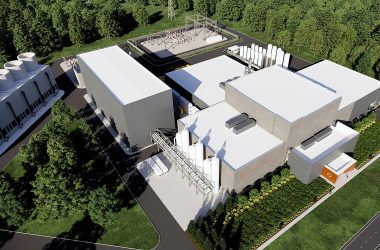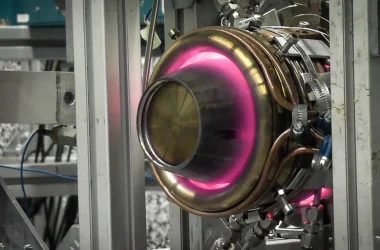
At the foot of the Tianshan mountains, where the Gobi Desert stretches flat and dry for hundreds of kilometres, 260,000 mirrors have begun tracking the sun. They cover 800,000 square metres of desert floor, focusing sunlight onto receivers that heat molten salt to 550°C. When the sun sets, the salt keeps generating electricity for another eight hours. No lithium batteries are involved.
This is the Hami molten salt solar plant, built by China Three Gorges Corporation (CTG) in the Xinjiang region. It entered commercial trial operation on 1 July 2026. With a total capacity of 1 GW, combining 900 MW of photovoltaic panels with 100 MW of concentrated solar power (CSP), it is now the world’s largest hybrid CSP-PV installation, overtaking Dubai’s Noor Energy 1 at 950 MW.
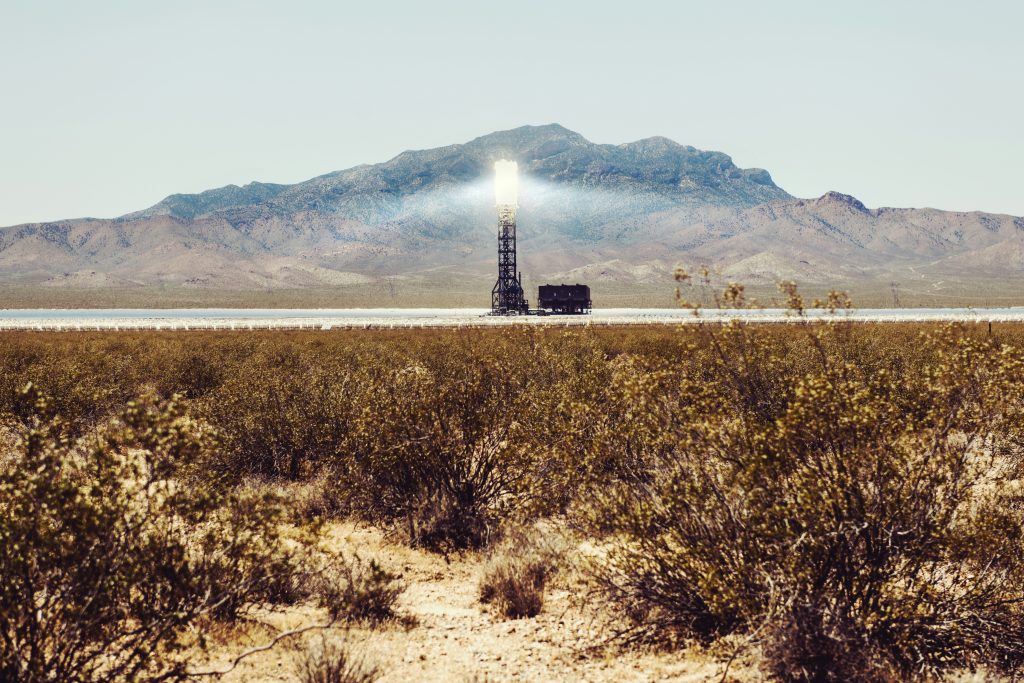
Above the existing Stateline Solar Farm, California, USA
The project covers 1,817 hectares (about 4,500 acres), exceeding the size of some small cities. The investment was CNY 3.53 billion, or approximately $480 million. This enabled CTG to build a power station that delivers continuous clean electricity without the degradation, fire risk, or mineral supply chain challenges of grid-scale battery storage.
How the molten salt solar plant stores energy
The 100 MW CSP component uses a tower design. Its 260,000 heliostats, each a flat mirror on a two-axis tracker, reflect sunlight onto a central receiver atop the tower. Inside, a sodium nitrate and potassium nitrate mixture (solar salt) absorbs the concentrated energy and heats to 550°C. The hot salt then flows to an insulated storage tank, retaining thermal energy with minimal losses.
When electricity is required, hot salt is pumped through a heat exchanger to produce superheated steam for a conventional turbine. The cooled salt, still liquid at about 290°C, returns to a cold storage tank for reheating the next day. This cycle can continue for decades, as molten salt does not degrade with use. The storage tanks are simple insulated steel vessels, not complex electrochemical cells.
The 900 MW PV component supplies most daytime generation. Photovoltaic panels in the Gobi Desert benefit from strong solar irradiance, low humidity, and minimal cloud cover. Combining PV and CSP enables maximum output during the day, with CSP charging thermal storage and continuing generation after sunset using stored heat.
Scale and what comes next
The Hami molten salt solar plant is large by any standard, but its record may soon be surpassed. China Energy Engineering Corporation is building a 1.5 GW hybrid CSP-PV plant nearby. China’s western deserts, with abundant land and solar resources, are becoming a testing ground for utility-scale renewable energy at sizes difficult to permit or finance elsewhere.
This development has geopolitical significance. China leads global solar panel manufacturing and has extensive experience with large-scale infrastructure. Building gigawatt-scale solar plants domestically reduces reliance on imported fossil fuels and develops expertise that can be exported with the technology.
Molten salt storage avoids several challenges associated with large-scale battery storage. Lithium-ion batteries degrade over time, losing about 20 percent of capacity within 10 to 15 years, and require metals with limited supply chains and environmental impacts. They also present fire risks. In contrast, molten salt uses abundant and inexpensive sodium and potassium nitrates.
Engineering Deep Dive
The concentrated solar power tower at Hami relies on established thermodynamic principles, but implementing them at this scale is complex. Each of the 260,000 heliostats must track the sun with better than 1 milliradian accuracy (about 0.06 degrees) to keep the reflected beam focused on the receiver, which may be several hundred metres away. At this distance, a 1 milliradian error causes a 0.3 metre beam displacement per 300 metres, potentially missing the receiver and wasting energy or damaging nearby structures.
The tracking systems combine open-loop astronomical algorithms, which calculate the sun’s position, with closed-loop corrections from flux sensors on the receiver. The control system coordinates all 260,000 heliostats simultaneously, adjusting each for its unique position relative to the tower. While computationally demanding, modern industrial controllers manage this routinely.
The central receiver is the most thermally stressed component. It absorbs concentrated solar flux of 500 to 1,000 kW per square metre (500 to 1,000 times normal sunlight) and transfers this energy to the molten salt in its tubes. These tubes, typically made from nickel-based superalloys such as Inconel 625 or Haynes 230, maintain strength at high temperatures and resist corrosion. The sun-facing surface can be 100 to 200°C hotter than the salt-facing surface, creating thermal stresses that may cause fatigue cracking over time.
Molten salt presents engineering challenges. The sodium nitrate-potassium nitrate mixture (60:40 by weight) melts at 221°C. If the temperature drops below this, the salt solidifies and blocks piping, making freeze protection essential. This requires trace heating on all piping, valves, and instruments, as well as careful procedures during start-up and shutdown. The salt is also mildly corrosive to carbon steel at high temperatures, so stainless steel or nickel alloys are used for all wetted components.
The thermal storage tanks are among the simplest components. They are large, insulated cylinders, typically 20 to 40 metres in diameter and 10 to 15 metres tall, lined with stainless steel and surrounded by mineral wool or ceramic fibre insulation. A well-designed hot tank loses less than 1 percent of its thermal energy per day, allowing the plant to store energy from Friday afternoon and generate power on Saturday evening with minimal losses.
The steam cycle after storage is a conventional Rankine cycle, similar to those in coal and gas power stations. Superheated steam at about 540°C and 100 to 130 bar drives a turbine connected to a generator. This cycle achieves a thermal-to-electric efficiency of 38 to 42 percent, comparable to modern coal plants. The overall solar-to-electric efficiency of the CSP component is about 15 to 20 percent, lower than PV panels (20 to 22 percent), but this is offset by the ability to store and dispatch energy as needed.
The hybrid configuration at Hami creates operational synergies. The PV component generates cost-effectively during sunlight hours, while the CSP component charges thermal storage. In the evening, the CSP system dispatches stored energy to offset declining PV output. This combined approach maintains a more consistent output than either technology alone, reducing grid balancing needs and improving capacity factor.
The Hami plant began commercial trial operations on 1 July 2026. Its performance will be closely monitored by energy planners worldwide, especially in sun-rich regions seeking dispatchable renewable generation without battery storage constraints. With a 1.5 GW successor under construction nearby, the Gobi Desert is emerging as a proving ground for large-scale solar power.
- China’s 1GW Hami solar plant combines 900MW PV with 100MW concentrated solar power using molten salt storage at 550°C
- The plant generates electricity for 8 hours after sunset without batteries, using abundant and inexpensive sodium-potassium nitrate salt
- Now the world’s largest hybrid CSP-PV installation at $480 million investment, with a 1.5GW successor already under construction