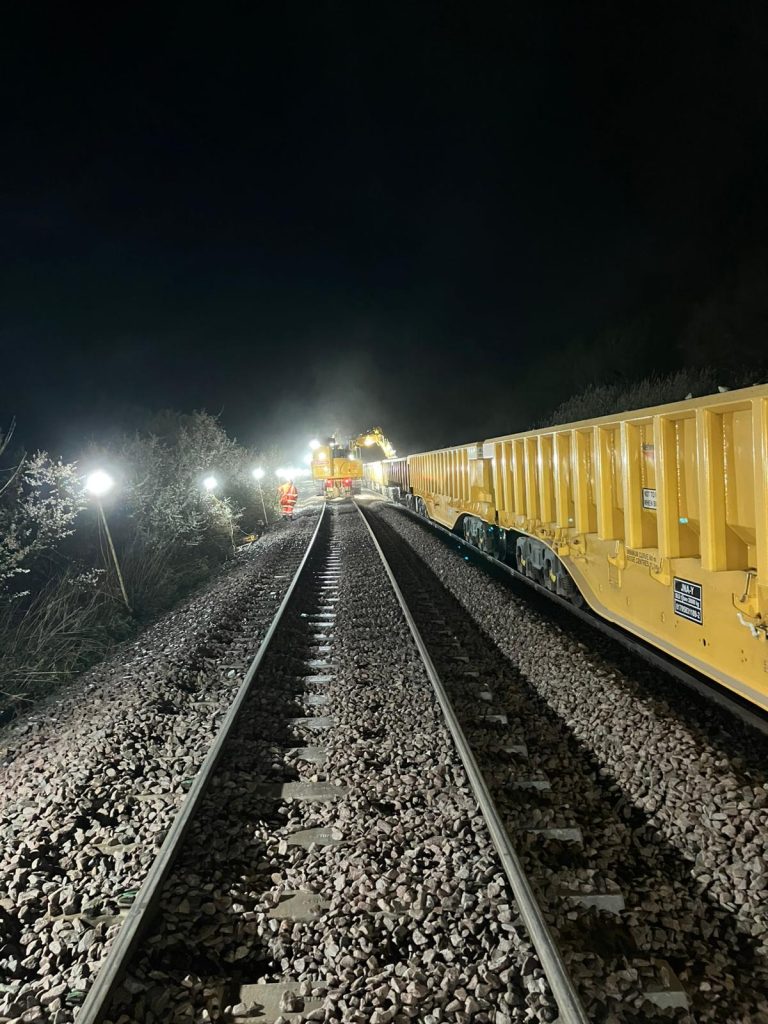
At half past seven on a bank holiday morning, a convoy of orange machines rolled onto a stretch of railway between Westbury and Taunton in Somerset. Over the next three days, while most of the country was eating chocolate eggs, a team of Network Rail engineers replaced 1.4 kilometres of rail, pulled out 1,080 concrete sleepers, and poured 3,300 tonnes of fresh ballast into the track bed. The work was finished several hours ahead of schedule. Passenger services resumed on Monday morning as planned.
The track they removed dated from the 1960s. Sixty years of express trains, freight wagons, and seasonal temperature swings had done what physics inevitably does to steel rails resting on stone: the rail heads had worn, the sleepers had cracked, and the ballast had degraded from sharp, angular granite chips into rounded, compacted rubble that no longer held the track in position. The Easter rail upgrade at East Somerset Junction was one component of a broader £75.5 million programme of renewal works carried out across the UK over the Easter weekend.
Railway engineering possessions, the industry term for periods when a section of track is closed for maintenance, are deliberately scheduled during bank holidays and school breaks when fewer passengers travel. The Easter weekend is one of the largest annual windows for major work. This year, alongside the Somerset project, engineers at Swinton station in South Yorkshire laid 420 metres of new rail, replaced three sets of points, installed 650 sleepers, and placed 2,500 tonnes of ballast. Near Eastbourne, 2,700 metres of track was renewed with 120 new sleepers and 150 tonnes of ballast.
These are not emergency repairs. They are planned renewals, part of a rolling programme that replaces components as they approach the end of their design life. Network Rail manages 20,000 miles of track across Britain. Keeping it safe and reliable means continuously replacing worn-out sections in precisely planned sequences that minimise disruption to a railway that carries nearly five million journeys on a typical weekday.
Mark Parker, Network Rail’s lead portfolio manager for the Somerset work, said: “I’d like to thank passengers for their patience over the long weekend as we completed another essential upgrade, replacing track dating back to the 1960s with modern components that will help ensure continued safe and reliable train journeys for years to come.”
The Engineering behind Track Renewal
A railway track looks simple. Two steel rails, some wooden or concrete blocks underneath, a bed of stones. But the engineering behind each component is more involved than it appears, and understanding it explains why maintenance costs billions of pounds a year.
Start with the rails themselves. Modern rails are made from high-carbon steel, typically with a carbon content of around 0.7 to 0.8 per cent, which gives the metal the hardness needed to resist wear from wheel contact while retaining enough ductility to avoid brittle fracture. A standard rail profile (the cross-sectional shape) in the UK is the CEN 60E1 section, which weighs approximately 60 kilograms per metre. The rail head, the top surface where the wheel runs, is designed with a specific curvature that distributes the contact stress over a small elliptical area, typically only about the size of a 10p coin, even under a 25-tonne axle load.
Over time, repeated wheel passes deform the rail head. Metal flows laterally, the running surface develops corrugations (tiny wave patterns that cause noise and vibration), and fatigue cracks can initiate below the surface. Rail grinding can extend a rail’s life, but eventually the head profile deviates too far from the design geometry and the rail must be replaced.
Sleepers, the transverse supports that hold the two rails at the correct gauge (1,435 mm in the UK, the standard gauge adopted from George Stephenson’s original colliery railways), transfer the load from the rails to the ballast. Modern concrete sleepers are pre-stressed, meaning steel wires or bars within the concrete are tensioned before the concrete sets. When the tension is released, the concrete is compressed, which gives it much greater resistance to the bending loads imposed by passing trains. A-level Physics students will recognise this as an application of stress, strain, and the behaviour of composite materials under load.
Ballast is perhaps the most underappreciated component. The crushed stone, typically granite or basalt with a particle size of 30 to 50 millimetres, performs several functions simultaneously. It distributes the concentrated load from each sleeper over a wider area of subgrade. It drains rainwater away from the track structure. It allows small adjustments to the track geometry through tamping, a process in which vibrating tines are inserted into the ballast to lift and reposition the track to the correct alignment.
Over years of service, ballast degrades. The angular particles that interlock and resist lateral movement become rounded through abrasion. Fine particles accumulate in the voids between stones, reducing drainage capacity and creating a phenomenon called ballast fouling, where the track bed becomes waterlogged and loses its load-bearing properties. This is why ballast must be cleaned periodically (using machines that scoop out the stone, sieve it, and return the clean material) or replaced entirely, as was done during the Somerset Easter rail upgrade.
The logistics of a weekend possession are an engineering challenge in their own right. The work window is typically 50 to 72 hours. Materials must be pre-positioned: rail delivered in 18-metre lengths on special wagons, sleepers stacked at access points, ballast stockpiled at railhead depots. The sequence matters. Old rail is cut and removed first, then sleepers are lifted out, and then the degraded ballast is excavated or redistributed. New ballast is laid, sleepers positioned, rails placed, and the whole assembly is tamped to the correct geometry using a tamping machine that adjusts the vertical and lateral position of the track to millimetre tolerances.
The next phase of follow-up work in Somerset was scheduled for the weekends following Easter, with adjustments to track geometry and signal maintenance. It is not dramatic work. There are no ribbon cuttings or grand openings. But this type of railway renewal engineering is the kind of patient, methodical infrastructure maintenance that keeps things moving, and the Easter weekend programme is one of the largest coordinated civil engineering efforts that most people never see.