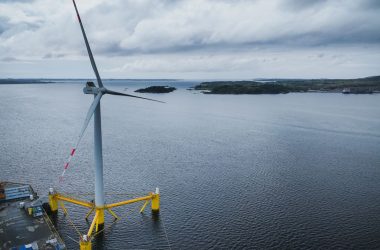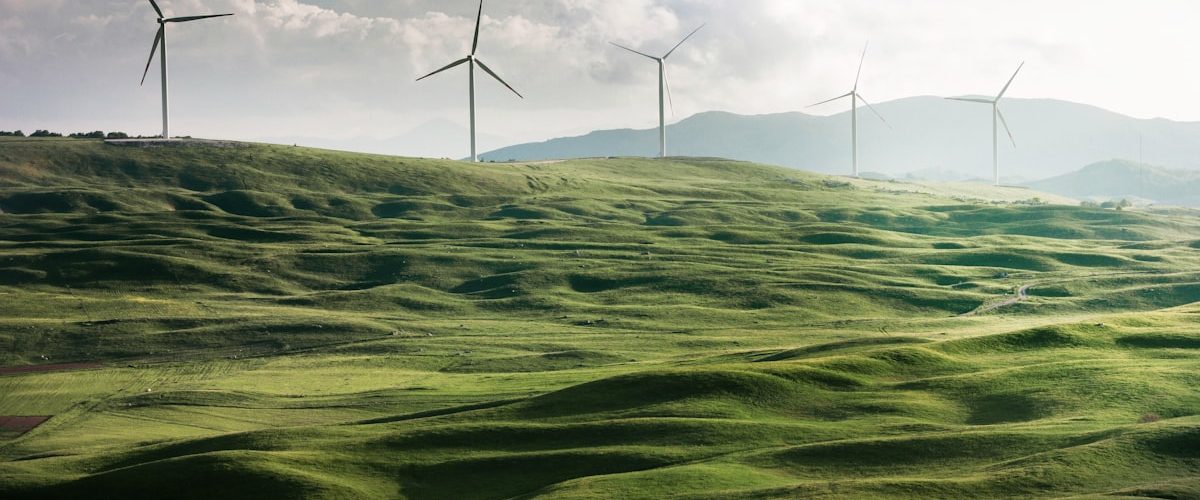
Each blade is longer than a Premier League football pitch. That fact alone is worth sitting with for a moment, because the first turbine at East Anglia THREE, installed 69 kilometres off the Suffolk coast in April 2026, carries three of them, each stretching 115 metres from root to tip and sweeping a rotor area larger than the London Eye.
The East Anglia THREE offshore wind farm is a joint development between ScottishPower Renewables and Masdar. When all 95 turbines are spinning later this year, the project will generate 1.4 gigawatts of electricity, enough to power more than 1.3 million homes. That makes it one of the largest offshore wind farms in the world, and its blades set a new UK record.
The turbines are Siemens Gamesa SG 14-236 DD machines, each rated at more than 14 megawatts. “DD” stands for direct drive, meaning the generator connects straight to the rotor hub without a gearbox, an engineering decision that reduces mechanical complexity, cuts maintenance costs, and eliminates one of the most common failure points in older turbine designs. Each completed turbine stands approximately 262 metres tall, tip to sky.
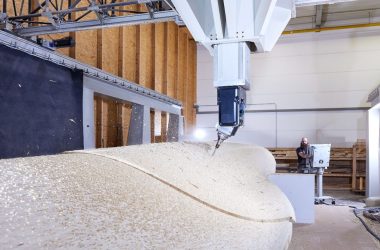
Every one of the 285 blades is manufactured at Siemens Gamesa’s factory in Hull, a detail that matters. The facility employs hundreds of workers to produce blades using a process called vacuum-assisted resin transfer moulding, in which layers of glass fibre and carbon fibre reinforcement are laid into a mould, sealed under a vacuum bag, and then infused with epoxy resin. The resulting composite is both extraordinarily strong and light enough to be lifted by crane onto a nacelle bobbing on the North Sea.
Getting these structures into the water is itself a feat of marine engineering. Cadeler, the Danish offshore installation contractor, is using its fleet of jack-up vessels to transport and install the turbines. A jack-up vessel works by sailing to the installation site, then lowering enormous steel legs to the seabed and lifting its own Hull clear of the waves, creating a stable platform from which cranes can operate. The vessel’s main crane has to lift nacelles weighing more than 500 tonnes to heights exceeding 100 metres, in a maritime environment where even moderate wave action can turn a routine lift into something very different.
The foundations are monopiles, single steel tubes driven vertically into the seabed. Each monopile for East Anglia THREE weighs more than 1,000 tonnes and is hammered into place using a hydraulic impact hammer that delivers blows of up to 4,000 kilojoules. The noise generated by this process is a significant environmental concern, particularly for marine mammals, so engineers deploy bubble curtains around the pile during installation. Air is pumped through perforated hoses laid on the seabed, creating a wall of rising bubbles that attenuates the sound waves before they propagate through the water column.
Engineering Deep Dive: How East Anglia THREE offshore wind turbines generate power
A wind turbine converts kinetic energy in moving air into electrical energy through a chain of physical transformations that A-level Physics students will find familiar. The power available in the wind passing through the rotor disc is given by P = ½ρAv³, where ρ is the air density, A is the swept area of the rotor, and v is the wind speed. The cubic relationship with wind speed is the reason these turbines are built offshore, where winds are stronger and more consistent than on land.
The SG 14-236 DD turbine has a rotor diameter of 236 metres, giving it a swept area of roughly 43,700 square metres. At a typical offshore wind speed of 12 metres per second and an air density of 1.225 kg/m³, the theoretical power available is about 47 megawatts. But the Betz limit, a result from fluid dynamics, shows that no turbine can extract more than 59.3% of the available wind energy. In practice, real-world efficiency, including aerodynamic losses, generators, and electrical transmission losses, reduces the actual output to around 14 megawatts at the rated wind speed.
The direct-drive generator eliminates the gearbox that older turbine designs used to step up the slow rotor speed (around 7-8 revolutions per minute) to the thousands of RPM needed by conventional generators. Instead, the SG 14-236 uses a permanent magnet generator with a very large diameter, allowing it to generate power efficiently at low rotational speeds. The trade-off is weight. Direct-drive generators are heavier than geared alternatives, which is why the nacelle weighs more than 500 tonnes, but the reduction in mechanical failures more than compensates over a 25-year operational life.
The blade design itself involves sophisticated aerodynamics. Each 115-metre blade is an aerofoil, shaped to generate lift as wind passes over it. The blade is twisted along its length, with a steeper pitch angle near the root (where rotational speed is low) and a shallower angle near the tip (where rotational speed is highest). This twist ensures that the angle of attack remains optimal across the entire blade span, maximising energy capture. The concept is directly analogous to propeller design, which students may encounter in A-level Design and Technology.
Composite materials are central to making blades this large. Glass fibre provides the bulk structural reinforcement, while carbon fibre spar caps run along the length of the blade to resist bending loads. The epoxy resin matrix binds the fibres together and distributes loads between them. The vacuum infusion process used in Hull ensures consistent fibre-to-resin ratios and eliminates air voids that could become crack initiation sites under fatigue loading. Each blade will undergo roughly 100 million load cycles over its lifetime, so fatigue resistance is not optional.
Power from the turbines is transmitted via subsea cables at 66 kilovolts to an offshore substation, where it is stepped up to 220 kilovolts for the 69-kilometre journey to the onshore grid connection. The cables are buried in the seabed to protect them from anchor strikes and fishing activity, a process that requires specialist cable-laying vessels and ploughs.
East Anglia THREE is part of a broader cluster of wind farms known as the East Anglia Hub, which will eventually deliver more than 3 gigawatts of capacity from the same stretch of the southern North Sea. The engineering challenges grow with each new project, as water depths increase and turbine sizes continue to scale upward. The next generation of machines, already in development, will push rotor diameters past 250 metres. Making blades that large, transporting them, and installing them at sea remains an open engineering problem, one where the answers are still being written.
- East Anglia THREE installed its first 14+ MW turbine 69km off the Suffolk coast in April 2026
- The 115-metre blades are the longest ever manufactured and used in the UK, each longer than a football pitch
- All 285 blades are built at Siemens Gamesa’s factory in Hull using vacuum-assisted resin transfer moulding
- The 1.4 GW wind farm will power more than 1.3 million homes when fully operational later this year
- Monopile foundations weighing over 1,000 tonnes each are driven into the seabed with hydraulic hammers delivering 4,000 kJ blows