Plants solve a problem that has defeated engineers for decades. They capture sunlight, split water, and store the resulting energy as chemical bonds, all without a battery in sight. A team at Osaka Metropolitan University has now built a device that does something similar, and the engineering behind it is more interesting than the headline suggests.
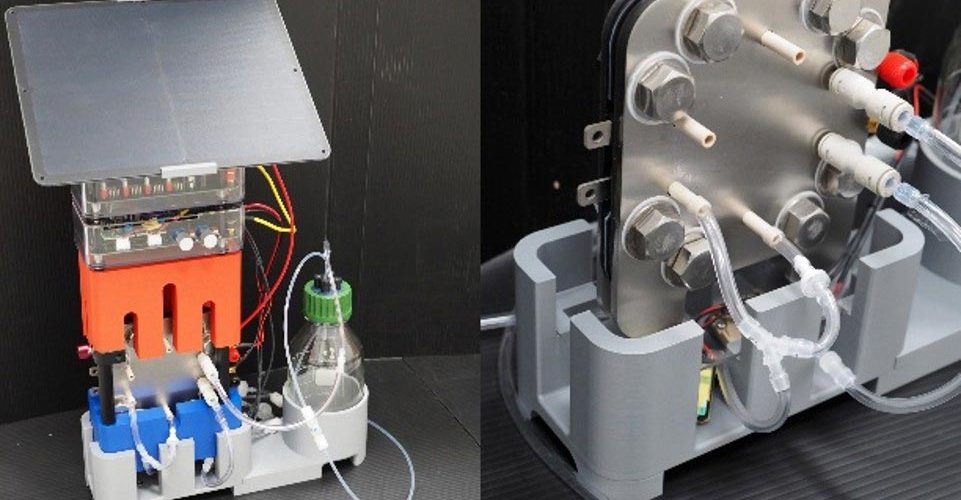
The research, led by Associate Professor Yasuo Matsubara and Professor Yutaka Amao at the university’s Research Centre for Artificial Photosynthesis, describes an electrochemical system that converts carbon dioxide and water into formic acid using only sunlight. No battery. No external control electronics. The system regulates itself. That last detail is what makes this work stand out from earlier research on artificial photosynthesis for solar fuel.
Formic acid might not sound glamorous, but it is a useful energy carrier. It is liquid at room temperature, relatively safe to handle, and can be converted back into hydrogen and carbon dioxide on demand, releasing energy in a fuel cell. It is also used directly in some industrial processes. The challenge with producing it from sunlight has always been managing the source’s variability. Clouds pass. Angles change. A solar panel’s output fluctuates constantly, and most electrolysers, the devices that use electricity to drive chemical reactions, are unhappy with inconsistent input. Feeding variable power into a fixed electrolyser wastes energy and can damage the device.
In grid-connected solar systems, this problem is handled by electronics called maximum power point trackers, or MPPT controllers. These devices continuously adjust the electrical load to extract the maximum power available from a solar panel as conditions change. They are effective but add cost and complexity. Matsubara and Amao’s approach eliminates them by building the tracking behaviour into the electrolyser itself.
The key is the solid electrolyte at the heart of the device. Most electrolysers use liquid electrolyte solutions that do not change their electrical properties with temperature. This team used a material whose impedance, its resistance to the flow of alternating current, changes predictably with temperature. As sunlight intensifies, the electrolyser absorbs more light and heats up. As it heats, the impedance of the solid electrolyte drops. As the impedance drops, the electrical current flows more freely. The device automatically draws more power when more power is available and less when the sun dims. It tracks the maximum power point without any silicon, software, or external circuit.
The concept was tested not just under laboratory lamps but under real outdoor sunlight in Osaka, with all the unpredictability that entails. Clouds drifted over. The angle of the sun shifted. The system kept working. It was also demonstrated at the Osaka Kansai Expo 2025, where it powered a miniature diorama, a small but visible proof that the chemistry and physics are functioning as intended.
The work was done in collaboration with Iida Group Holdings Co., Ltd, and published in the journal EES Solar. The involvement of an industrial partner signals that the research is being developed with practical applications in mind rather than remaining purely in the academic register.
What self-regulation means for scale
Removing the MPPT controller does more than simplify the circuit. It removes a failure point, reduces maintenance requirements, and lowers the cost of each unit. If artificial photosynthesis solar fuel systems are ever to be deployed on a large scale, perhaps in distributed arrays in sunny regions, the economics need to work without expensive electronics in every module. A self-contained, mechanically simple system is far easier to deploy and maintain than one that requires specialist electronic components.
The formic acid output is modest at prototype scale. Scaling the reaction rate to industrially meaningful volumes requires significant engineering work on electrode surface area, catalyst loading, and the mass transport of carbon dioxide to reaction sites. These are known problems with known approaches, but they require sustained effort. The Osaka team has demonstrated that the concept of self-regulation works. The next stage is making it work bigger.
Engineering Deep Dive: Electrolysers, Impedance, and the Physics of Self-Regulation
To understand what Matsubara and Amao built, it helps to start with what an electrolyser actually does. An electrolyser uses electrical energy to drive a chemical reaction that would not occur on its own, or would occur far too slowly at room temperature without an energy input. In this case, the reaction is the reduction of carbon dioxide to formic acid (HCOOH) and the oxidation of water to oxygen. At one electrode, CO2 gains electrons and combines with protons from water to form formic acid. At the other end, water loses electrons and releases oxygen gas. The overall reaction is energetically uphill: you have to put energy in to make it go.
The energy comes from a photovoltaic cell that converts sunlight into direct current. The challenge is that a photovoltaic cell’s output voltage and current depend on the amount of light it receives, and both cloud cover and solar angle vary. If you connect a solar panel directly to an electrolyser without any matching circuit, the two devices will almost certainly be mismatched. The electrolyser might demand more current than the panel can provide, causing the voltage to sag. Or the panel might be capable of delivering more power than the electrolyser is drawing, wasting potential output. Maximum power point tracking is used to address this mismatch.
MPPT works by continuously measuring the solar panel’s output voltage and current and adjusting the electrical load, typically via a DC-DC converter, to keep the operating point at the peak of the panel’s power-versus-voltage curve. This peak shifts as light intensity changes. On a bright day, the maximum power point sits at a higher voltage than on an overcast day. A well-designed MPPT controller can extract 10 to 30 per cent more energy from a solar panel over a full day compared to a fixed-load connection.
What the Osaka team realised is that you can achieve automatic tracking without any active electronics if the electrolyser’s own electrical characteristics change with temperature in the right way. The relevant property is impedance. In alternating current circuits, impedance is the total opposition to current flow, combining resistance (which dissipates energy as heat) and reactance (which stores and releases energy in capacitors and inductors). For the solid electrolyte used in this device, the ionic conductivity, and therefore the impedance, is temperature-dependent. Higher temperature means lower impedance, which means the device presents a lower effective resistance to the solar panel.
Now consider what happens when sunlight increases. The solar panel produces more power. Some of that power is absorbed by the electrolyser as heat, raising its temperature. The temperature rise lowers the impedance. The lower impedance allows more current to flow for a given voltage. The operating point shifts automatically towards the solar panel’s new maximum power point. When sunlight decreases, the electrolyser cools slightly, impedance rises, current falls, and the system retreats to a lower power draw. The tracking is not as perfect as that of an electronic MPPT controller, but it is continuous, passive, and requires no additional components.
The catalyst at the electrodes matters too. Reducing CO2 to formic acid is a two-electron process: each molecule of CO2 takes up two electrons and two protons to become HCOOH. Selectivity is a significant challenge. Other reactions compete, particularly the reduction of protons to hydrogen gas. A catalyst that produces lots of hydrogen and little formic acid is not useful for this application. The Osaka team used catalyst materials chosen for their selectivity towards formic acid production, though the exact compositions are specific to the published research. The solid electrolyte also facilitates proton transport between the two electrode compartments, playing a role analogous to that of the membrane in a hydrogen fuel cell.
For A-level students, the connections to the Physics curriculum are direct. Ohm’s law and resistance underpin the impedance behaviour. Faraday’s laws of electrolysis describe how the amount of chemical product depends on the charge passed. The photovoltaic effect connects to quantum physics and the photoelectric effect. And the thermodynamics of the reaction, whether it requires an energy input or releases energy, is linked to enthalpy and Gibbs free energy. The Osaka experiment is, in essence, several A-level topics running simultaneously in a single small device.
Artificial photosynthesis solar fuel research has been steadily moving from laboratory curiosity towards engineering reality over the past two decades. The Osaka system does not yet produce fuel at a scale sufficient to power a town or even a street. But the self-regulating electrolyser removes one of the persistent obstacles to practical deployment. For students interested in chemical engineering, electrochemistry, or renewable energy systems, understanding how this kind of passive feedback works, and where its limits lie, is worth more than the headline number. The engineering is in the detail.
- Osaka Metropolitan University built an artificial photosynthesis system that produces formic acid from CO2 and water without needing batteries
- The system’s solid electrolyte self-regulates voltage by adjusting its thermal and impedance properties as sunlight fluctuates
- Removing batteries and external electronics makes the system simpler and cheaper to build
- The prototype was successfully tested under real outdoor sunlight and showcased at the Osaka Kansai Expo 2025