Shipping contributes approximately three per cent to global greenhouse gas emissions. There has been a lot of discussion among various organisations regarding the need to deal with this issue. CMB.TECH has responded to it by putting the world’s first ammonia-powered ship into commercial operation.
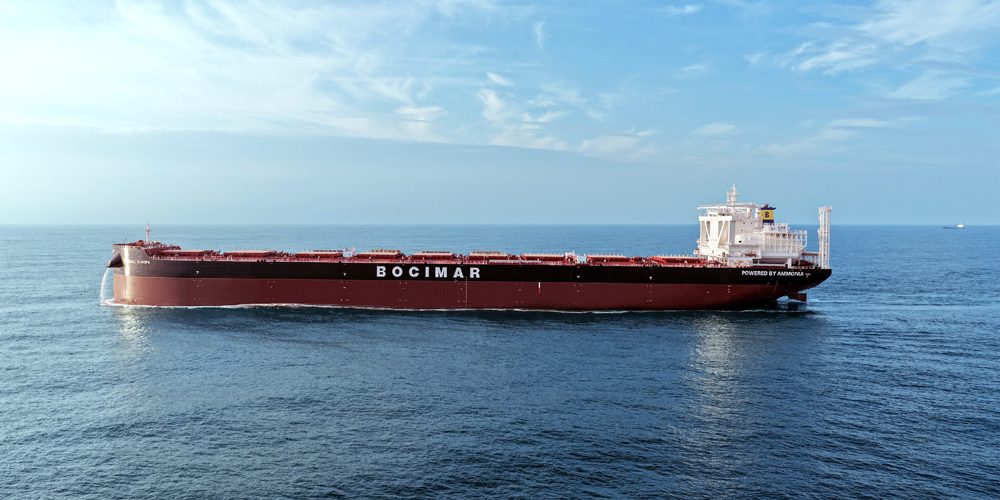
The Mineral Europa, a bulk carrier having a deadweight tonnage of 210,000 tonnes and a length of 300 metres from stem to stern, was built at the Qingdao Beihai Shipyard in China and is currently on its first trip, carrying iron ore for Fortescue, the large Australian mining company, from Western Australia to ports in Asia. The ship’s dual-fuel engine can run on standard marine fuel or on green ammonia, which is produced using renewable energy. As the shipping industry regards even minor fuel savings as a form of progress, this is a major advance.
Inside the Ammonia Powered Ship’s Engine Room
The propulsion system of Mineral Europa employs a WinGD X-DF-A two-stroke engine. This engine, made by WinGD of the China State Shipbuilding Corporation, was designed for use with ammonia as fuel and has the capability of switching between diesel oil and ammonia while the ship is operating, giving it the flexibility needed in situations where ammonia is not available at each port.
Ammonia, NH3, contains no carbon; when it is burned it produces nitrogen and water rather than carbon dioxide. Which is the reason why it is seen as a promising fuel for use in the shipping industry, at least in theory. Yet because of practical difficulties most of the industry have just been content to remain on the sidelines. Ammonia is toxic, corrosive and the way in which it burns is very different from that of diesel. It has therefore been necessary to completely redesign all of the engine components, the fuel handling systems and the crew safety procedures.
During several years of development, CMB.TECH’s method tackled these problems by initially trying out ammonia propulsion on smaller vessels, such as a tugboat and a crew transfer vessel, before proceeding to a full-scale bulk carrier; the operational data gathered from those earlier projects then had an effect on the design and safety systems of Mineral Europa.
The green ammonia, which is produced by CEEC, is the fuel used on the first trip. This type of ammonia is made by first using electrolysis to split water into hydrogen, the process being powered by renewable electricity, and then combining that hydrogen with nitrogen taken from the air through the Haber-Bosch process. The word “green” means that fossil fuels are not used in the manufacturing process. Even though conventional ammonia - that is made from natural gas - has the benefit of burning without producing carbon dioxide, it does so at the expense of the emissions generated during hydrogen production.
Europa’s Mineral is not merely a standalone technology demonstrator; CMB.TECH, through its subsidiary Bocimar, has ordered 21 bulk carriers which are capable of carrying ammonia, the deliveries for which are to take place by 2029. The size of this commitment demonstrates genuine confidence in the technology and shows that the company is aware that the increasingly strict emissions regulations introduced by the International Maritime Organisation leave no room for hesitation.
The fact that Fortescue is taking part in the arrangement gives it a commercial credibility. The company has based its reputation on the decarbonisation of heavy industry, so securing a long-term charter for ammonia-fuelled ore carriers is consistent with that strategy. The green hydrogen and ammonia production capacity which Fortescue is developing at a number of sites in Australia may some day supply the fuel for the ships that transport its products. A system which operates from mine right through to port and on back during the return trip is the type of integrated approach that is likely to please shareholders.
The shipping industry as a whole is closely watching how things are developing. Maersk has made the choice to use container ships driven by methanol, while at the same time certain operators are considering the use of LNG as a temporary fuel. Ammonia has its own benefits; it is energy-dense when stored as a liquid at moderate pressure, does not have to be stored at cryogenic temperatures like hydrogen, and can be produced from renewable electricity by means of the current industrial chemistry, which has been improved upon over the past century.
Engineering Deep Dive
The WinGD X-DF-A engine works on a two-stroke, low-speed cycle, this being typical of large marine engines. In ammonia mode it uses a diesel pilot injection to initiate combustion because ammonia has a high auto-ignition temperature of about 651 degrees Celsius and therefore cannot be reliably ignited by compression alone; the pilot fuel accounts for approximately five per cent of the total energy input.
The lower heating value of ammonia is roughly 18.6 megajoules per kilogram, compared with about 42.7 MJ/kg for marine diesel oil. This means that the vessel must carry around 2.3 times the volume of ammonia in order to obtain the same amount of energy as diesel. In order to allow for this, the fuel tanks on the Mineral Europa have pressure vessels which have been specially designed for the conditions needed to store ammonia, the pressure in these being normally about 10 bar at ambient temperature.
Safety measures include the employment of redundant gas detection systems in both the engine room and in the areas where fuel is handled. The fact that ammonia has a sharp odour which can be detected at concentrations well below those that are hazardous - approximately 5 parts per million - provides a natural early warning. However, owing to the characteristics of enclosed spaces, it is necessary to have mechanical ventilation as well as automatic shut-off valves in order to prevent the accumulation of ammonia.
The SCR unit used in the ship’s exhaust after-treatment system serves the purpose of controlling nitrogen oxide emissions. Although the combustion of ammonia does not cause the formation of CO2, the high-temperature reaction can result in the production of NOx, in particular at the spot where the ammonia flame comes into contact with the diesel pilot injection. The SCR system then catalytically converts the NOx back into harmless nitrogen and water.
What It Means for the Future of Shipping
The economic aspects of ammonia-based shipping are still uncertain; at present green ammonia is much more expensive than conventional marine fuel, but the gap is narrowing since the price of renewable electricity is continually falling, and the possibility of introducing a carbon price for the shipping industry - something which is expected under IMO regulations from 2027 - could have a major impact.
There are yet some technical problems to be dealt with. The facilities required for bunkering ammonia are almost non-existent. It will be necessary to set up new certification schemes in order to train crews how to handle a toxic fuel at sea. Furthermore, since ammonia has a lower energy density there is a loss in efficiency, which implies that the fuel tanks have to be bigger, either reducing the quantity of cargo that can be carried or requiring new hull designs.
Even so, CMB.TECH has managed to expand its operations. For engineering students who are considering a career in marine propulsion, the information transmitted by Mineral Europa is something that merits attention; the engines are being altered, the fuels are being changed, and the companies that are choosing to build on a large scale rather than waiting for someone else to lead are setting the standard for the next generation of ships.
- CMB.TECH has launched the Mineral Europa, the world’s first ammonia powered ship in commercial service
- The 210,000 dwt bulk carrier uses a WinGD X-DF-A dual-fuel engine that switches between diesel and green ammonia
- The vessel is carrying iron ore for Fortescue on its maiden voyage to Australia
- CMB.TECH has ordered 21 ammonia-capable bulk carriers for delivery by 2029
- Ammonia produces no carbon dioxide when burned, offering a pathway to zero-carbon shipping