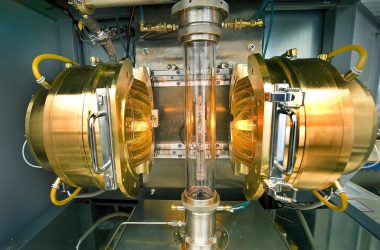
Titanium is a metal engineers use in many applications, such as hip replacements and fighter jets; it is strong, resists corrosion, and is lighter than steel. However, the idea of it floating was never part of the original proposal. Researchers at RMIT University in Melbourne have changed this by producing a floating titanium metamaterial. This 3D-printed composite is carefully structured to sit on water like a cork, even though it is 70 per cent stronger than stainless steel at the same density.
The study, which was published in the journal Advanced Materials in October 2026, might open up new possibilities for use in marine structures, aerospace components and biomedical implants. At the same time it calls into question some long-held assumptions regarding what metals can and cannot do.
Titanium has a density of about 4.5 grams per cubic centimetre, roughly four and a half times that of water. If you dropped a piece into the ocean, the outcome would be as expected. For this reason, Dr Jordan Noronha and Professor Ma Qian’s team at RMIT adopted an indirect method.
Instead of altering the chemistry of titanium, they modified its structure. Using laser powder bed fusion, a type of metal 3D printing, they created a complex lattice structure from a titanium alloy. Imagine a scaffold made of thin, interconnected struts arranged in a repeating geometric pattern. Each strut is solid titanium, but the lattice as a whole contains much empty space.
The researchers added closed-cell polyurethane foam into that space; the foam fills the gaps in the lattice and gives buoyancy while the titanium frame carries the structural load. The end product is a composite material whose total density is less than 1 gram per cubic centimetre, which is the density level at which objects will float in water.
Noronha said that the concept they had was skeletal density. Instead of measuring the density of bulk titanium, the team designed the floating titanium metamaterial so that the combined density of the lattice and foam was less than that of water. This is a structural rather than a chemical method.
A material is only of interest if it is capable of withstanding the conditions it would actually face, and the RMIT team carried out a series of tests to find out.
Samples of the floating titanium metamaterial were left in simulated seawater for over two months. The mass loss was negligible, only 0.15 per cent, indicating excellent corrosion resistance. The titanium lattice prevented the internal foam from deteriorating, while the foam kept seawater from collecting in the lattice voids.
The material was mechanically tested by applying compressive loads to determine failure modes that could limit its use. The specimens resisted both cracking and layer fracture, two common failure mechanisms in lattice composites. Using flexible foam with rigid titanium ensured stresses were transmitted throughout the structure instead of concentrating at weak points.
At the same overall density, the metamaterial was 70 per cent stronger than stainless steel. This comparison matters because stainless steel is widely used in marine engineering, such as in ship hulls and offshore platform components. That a floating material matches or exceeds this strength marks a real advance.
Engineering Deep Dive
The Ti-6Al-4V alloy, the most commonly used titanium alloy in engineering, was used to print the titanium lattice. Using laser powder bed fusion, the component is built layer by layer by melting metal powder with a concentrated laser beam. The lattice geometry was based on a body-centred cubic unit cell, with strut diameters ranging from 200 to 500 micrometres.
The rigid, closed-cell polyurethane foam used had a density of about 0.04 g/cm³. Closed-cell foams trap gas in separate bubbles rather than creating connected channels, preventing water from entering and ensuring buoyancy is maintained over time.
The most important engineering factor was the volume fraction of titanium in the lattice. If the metal amount was too high, the composite would sink; if too low, the material would lack adequate structural integrity. The team found that a titanium volume fraction between 8 and 15 per cent offered the best compromise - low enough to float and high enough to carry significant loads.
The highest compressive strength achieved by the samples was over 45 megapascals, similar to certain aluminium alloys used in aerospace structures. Young’s modulus, a measure of stiffness, changed predictably with volume fraction, allowing engineers to adjust the metamaterial’s properties for specific applications.
The clearest applications are in marine engineering. Using floating structural components could reduce the weight of offshore platforms, buoys, and underwater vehicles. For submarine design, a hull material that provides structural strength while aiding buoyancy rather than opposing it would fundamentally change how naval architects perform displacement calculations.
The idea could also apply in aerospace. Reducing component mass has always been a top priority in aircraft and spacecraft design. A metamaterial that provides titanium-quality strength at a small fraction of the weight might be used in fairings, panels, and other secondary structures, where loads are moderate but weight savings add up.
It is worth watching biomedical implants. Titanium is currently preferred for joint replacements and bone plates because the body tolerates it well. A porous, lighter type could better resemble natural bone’s mechanical properties and reduce stress shielding, which over time can weaken bone around a solid implant.
The RMIT team admits scaling up production remains difficult. Laser powder bed fusion is expensive, and making large lattice components requires careful quality control at each layer. However, the basic principle of combining an engineered metal structure with a lightweight filler could apply to other metals and manufacturing techniques as additive manufacturing develops.
Currently, the floating titanium metamaterial is in a Melbourne laboratory, bobbing in a tank of salt water. It has done so for two months without signs of failure. In materials science, where breakthroughs often take decades to move from lab to application, such patience is a good sign.
- RMIT University has created a titanium metamaterial that floats on water despite being 70% stronger than stainless steel at the same density
- The composite uses a 3D-printed titanium lattice filled with closed-cell polyurethane foam to achieve a density below 1 g/cm³
- Samples survived over two months in simulated seawater with just 0.15% mass loss
- Potential applications include marine structures, aerospace components, and biomedical implants