Aerospace, Defence & Marine
Plans for the West Somerset Lagoon would place 125 turbines in a curved wall of concrete caissons between Minehead and Watchet, turning the Bristol Channel's huge tides into electricity, with completion targeted for 2038.
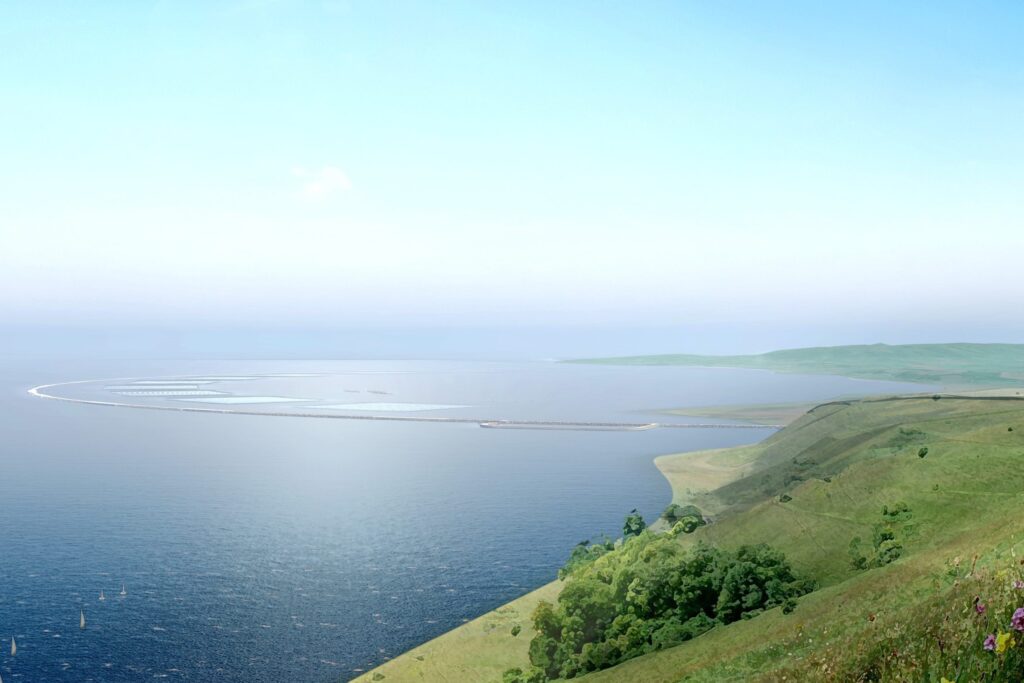
The proposed West Somerset Tidal Lagoon project has unveiled plans for a marine engineering structure, estimated to cost between £10bn and £10.9bn[1][2], designed to capture and convert the Bristol Channel’s powerful tidal forces.
The project plans to span nine miles between Minehead and Watchet[3] and incorporate 125 turbines[4][5] within a semicircular array of concrete caissons.
Tidal lagoons function through the interplay of natural forces and engineered systems. At their core, these structures create an artificial basin that captures and releases tidal water through strategically placed turbines. The process begins as the tide rises, filling the lagoon through sluice gates and turbines. As water levels equalise, the gates close, creating a height differential between the lagoon and the receding tide.
This differential reverses the turbines as water flows back to the sea. The cycle repeats with each tidal movement, roughly four times daily in the Bristol Channel[6]. The system’s efficiency stems from the predictable nature of tidal movements, allowing precise calculation of power generation potential.
The Bristol Channel’s unique geography amplifies this effect. Its funnel shape and depth profile create the world’s second-highest tidal range, exceeding 10 meters[7][8]. The proposed lagoon’s location is designed to maximise this natural advantage while remaining outside significant shipping channels and environmentally sensitive areas.
A tidal lagoon harnesses one of nature’s most reliable forces through a feat of modern engineering that would have been impossible decades ago. At first glance, the principle seems simple: create an artificial lake with the ocean as your tap. However, the complexity of engineering lies in managing forces that could tear apart conventional structures.
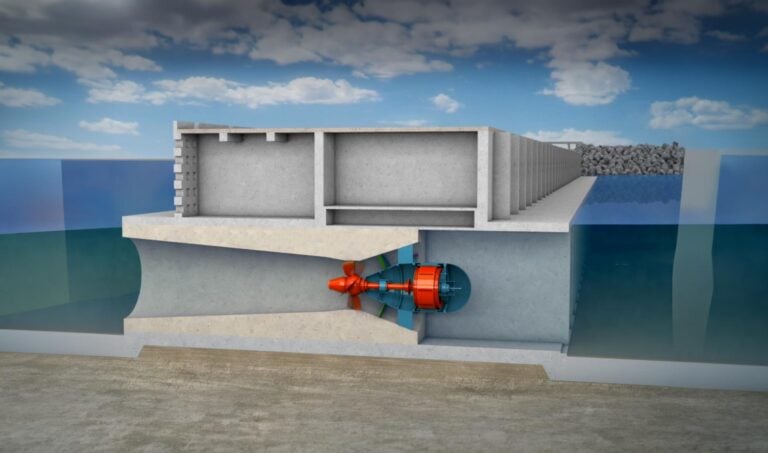
The heart of these systems consists of massive concrete caissons, each weighing as much as thirty blue whales. These structures house the turbines and must withstand forces equivalent to continuous battering from high-speed trains. Modern computational fluid dynamics has revolutionised their design, allowing engineers to model and counter every ripple and surge of the Bristol Channel’s powerful tides.
Inside each caisson, variable-speed turbines represent a triumph of adaptive engineering. Unlike their predecessors, which could only generate power as water flowed in one direction, these sophisticated machines work like a mechanical heart valve, extracting energy as water flows both in and out. Computer-controlled systems continuously adjust the blade angles, like a pilot trimming aircraft flaps, to maintain peak efficiency regardless of tidal conditions.
Standard concrete would fail within years in the harsh marine environment. Instead, engineers have developed specialised mixtures that can withstand decades of saltwater assault while maintaining structural integrity. These advanced materials incorporate sophisticated additives that actively resist corrosion and heal minor cracks before they threaten the structure.
Perhaps the most overlooked engineering achievement lies beneath the waves. Modern seabed preparation techniques employ underwater robots that would look at home in a space mission. These machines precisely level the seabed, laying foundations that must remain stable for over a century. GPS-guided positioning systems, accurate to within millimetres, ensure each massive caisson slots into place like pieces in a giant mechanical puzzle.
Tidal energy arrives in predictable but irregular pulses. Modern control systems, running algorithms that would take a human mathematician years to compute, balance these pulses against grid demand in real-time. The result is a steady stream of electricity from an inherently variable source.
Environmental protection drives innovation throughout the design. Advanced acoustic systems create invisible barriers that guide fish away from turbines, while precisely engineered water passages ensure marine life can navigate safely around the structure. Real-time monitoring systems, using technology developed initially for deep-sea exploration, track everything from water quality to fish movements, allowing operators to fine-tune the system’s environmental impact.
The engineering design centres on various bi-directional turbines housed within concrete caissons. Each caisson serves multiple functions: supporting the turbine assembly, providing maintenance access, and forming part of the lagoon’s structural backbone. The 200-plus caisson array[9][10] creates a semicircular barrier, forming an engineered bay.
The turbine system incorporates variable-speed generators, allowing optimal power extraction across different tidal conditions. Control systems adjust blade angles and rotation speeds to maximise efficiency during filling and emptying cycles. This bidirectional capability doubles the power generation opportunities compared to single-direction systems.
Power storage and grid integration present significant engineering challenges. The project includes a 35-acre battery storage facility near Doniford[11], designed to smooth out power delivery to the grid. This system enables consistent electricity supply despite the intermittent nature of tidal generation.
This means that the construction process involves the precise positioning of massive concrete caissons in the challenging marine environment of the Bristol Channel. Each caisson requires careful foundation preparation on the seabed and exact placement to maintain the lagoon’s structural integrity. The project team plans to use specialised marine construction vessels for this phase.
Marine locks at Minehead and Watchet integrate into the structure, maintaining access for commercial and recreational vessels[12][13]. These locks represent complex engineering subsystems, requiring coordination between tidal power generation and maritime traffic needs.
The design incorporates multiple environmental engineering features. The positioning avoids significant river systems and Special Areas of Conservation[14], while the structure itself may provide additional coastal protection against storms and rising sea levels. The turbine design includes fish protection systems and carefully calculated flow rates to minimise marine life impact.
The lagoon would have a generating capacity of 2,500MW[1], compared with 3,260MW for Hinkley Point C[15]. The long-term energy contribution becomes significant with an operational lifespan of 120 years – double that of nuclear installations[16]. The lagoon’s estimated cost compares with £31bn to £34bn (in 2015 prices) for Hinkley Point C[17].
Alongside producing power, the project would include substantial coastal infrastructure improvements. The design incorporates a public walkway around the perimeter, new marina facilities, and coastal protection elements[18][19]. These additions aim to integrate the engineering project with local community needs.
Construction could begin in the early 2030s if approved, with completion targeted for 2038[20]. The project team has secured preliminary land agreements[21] and is advancing detailed engineering studies. The implementation strategy includes phased construction to minimise local disruption and optimise resource utilisation.
The West Somerset Lagoon could represent one of the most sizeable steps forward in renewable energy engineering in the UK in decades. Its success could establish a template for similar projects in high-tidal-range locations worldwide. As engineering teams refine the design and environmental studies continue, the project’s viability as a long-term clean energy solution becomes more apparent.
Credit via newcivilengineer.com
£10.9bn Somerset tidal power proposal will bring flood defence, social and transport benefits
The team behind proposals for a £10.9bn Somerset tidal lagoon with 2,500MW capacity
Checked 18 November 2026
Plans for new £10bn tidal lagoon in Bristol Channel
This tidal lagoon, if it happens, will take ten years and it's going to cost £10bn
Checked 18 November 2026
£10.9bn Somerset tidal power proposal will bring flood defence, social and transport benefits
The proposal is for a 22km long semi-circular concrete embankment to be built between the towns of Watchet to Minehead, on the southern side of the Bristol Channel. This would span about 14km of coast
Checked 18 November 2026
£10.9bn Somerset tidal power proposal will bring flood defence, social and transport benefits
the proposal includes 125 bi-directional turbines positioned in five groups of 25.
Checked 18 November 2026
The proposed layout consists of 125 bulb turbines of 7.2 m diameter and capacity 20 MW, thus providing a total generating capacity of 2500 MW.
Checked 18 November 2026
flow in and out of the lagoon's 125 bulb turbines to generate electrical energy, producing four periods of energy every 24 hours.
Checked 18 November 2026
West Somerset Lagoon | Tidal Energy
between Minehead and Watchet to take advantage of the world's second highest tidal range
Checked 18 November 2026
where the tides reach one of the world's highest ranges of over 10 metres
Checked 18 November 2026
Plans for new £10bn tidal lagoon in Bristol Channel
The tidal lagoon would comprise more than 200 concrete caissons in the Bristol Channel, arranged in a semicircle between Minehead and Watchet.
Checked 18 November 2026
206 concrete caissons built in Severn Estuary / Bristol Channel ports
Checked 18 November 2026
Plans for new £10bn tidal lagoon in Bristol Channel
The project team were in the middle of buying about 35 acres towards Doniford to put in the batteries
Checked 18 November 2026
Plans for new £10bn tidal lagoon in Bristol Channel
There would be locks within the lagoon structure at Minehead and Watchet, allowing the towns' harbours to continue both commercial and leisure operations.
Checked 18 November 2026
Locks near the Minehead and Watchet landfalls.
Checked 18 November 2026
The lagoon site has been carefully chosen to be outside designated conservation areas, including the Special Area of Conservation (SAC)
Checked 18 November 2026
The planned twin unit UK EPR is capable of generating 3,260MW of secure, low carbon electricity for 60 years.
Checked 25 October 2026
£10.9bn Somerset tidal power proposal will bring flood defence, social and transport benefits
Compared to the expected lifespan of a plant like Hinkley Point C, which is 60 years, the tidal lagoon will have at least double that at 120 years
Checked 18 November 2026
The costs of completing the project are now estimated at between £31 billion and £34 billion in 2015 values.
Checked 18 November 2026
Plans for new £10bn tidal lagoon in Bristol Channel
They're going to put a walkway around it – you'll be able to walk around the lagoon.
Checked 18 November 2026
£10.9bn Somerset tidal power proposal will bring flood defence, social and transport benefits
There is also a proposal for a 300-boat marina as part of the embankment. The space atop the embankment itself will be fully traversable for cyclists, runners or walkers.
Checked 18 November 2026
£10.9bn Somerset tidal power proposal will bring flood defence, social and transport benefits
Construction of the project would then take place between 2032 and 2037, with first energy being generated in 2037. It would come fully online in 2038.
Checked 18 November 2026
Plans for new £10bn tidal lagoon in Bristol Channel
the Luttrell Estate has agreed to let us have the land
Checked 18 November 2026
Aerospace, Defence & Marine
Electronics & Communications
Electronics & CommunicationsBreakthroughs