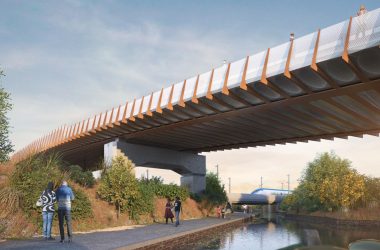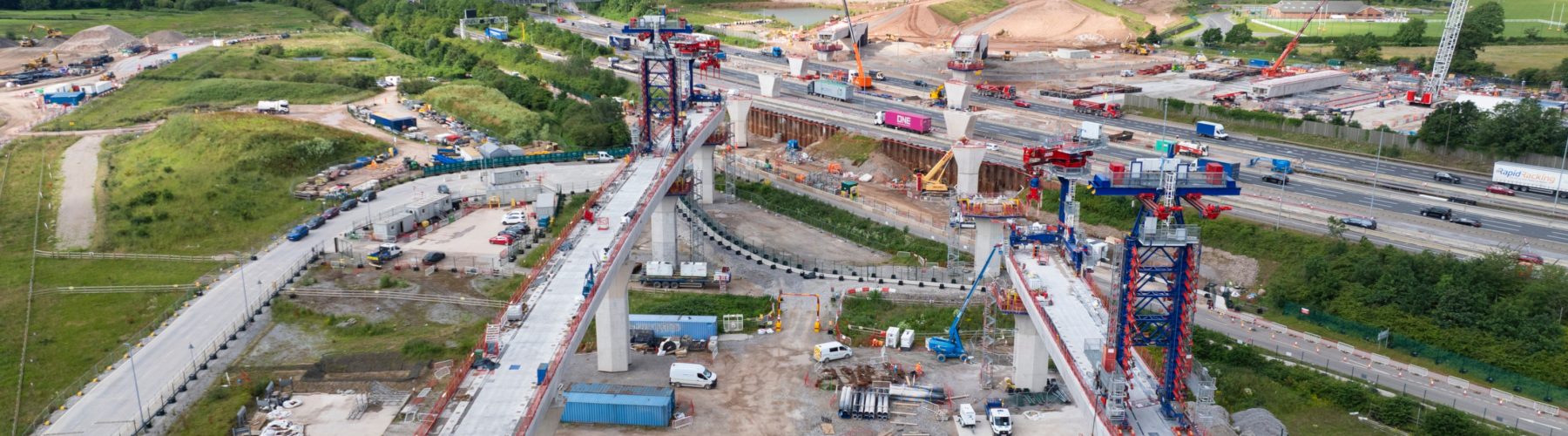
Between junctions 6 and 7a of the M42, just east of Solihull, a 300-metre-long concrete structure is being built above one of the West Midlands’ busiest motorways.
The HS2 M42 twin box structure will carry high-speed trains over a 130-metre stretch of road while thousands of vehicles pass underneath, mostly unaware of the work above. It is one of the most challenging parts of the 140-mile railway between London and the West Midlands, and this summer, the biggest lifts are happening.
The structure is named for its two rectangular sections that make up the railway deck. To build it, engineers from Balfour Beatty VINCI (BBV) and subcontractor Expanded are lowering 175 prefabricated concrete beams into place. Each beam weighs between 56 and 92 tonnes, about as much as a fully loaded Boeing 737 at the heaviest, and they fit into a space only just wider than the motorway.
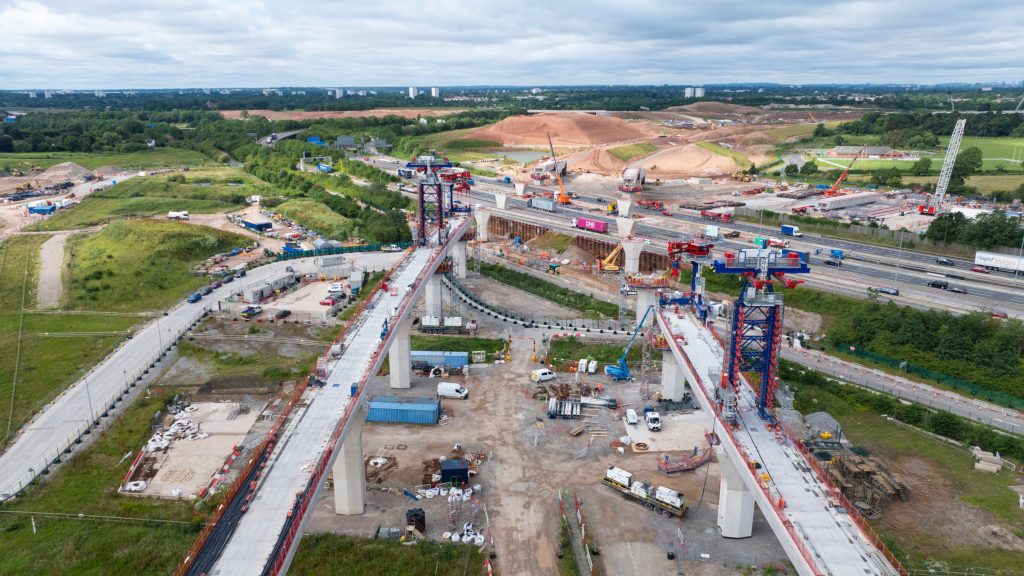
Since closing a major road for months was not possible, the team planned four weekend closures during the summer of 2026. In the first closure in late June, they installed 50 beams, which was seven more than planned. The second closure in late July added 44 more beams over the northbound lanes. Two more weekends in August and September will finish the job. Each closure lasts from Friday night to Monday morning, giving crews about 60 hours to lift beams into place, check their alignment, and secure them before reopening the road.
Agnes Usciak, HS2’s Senior Project Manager, called this summer “the most significant programme of work yet to carry HS2 over the motorway network.” Oliver Shore, BBV’s Project Director, highlights that engineers are working day and night on two main tasks: building the box structure and, nearby, extending two Water Orton viaducts across the same motorway.
The Water Orton viaducts, each about 1,200 metres long, bring a different challenge. Instead of using individual beams, their M42 crossing uses six spans, each 45 metres long and nearly 1,000 tonnes in weight. The 108 segments for these spans were put together on land next to the road, then moved into place by self-propelled modular transporters. These are flat platforms with many axles that move slowly under heavy loads, spreading the weight across many wheels so the ground stays stable.
National Highways has worked with BBV to plan detours and reduce disruption during closures. The modular approach for both the twin box structure and the viaduct spans is intentional. By making parts off-site and putting them together quickly during short closures, engineers avoid the slow and weather-dependent process of pouring concrete above live traffic. This idea comes from manufacturing, where using standard parts and factory conditions gives more reliable results than working outdoors.
Engineering deep dive: inside the HS2 M42 twin box structure
Why a twin box?
A box girder is a hollow beam with a closed shape, usually rectangular or trapezoidal. The “twin” in the HS2 M42 twin box structure means there are two of these girders side by side, one for each rail track. Box girders handle twisting forces much better than open I-beams because their closed shape lets shear stresses move in a loop. If you have studied A-level physics, you can think of torsion as a couple acting along the beam. An open section bends under this force, but a closed box section resists it.
This matters for a railway bridge. When a 200-metre-long train travels, this is important for a railway bridge. When a 200-metre-long train moving at up to 360 km/h crosses the bridge, it creates moving loads that quickly shift from side to side. If one track has more weight, an open girder could twist, changing the rail shape and possibly making the train unstable. The twin box design keeps these movements small and predictable. Stored in a controlled environment away from the motorway, then transported to site on multi-axle low-loaders. Prefabrication offers three advantages that A-level physics and materials science students will recognise.
First, quality control. Concrete needs the right temperature and humidity to cure properly. In a factory, engineers can keep conditions ideal - about 20 degrees Celsius and high humidity for Portland cement - so the concrete has a more even structure with fewer gaps. Fewer gaps mean stronger concrete. Concrete is good at handling pressure but not pulling forces, so the beams are pre-stressed with steel tendons to keep them under pressure and balance out the pulling forces from traffic later on.
Second, speed. By making and testing the beams off-site, the motorway only needs to close for lifting and connecting the beams, not for waiting 28 days for the concrete to get strong enough.
Third, repeatability. Using standard molds makes beams with the same size, which makes it easier to line them up during installation. High-speed rail bridges need very tight tolerances. The track must be accurate within a few millimetres for safe travel, so every beam has to fit exactly on its supports.
How the beams are installed
During each weekend closure, mobile cranes stand over the road and lift beams from nearby staging areas. The heaviest beams, weighing 92 tonnes, need cranes that can lift over 200 tonnes. These cranes are set up on ground that has been checked and reinforced to handle the weight. Riggers guide each beam into place with ropes, then set it onto elastomeric bearings - rubber and steel pads that let the beam move a little with temperature changes without passing harmful forces to the structure below.
The Water Orton viaduct spans
The twin box structure uses many smaller beams, but the Water Orton viaducts use fewer, much larger spans. Each 45-metre, 1,000-tonne span was built from precast segments that were glued and tightened together on the ground, then moved sideways or lengthwise into place by self-propelled modular transporters (SPMTs). SPMTs are computer-controlled platforms with many steerable axles. They can turn, move sideways, and even change height, letting operators move a 1,000-tonne load around obstacles with centimetre accuracy.
A-level connections
This project uses ideas from A-level mechanics, like moments, equilibrium, and stress analysis, as well as material properties and Young’s modulus from materials science. Thermal expansion explains why elastomeric bearings are used. Students taking further mathematics will see the torsion problem as an example of second moments of area.
The last two weekend closures in August and September 2026 will finish the HS2 M42 twin box structure and the Water Orton viaduct crossings. After the beams and spans are set, crews will move on to waterproofing, building the track slab, and installing rail systems. For the thousands of drivers who use the M42 every day, the finished bridge will just be a shadow above. For the engineers who built it, weekend after weekend and beam by beam, it will mean much more.
- HS2 engineers are installing a 300-metre-long twin box structure to carry high-speed trains over the M42 motorway near Solihull
- 175 prefabricated concrete beams, each weighing 56 to 92 tonnes, are being craned into place over four weekend motorway closures in summer 2026
- Nearby, two 1,200-metre Water Orton viaducts are being extended over the same motorway using six 1,000-tonne spans moved by self-propelled modular transporters
- The modular, off-site fabrication approach minimises disruption to live traffic and improves quality control