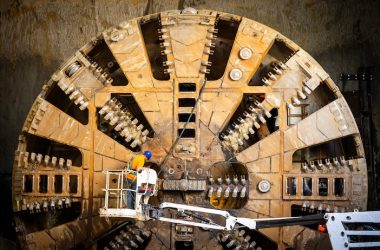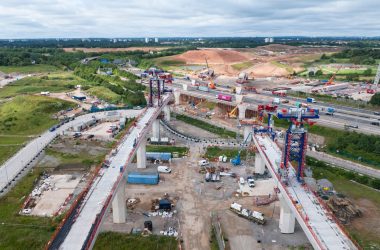
In Schwanau, southwest Germany, Herrenknecht engineers are designing a tunnel boring machine so large it must be shipped to Britain by sea. The Lower Thames Crossing machine will measure 16.4 metres in diameter, 120 metres in length, and weigh over 5,000 tonnes. Scheduled to begin work in 2028, it will be the largest tunnel boring machine in Europe and the third largest globally.
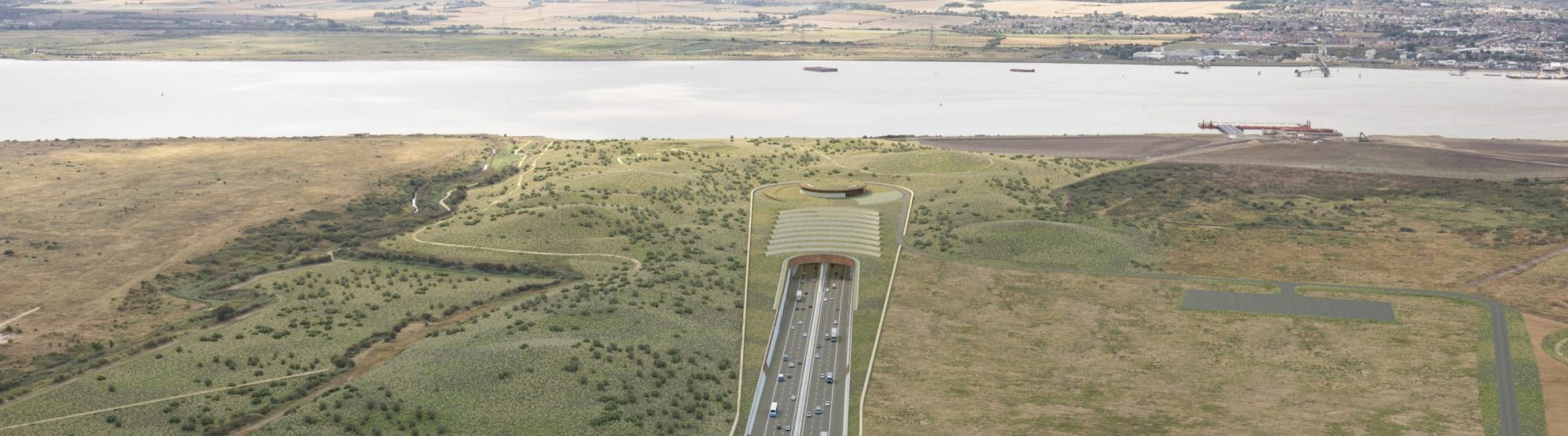
National Highways confirmed the selection in July 2026, marking a key milestone for the £11 billion project. The Lower Thames Crossing tunnel boring machine will excavate two parallel tunnels beneath the Thames east of London, each accommodating three lanes of 70 mph traffic. Combined, they will create the UK’s longest road tunnel at 4.2 kilometres, doubling river crossing capacity and easing congestion at the Dartford Crossing, which now carries 180,000 vehicles daily despite a design capacity of 135,000.
Unlike most twin-tunnel projects that use two machines, the Lower Thames Crossing will use only one. After completing the southbound tunnel from a launch portal near the Port of Tilbury in Thurrock, the machine will be turned around underground to excavate the northbound tunnel. This approach was chosen to reduce costs and minimise the project’s carbon footprint, as building, transporting, and operating a second machine would have significantly increased embodied carbon.
The machine will be a Variable Density TBM, capable of adjusting the support fluid density at the cutting face to suit varying ground conditions. Beneath the Thames, it will encounter water-bearing gravel, London Clay, and chalk, sometimes within a single drive. This system allows engineers to switch between slurry and earth-pressure balance modes without interruption, which is essential when tunnelling up to 60 metres below the riverbed.
Herrenknecht will construct the machine at its German headquarters. Due to its size, it cannot be transported by road and will instead be disassembled, shipped by barge up the Thames to the Port of Tilbury, and reassembled on site. Herrenknecht has extensive experience delivering heavy equipment by water, having supplied machines for the Elizabeth Line, Silvertown Tunnel, HS2, and Thames Tideway projects.
Bouygues TP Murphy Joint Venture, the delivery partner, will operate the machine. Tunnel construction director Didier Jacques stated that the team will now proceed to detailed design development, focusing on carbon reduction, safety integration, and innovative construction techniques.
The Lower Thames Crossing aims to be the UK’s first major infrastructure project to achieve carbon neutrality during construction. This is an ambitious goal for a project involving 4.2 kilometres of bored tunnel, but the engineering decisions support this target. The TBM will operate on renewable electricity, the tunnel lining will use low-carbon concrete mixes, and design modifications have reduced the amount of material to be excavated and transported.
Approximately 80 per cent of the 14.3-mile route will be in a tunnel, cutting, or behind an embankment, designed to integrate with the landscape and protect habitats. A tunnel was selected over a bridge in part to preserve Ramsar-protected wetlands along the estuary, which support internationally significant populations of wading birds. The new road is expected to open in the early to mid-2030s.
Engineering Deep Dive: How the Lower Thames Crossing tunnel boring machine works
A tunnel boring machine functions as a self-contained factory, excavating, supporting, and lining a tunnel in one continuous operation. At the front, a rotating cutter head with disc cutters and scraping tools breaks the ground. A pressurised chamber behind the head retains surrounding soil and groundwater while spoil is removed. The remainder of the machine houses hydraulic jacks for propulsion, erector arms for placing precast concrete segments, and conveyors or pipelines to transport excavated material to the surface.
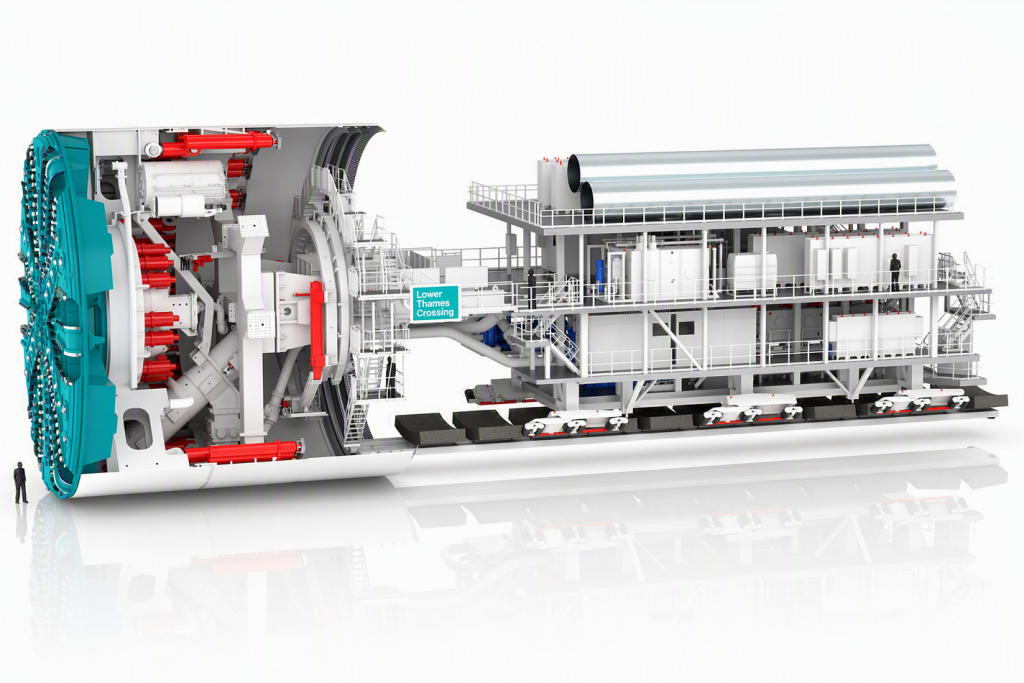
The Lower Thames Crossing machine will be a Variable Density TBM, which is a hybrid between two older designs. A slurry TBM pumps a pressurised bentonite slurry into the face chamber, suspending the excavated soil and piping the mixture to a separation plant on the surface. An earth-pressure balance (EPB) TBM uses the excavated soil itself, mixed with conditioning agents, to maintain face pressure. Each works well in certain ground conditions, but a Variable Density machine can operate in either mode and switch between them without dismantling the head. This capability is essential because the Lower Thames Crossing route passes through at least three distinct geological layers. The Lambeth Group contains water-bearing sands and gravels requiring slurry support. London Clay is stiff and low-permeability, making it suitable for EPB mode. The Upper Chalk is relatively soft but may include flint bands and water-filled fractures. The machine’s control systems will adjust face pressure, slurry density, and screw conveyor speed in real time to ensure stable excavation through these transitions. These transitions.
If you are studying A-level physics, the face pressure calculation is a direct application of hydrostatics. The TBM must balance the pressure exerted by the column of groundwater and overburden soil above the tunnel. At 60 metres depth, assuming a groundwater table near the surface and a soil unit weight of roughly 20 kN per cubic metre, the overburden pressure is approximately 1,200 kPa. The face support pressure must match or slightly exceed this to prevent collapse without over-pressurising and causing a blowout at the surface.
This machine will feature the largest accessible cutter head Herrenknecht has produced. ‘Accessible’ means engineers can enter the chamber from behind to inspect and replace worn cutters during operation, avoiding surface excavation. Given the 4.2-kilometre drive and abrasive flint in the chalk, cutter changes will be required. The head will rotate at about 1 to 2 revolutions per minute, delivering torque between 80,000 and 100,000 kNm, generated by electric motors positioned around the head’s perimeter.
The U-turn is perhaps the most interesting engineering challenge. After the first drive, the machine will be partially disassembled at the southern portal, rotated, and reassembled facing the opposite direction. This avoids the cost of a second machine but demands careful planning of the portal dimensions and the logistics of moving a 5,000-tonne machine in a confined space. The technique has been used on smaller machines but never at this diameter.
For students interested in materials science, the tunnel lining is worth examining. Each ring consists of several precast reinforced concrete segments bolted together. The segments must resist the external ground and water pressure (acting like a buried pipe under compression) and the internal forces from the TBM’s thrust jacks during installation. Using low-carbon concrete, which typically replaces a proportion of Portland cement with ground granulated blast-furnace slag or pulverised fuel ash, reduces the embodied carbon but requires careful control of early-age strength to ensure the segments can be demoulded and handled on schedule.
When that cutter head starts turning in 2028, it will mark the beginning of what could be the most complex tunnelling operation Britain has ever attempted. The engineering decisions made now, from the choice of a single variable density machine to the low-carbon concrete lining, will shape how the profession approaches large-scale underground construction for decades.
- Herrenknecht will build Europe’s largest tunnel boring machine at 16.4m diameter for the Lower Thames Crossing
- A single Variable Density TBM will dig both 4.2km tunnels via an underground U-turn, saving cost and carbon
- The machine will be delivered by sea to the Port of Tilbury in 2028, weighing over 5,000 tonnes
- The £11bn project aims to be the UK’s first carbon-neutral major infrastructure build