Drilling holes in aircraft structures sounds mundane. It is not. A single-aisle commercial aircraft contains roughly three million fastener holes, each drilled to tolerances measured in hundredths of a millimetre, each in a material, aluminium alloy, titanium, carbon-fibre composite, that punishes sloppy technique with cracked panels or weakened joints. For decades, human operators have drilled these holes using hand-held pneumatic tools, guided by templates and jigs. The work is precise, repetitive, physically demanding, and responsible for a significant share of manufacturing defects.
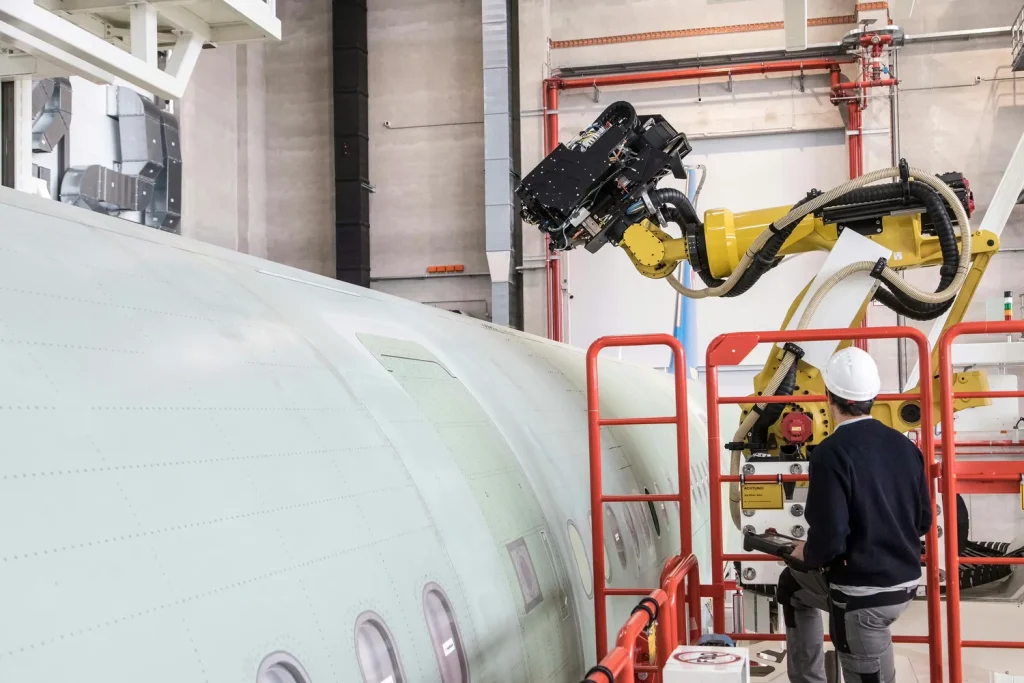
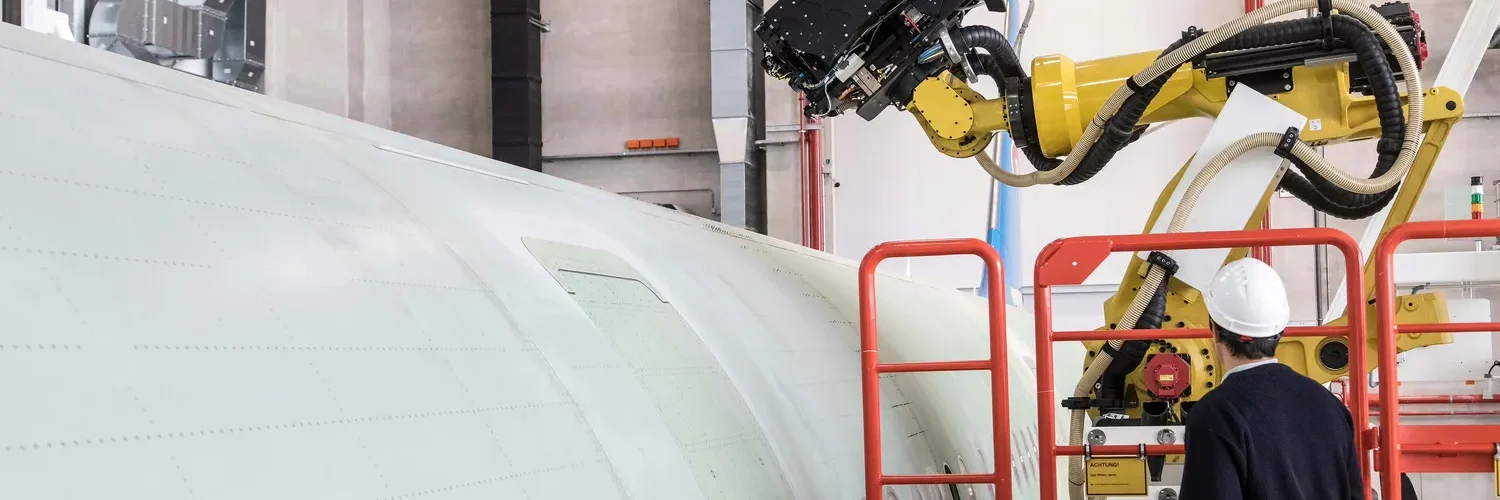
At MACH 2026, the UK’s largest manufacturing technology exhibition, opening this week at the NEC in Birmingham, Airbus is showing an alternative. The Airbus robotic drilling system, displayed at the FANUC stand, uses a FANUC M-800iA/60 six-axis robot arm paired with a drilling end-effector controlled by a FANUC CNC, all mounted on a mobile platform that can be repositioned around large airframe sections. Airbus designed and built the entire cell.
The case for automation rests on three pillars: consistency, throughput, and ergonomics. A skilled human operator can drill to aerospace tolerances, but not for eight hours straight without fatigue-related variation. A robot can. Across a production run of hundreds of aircraft, that consistency compounds into measurably fewer rework cycles and rejected parts. The FANUC M-800iA/60 offers a rated repeatability of plus or minus 0.05 millimetres, tighter than most manual operations can sustain over a full shift.
The mobile platform is a pragmatic touch. Fixed gantry drilling systems already exist in aerospace, but they cost millions, occupy permanent floor space, and cannot be moved between workstations. Airbus’s approach uses a wheeled robot. The platform drives to the workpiece, locks itself in position using precision locating systems, drills, and then moves on. It is automation that adapts to the factory layout rather than requiring the factory to adapt to it.
Aircraft structures increasingly use stacked assemblies: layers of carbon-fibre reinforced polymer (CFRP) bonded or clamped to aluminium or titanium. Drilling through these stacks is one of aerospace manufacturing’s most technically demanding operations, because each material demands different cutting parameters. Get it wrong, and you delaminate the composite, overheat the metal, or produce a hole with poor surface finish that will become a fatigue crack initiation site after thousands of pressurisation cycles.
CFRP is abrasive. It wears drill bits quickly and generates heat through friction rather than through the plastic deformation that heats metals during cutting. If the drill speed is too high, the resin matrix softens and the fibres fray, leading to delamination at the hole entry and exit. Aluminium, by contrast, is gummy. It tends to form long, stringy chips that can clog the drill flutes and scratch the hole wall. Titanium is hard, work-hardens rapidly, and generates extreme heat at the cutting edge because of its low thermal conductivity.
The solution is adaptive drilling: adjusting spindle speed, feed rate, and peck depth in real time as the drill transitions from one material to the next. The FANUC CNC controlling the drilling end-effector can execute these transitions within a single hole, ramping spindle speed down as the drill enters titanium and up as it exits into CFRP. Force sensors in the end-effector measure thrust and torque, providing feedback to the CNC that it uses to detect material transitions and adjust parameters accordingly. For A-level Physics students, this is a practical application of force-feedback control, the same principle that allows a car’s anti-lock braking system to modulate brake pressure based on wheel speed.
The six-axis robot arm introduces complexity that a simple three-axis gantry does not. A gantry moves along orthogonal axes, X, Y, and Z. A six-axis robot arm reaches its target position through a chain of rotational joints, each contributing a small angular error. These errors accumulate along the kinematic chain, a phenomenon called error stacking. The M-800iA/60’s rated repeatability of 0.05 millimetres is the combined result of precision gear trains, high-resolution encoders on each joint, and sophisticated calibration algorithms that compensate for thermal expansion, gravitational deflection, and backlash.
Stiffness is another consideration. Robot arms are inherently less stiff than gantry systems because their cantilevered structure deflects under cutting forces. When drilling titanium, thrust forces can reach several hundred newtons. The M-800iA/60 manages this through a combination of its own structural rigidity, the weight of its 60 kg payload capacity providing inertial resistance, and the drilling end-effector’s own clamping system, which presses the effector firmly against the workpiece surface before drilling begins. This clamping force creates a rigid connection that bypasses much of the robot arm’s compliance.
For students interested in manufacturing engineering, the mobile platform concept is worth studying. Traditional fixed automation in aerospace achieves sub-millimetre accuracy through massive, thermally stable structures bolted to factory floors. A mobile platform sacrifices some of that stability but gains flexibility. The locating system typically uses a combination of laser trackers, which measure the platform’s position relative to fixed reference points in the factory, and local datum pins that interface with tooling holes on the workpiece. The result is a two-stage positioning system: coarse positioning by the platform’s wheels, fine positioning by the robot arm guided by the laser tracker, and final positioning by the end-effector’s clamping and probing cycle.
The broader trend is clear. Aerospace manufacturing is following automotive manufacturing’s path toward robotic assembly, but with tolerances an order of magnitude tighter and materials an order of magnitude more difficult to machine. The Airbus cell at MACH 2026 is not a prototype. It is a working system that has already improved productivity on Airbus production lines. The question now is how quickly similar systems appear at other airframe manufacturers and their supply chains.
MACH 2026 runs from 20 to 24 April at the NEC Birmingham. The Airbus drilling cell is on Stand 18-449 alongside FANUC’s next-generation FS500i-A CNC controller. For anyone considering a career in manufacturing or aerospace engineering, it is a chance to see one of the industry’s most stubborn manual processes being handed over to a machine that never tires and never loses concentration.
- Airbus designed and built a robotic drilling cell using a FANUC M-800iA/60 six-axis robot arm with CNC control
- The system drills aerospace fastener holes to tolerances of 0.05 mm, replacing manual pneumatic drilling
- A mobile platform allows the cell to be repositioned around large airframe sections
- Adaptive drilling adjusts speed and feed rate in real time when transitioning between CFRP, aluminium, and titanium
- The cell is demonstrated live at MACH 2026 in Birmingham from 20-24 April