This month, the first fully electric Range Rover rolled off the production line in Solihull, and the most interesting feature of this car is not the vehicle itself. Instead, it is the factory. The Jaguar Land Rover plant in the West Midlands has been making Range Rovers since 1970, and the new electric model is being assembled on the same production line as both its mild-hybrid and plug-in hybrid versions. There is no separate facility and no requirement for clean-room procedures. In its place,e there are 9,000 workers who have been trained for this new role and a flexible design strategy that treats the powertrain as a variable rather than a fixed limitation.
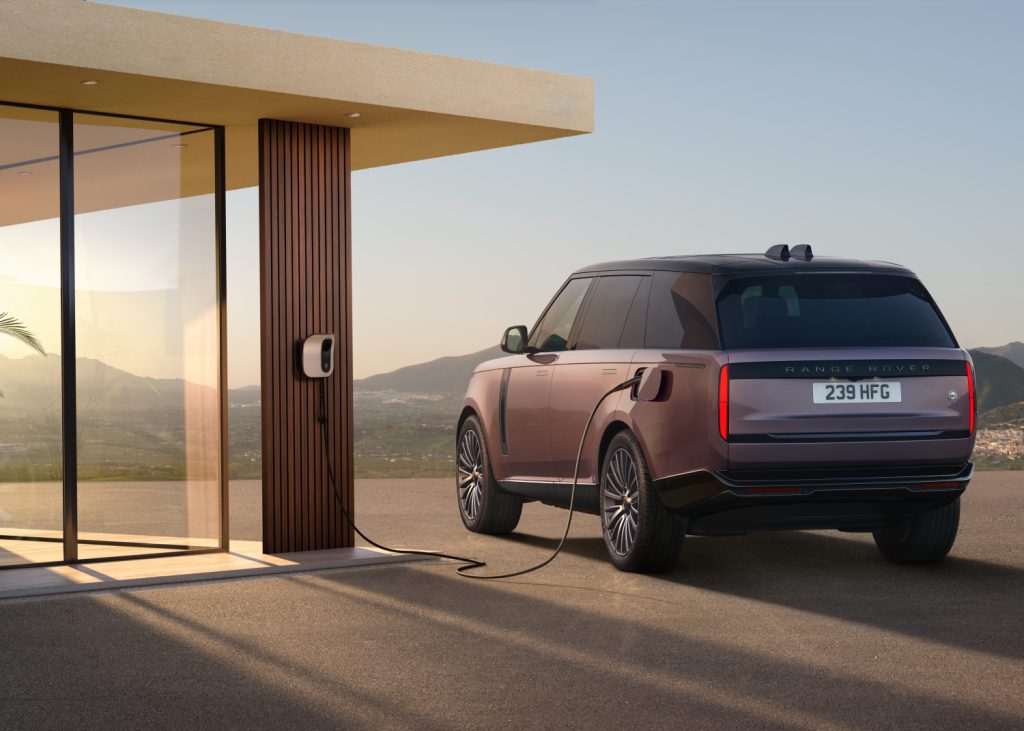
The figures present a clear account of the engineering involved: an 118.5 kWh battery pack, split into two layers, powers two permanent-magnet motors that deliver 550 PS and 850 Nm of torque. Because of the 800-volt electrical system, the vehicle can be charged from 10 to 80 per cent in 22 minutes, which adds an extra 220 kilometres of range in just 22 minutes. The WLTP range is 372 miles, and JLR believes this will be about 333 miles under normal driving conditions. This is sufficient to make the journey from London to Edinburgh on a single charge, with some room to spare, as set out in JLR’s technical press release.
How silicon carbide changed the game
The silicon carbide (SiC) semiconductors are built into the motor inverters, and it is there that the Range Rover Electric shows its true ingenuity. Traditional silicon transistors switch on and off relatively slowly, dissipating energy as heat each time they switch. SiC devices, on the other hand, switch at microsecond speeds, greatly reducing switching losses. As JLR’s engineers state, this results in motors that deliver 20 per cent more torque than similarly sized motors using conventional silicon. Given that the vehicle weighs more than two tonnes and yet has to drive through 900 millimetres of water, this improvement in efficiency is not just a marketing claim; it is a thermodynamic necessity.
The Integrated Traction Management system can redistribute torque between the front and rear axles within 50 milliseconds, with Jaguar Land Rover saying this is 100 times faster than what can be achieved with a combustion engine. There is also a system called Intelligent Driveline Dynamics, which handles left-to-right torque vectoring on the rear axle by distributing drive power from 0 to 100 per cent between the two rear wheels. Along with the twin-chamber air suspension and a lower centre of gravity than the combustion-engine model, the engineers’ objective is to deliver a driving experience similar to that of a Range Rover, not like a battery on wheels.
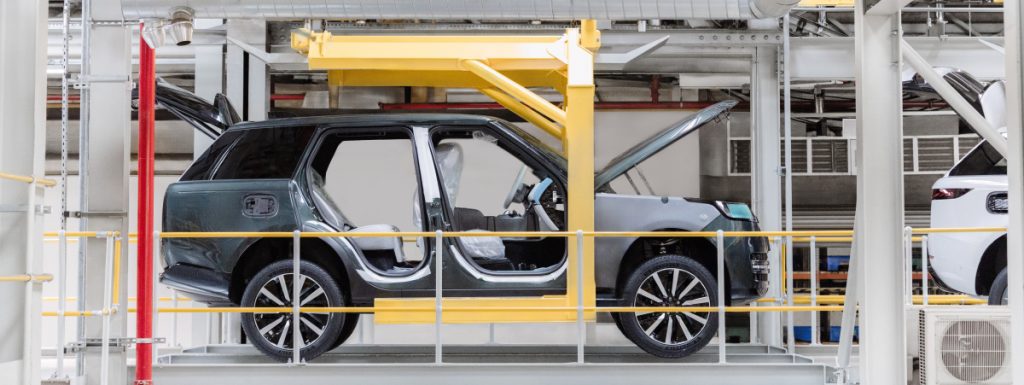
The manufacturing element is likely the more significant one in the case of UK engineering. The Electric Propulsion Manufacturing Centre in Wolverhampton now has 13 production lines for battery packs and electric drive units. Each battery cell is individually performance-tested before it is installed, and an AI-enabled scanning process is carried out at all stages of assembly. As part of the programme, more than 300 patent applications have been submitted. Before the car went into production, the company had carried out over 1.5 million kilometres of physical testing and 250,000 hours of virtual testing.
At £154,070, this is not a car most people will buy. But the manufacturing system behind it, a flexible line producing electric, hybrid, and combustion vehicles side by side, represents an approach that could reshape how the UK automotive industry navigates the transition to electrification without building entirely new factories.
Engineering Deep Dive: 800-Volt Architecture and Why Voltage Matters
Electric vehicles currently on the road generally have 400-volt battery systems, while the Range Rover Electric has 800 volts; this one difference has a chain of effects throughout the vehicle’s electrical engineering.
The basic relationship in question is Ohm’s law, which A-level Physics students will be familiar with: power equals voltage multiplied by current (P = VI). If the power output is fixed, doubling the voltage will halve the current. Since the current is lower, the cables can be thinner, the wiring loom lighter, and less heat will be produced due to resistive losses (P = I²R). In a vehicle where each kilogram affects range, reducing the mass of the copper cabling is a significant engineering achievement.
It is in charging speed that the 800-volt system shows its advantages. DC fast chargers operate at a rate that is partly determined by the cable thickness and the connector rating. To achieve a charging power of 200 kW, a 400-volt system with a current of 500 amps requires thick, stiff cables that are difficult to handle. The 800-volt system, on the other hand, can deliver the same 200 kW at only 250 amps, thereby halving the current and allowing the use of thinner, more flexible charging cables. The Range Rover Electric’s maximum charging rate adds an extra 220 km of range in ten minutes, a benefit that depends directly on its higher voltage, enabling greater power output without overheating.
The battery consists of 344 prismatic lithium-ion cells arranged in a double-stack configuration. Prismatic cells are flat and rectangular, and they pack more efficiently into a given volume than cylindrical cells. Before they are put together into modules, each cell is tested individually. It’s not paranoia that a single cell that performs poorly in a series string affects the performance of all the other cells around it, and in an 800-volt system, the effects of a cell failing are more serious because of the higher voltages involved.
The silicon carbide semiconductors used in inverters warrant more attention. An inverter converts the battery’s direct current into three-phase alternating current, which then drives the motors. The switching frequency - the number of times per second the transistors switch from on to off - affects how smoothly the motor runs and how much energy is lost as heat. Silicon carbide transistors can switch at frequencies above 20 kHz while exhibiting much lower losses than silicon devices. The greater bandgap of silicon carbide (3.26 eV compared with silicon’s 1.12 eV) enables the material to withstand higher voltages and temperatures before breakdown. Students who are studying semiconductor physics will see this as a direct result of the energy gap between the valence and conduction bands.
The rear axle torque vectoring employs a system which is capable of directing 100 per cent of the rear drive torque to either of the two wheels. The principle involved is rotational mechanics: when a vehicle goes around a corner, the outer wheel covers a greater arc than the inner one, and by sending more torque to the outer wheel, the car is helped to turn into the corner, thus reducing understeer. The system’s response time of 50 milliseconds is due to the near-instantaneous torque delivery of electric motors, a feature that a mechanical differential equipped with clutch packs could never achieve.
The ThermAssist heat management system is designed to recycle waste heat from the motors and power electronics to heat the cabin and condition the battery. Since battery performance decreases in cold weather due to the slowing of the electrochemical reactions, ThermAssist directs the surplus thermal energy to the battery pack so as to keep the cells at an optimal temperature and thereby adds up to 40 km of range under winter conditions; this is a practical example of the second law of thermodynamics being applied to energy which would otherwise be lost to the surrounding air.
It remains uncertain whether the UK automotive industry can apply this flexible manufacturing model to its other brands. While JLR has shown that electric and petrol vehicles can be produced on the same assembly line, the economic viability of this approach will depend on sustained demand for high-end electric vehicles in a market where consumer sentiment can shift from quarter to quarter. The engineering aspect has at least been proven, but the commercial case will require more time to establish.
- JLR has launched the first fully electric Range Rover, built at its Solihull plant on the same line as combustion and hybrid models
- The 800-volt architecture enables 10-80% charging in 22 minutes and supports 372 miles of WLTP range from a 118.5 kWh battery
- Silicon carbide semiconductors in the inverters deliver 20% more torque than equivalently sized conventional motors
- The Integrated Traction Management system redistributes torque between axles in 50 milliseconds, 100 times faster than combustion equivalents
- Over 300 patents filed, 1.5 million km of physical testing, and 9,000 Solihull workers upskilled for electrification