A major tunnel-boring machine is stuck 177 feet below China’s Yangtze River; the Chinese engineers have to decide whether to give up their expensive machinery - which could ruin their $100 million+ project - or create an unprecedented plan to do something with no precedent. They decided to use the second machine of the pair to perform a precise underground rescue. It has set the bar for what can now be accomplished in tunnel engineering.
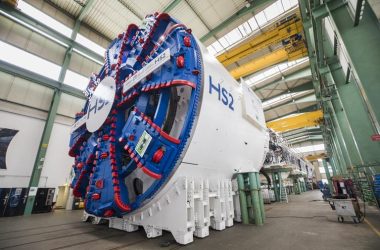
In late 2011, the crisis occurred while construction of the Jiangyin-Jingjiang Yangtze River Tunnel was underway. This will be a four-mile road tunnel connecting communities over one of China's primary bodies of water. The project required a tunnel boring machine (TBM) that was 52.5 ft wide. A TBM is a large, specialised piece of equipment used in civil construction to dig tunnels by supporting the tunnel as it is being dug and lining the tunnel at the same time as it is digging it. In short, TBMs are the most complex pieces of engineering equipment currently available in the field of civil construction. Each unit has multiple components, ts including a hydraulic system, cutting head, conveyor belt and structural support.
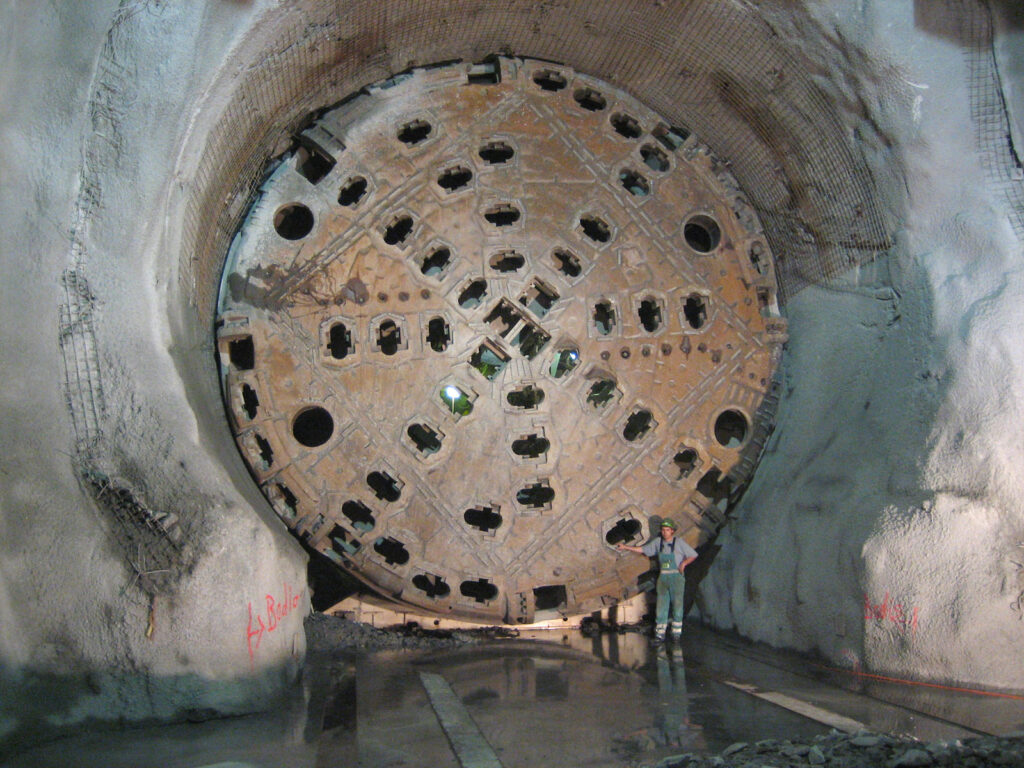
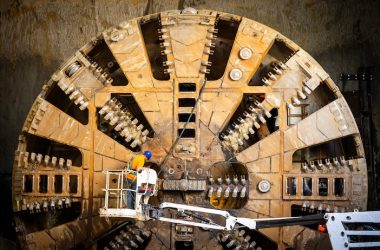
Example of a tunnel boring machine (TBM)
When the TBM failed catastrophically beneath the Yangtze River, the engineers faced a nightmare situation. The machine was too far down to move backwards, too far down to be fixed in place, and too far down to be disassembled safely. Traditional recovery options were also unavailable due to a combination of factors related to the extreme depth of the failure, the extreme water pressure beneath the river and the extremely poor condition of the soft river sediment,ment meaning traditional recovery methods could be disastrous.
The engineers at the site were very systematic in their approach to evaluating this option for the team. Giving up on the TBM would cost them at least tens of millions of dollars in equipment and risk destroying the entire tunnel. Adding time to the project by redesigning it around the TBM would likely take years and cost the company billions of dollars. Instead of either option, the engineers recommended doing something unheard of: launching the second TBM from the other side of the river, having it run into the other TBM at the same spot where the first TBM broke down, and executing what engineers call a mid-tunnel docking.
To make this happen, the engineers had to solve several difficult engineering problems simultaneously. They had to know how to predict and account for ground movement under saturated-sediment conditions, and to maintain directional control over the TBM for many miles, with accuracy measured in millimetres. If the TBM were not vertically aligned with the tunnel wall, there would be a good chance that the tunnel would collapse. If the TBM was not horizontally aligned with the other TBM, the TBM may never even meet the other TBM. The margins for error are smaller than the thickness of a coin.
What Are Tunnel Boring Machines?
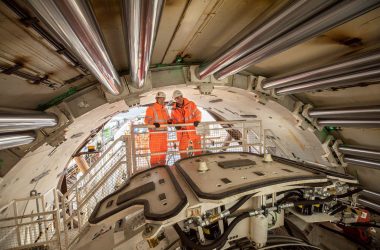
The complexities of this rescue effort were well understood by understanding how Tunnel Boring Machines (TBMs) function. These machines are essentially self-contained “underground factories” capable of performing many functions simultaneously. The TBM’s cutting head rotates, containing discs that break up the ground material. Behind the cutting head, a series of hydraulic jacks applies force to pre-installed tunnel rings, thereby moving the TBM forward.
There are three basic engineering principles involved in the successful operation of TBMs: soil mechanics, hydraulic pressure management, and structural support theory. As the TBM travels through the soil mass, it is necessary to maintain equilibrium between the external hydrostatic pressure from the surrounding soil and water and the internal void created by the advancing tunnel face. This is accomplished using what are referred to as “face support pressures,” which can be generated with compressed air, a slurry, or an earth pressure-balanced system.
When excavating under rivers, there are additional challenges. The hydrostatic pressure generated by the water table increases exponentially with depth, as indicated by the equation P=ρgh. As the TBM travelled to depths of 177 feet below the river surface, the pressure differential between the tunnel’s internal void and the surrounding saturated ground was extreme.
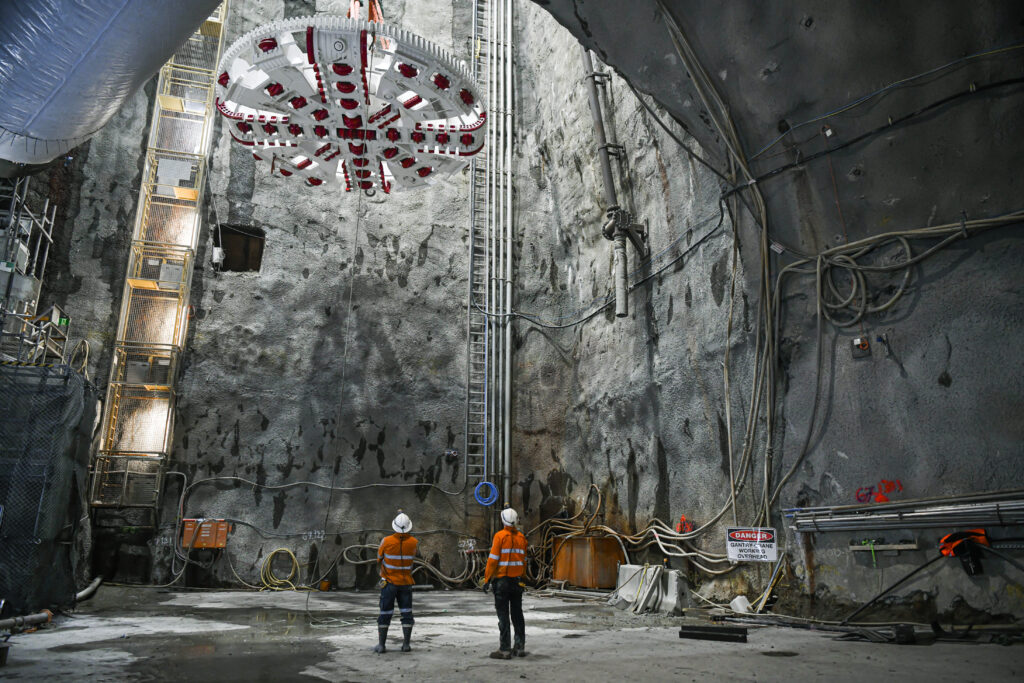
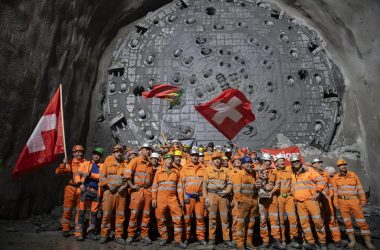
Example of a tunnel boring machine
The giant cutter head of tunnel boring machine (TBM) ‘Kathleen’ is lowered into the shaft at Barangaroo, ready to be assembled ahead of the historic start of the first rail crossing under Sydney Harbour.Measuring 130 metres and weighing 975 tonnes, the TBM will churn through clay, sediment and rock on its way under the harbour from Barangaroo to Blues Point.The twin kilometre-long tunnels will form part of the second stage of a $20 billion metro rail line.’Kathleen’ was named in honour of Kathleen Butler who played a vital role in the construction of the Sydney Harbour Bridge as the technical advisor to legendary engineer John Bradfield.
Modern TBMs utilise a variety of precision guidance systems to ensure accurate positioning and orientation of the machine, including laser theodolites, gyroscopes, and inclinometers. These systems provide continuous feedback to the operator regarding the machine’s location and orientation, and the operator uses this information to adjust the hydraulic steering cylinders in small increments. For example, a ship cannot see where it is going, and if the operator makes a wrong turn, the ship will never go in that direction again.
As part of their planning for the rescue efforts, the engineers also accounted for patterns of ground deformation that occurred as the rescue TBM progressed toward its target. The deformation of soil occurs as a result of the three-dimensional stress field caused by the movement of the TBM through the soil. However, the behaviour of the deformation in water-saturated river sediment is much more difficult to predict than in dry soils. The engineers utilised finite element analysis to simulate how the ground would react to the rescue TBM as it approached the area of interest.
The decision to perform mid-tunnel docking of the two tunnels was based on an engineering risk assessment. A docking of two tunnels requires precise control over the six degrees of freedom (three translation degrees of freedom [x,y,z], and three rotational degrees of freedom [pitch, yaw, roll]). The team chose this docking process because it was the only option to both recover the lost equipment and salvage the project schedule.
There were also significant advances made in tunnel engineering as a result of this operation. Tunnelling systems can achieve precision previously thought unattainable just a few years ago. Advances in computing have greatly increased the ability to simulate and predict the behaviour of the ground under complex geological conditions. Ultimately, the success of this operation shows that catastrophic equipment failure is not always a death knell for tunnel projects; there are viable methods available to recover from such failures.
This is an example of how engineering students’ theoretical knowledge translates into solving problems in practice. The team applied the basic principles of soil mechanics, structural engineering, hydraulics, and control systems to develop a solution that many would say should not have been attempted using textbook knowledge alone. However, the team demonstrated a deep understanding of these principles, a key component of engineering innovation and problem-solving.
The potential implications of this project are far-reaching and go beyond this individual project. With advances in underwater retrieval technology, similar technologies may be able to extract TBMs trapped in cities, mountains, or underwater. The ability to recover from equipment failures will become increasingly important as more tunnels are built worldwide to support transportation and utility infrastructure needs in densely populated urban areas. Therefore, the ability to recover from such failures will have economic significance. This recovery effort has provided the industry with a new tool (rescue operations) that may reduce costs associated with abandoning projects due to equipment failure by tens of billions of dollars annually.
This is an example of how engineering students’ theoretical knowledge translates into solving problems in practice. The team applied the basic principles of soil mechanics, structural engineering, hydraulics, and control systems to develop a solution that many would say should not have been attempted using textbook knowledge alone. However, the team demonstrated their deep understanding of these principles, which is a key component of engineering innovation, as well as problem-solving
The potential implications of this project are far-reaching and go beyond this individual project. With advances in underwater retrieval technology, similar technologies may be able to extract TBMs trapped in cities, mountains, or underwater. The ability to recover from equipment failures will become increasingly important as more tunnels are built worldwide to support transportation and utility infrastructure needs in densely populated urban areas. Therefore, the ability to recover from such failures will have economic significance. This recovery effort has provided the industry with a new tool (rescue operations) that may reduce costs associated with abandoning projects due to equipment failure by tens of billions of dollars annually.
The potential implications of this project are far-reaching and go beyond this individual project. With advances in underwater retrieval technology, similar technologies may be able to extract TBMs trapped in cities, mountains, or underwater. The ability to recover from equipment failures will become increasingly important as more tunnels are built worldwide to support transportation and utility infrastructure needs in densely populated urban areas. Therefore, the ability to recover from such failures will have economic significance. This recovery effort has provided the industry with a new tool (rescue operations) that may reduce costs associated with abandoning projects due to equipment failure by tens of billions of dollars annually.
The rescue operation faced many of the same challenges and considerations as the design of underground tunnels. In addition, the rescue operation demonstrated the potential of tunnelling to solve seemingly insurmountable problems in underground construction. The challenge facing the designers of the rescue operation was to safely locate the failed TBM and successfully dock the rescue TBM. Both tasks had to be accomplished while dealing with the extreme pressure of being located directly below a large body of water and the surrounding soil’s instability. Several technical issues needed to be addressed before the rescue operation could begin. These included determining the exact location of the failed TBM and developing a plan to guide the rescue TBM to that location. Another issue that needed to be resolved was developing a method to ensure the safe docking of the two TBMs. This involved creating a precise and reliable guidance system to accurately measure and correct the position of the rescue TBM as it approached the failed TBM. Once all technical issues were resolved, the two TBMs had to be docked so the engineers could safely enter the failed TBM.
TLDR
- Crisis: $50M tunnel boring machine trapped 177 feet beneath China’s Yangtze River during tunnel construction
- Challenge: Impossible to abandon, repair in place, or extract using conventional methods due to water pressure and depth
- Solution: Used twin TBM from opposite riverbank to execute first-ever mid-tunnel precision docking rescue
- Precision: Achieved vertical alignment within 2mm (thickness of a nickel) after miles of underground navigation
- Impact: Transformed potential multi-year project failure intoa temporary setback, setting new tunnelling engineering standards
- Innovation: Proved catastrophic equipment failures don’t mean project abandonment, adding a new recovery method to the engineering toolkit