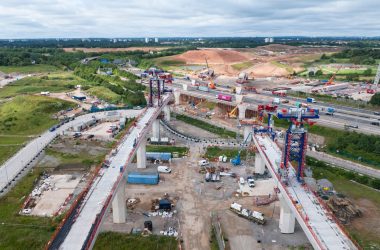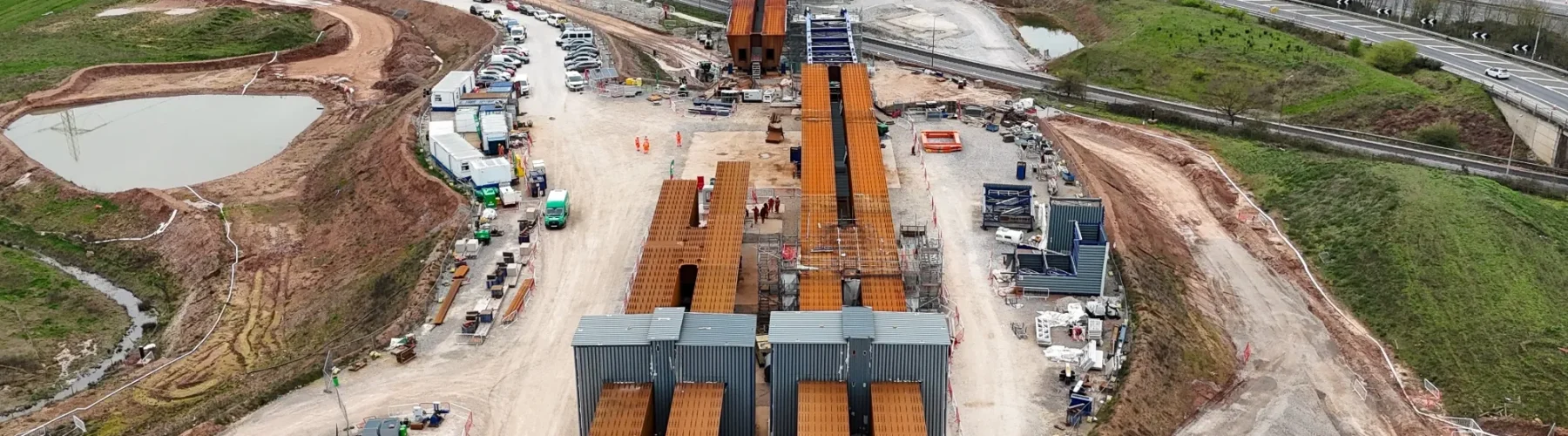
On the morning of Saturday 11 April, a 45-strong crew gathered beside the M6 near Chelmsley Wood, east of Birmingham. Their task: to drag 1,250 tonnes of weathering steel across a live motorway junction without closing the main carriageway. By Sunday evening, the first section of the HS2 M6 South viaduct’s west deck sat locked onto its concrete piers, 102 metres from where it started. The whole operation took roughly 41 hours.
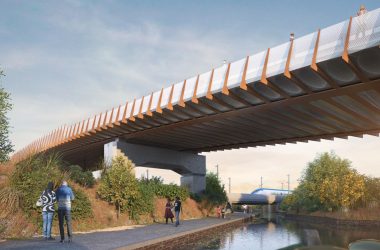
The HS2 viaduct M6 slide is, by any measure, a feat of precision logistics as much as structural engineering. The west deck, which will eventually carry high-speed trains towards Birmingham, spans 320 metres. Because of tight site constraints, including staggered abutments and a curved loop road beneath, contractor Balfour Beatty VINCI (BBV) divided it into four sections rather than the three used for the parallel east deck completed in 2025. This first section, 107 metres long, had to travel over the Junction 4 southbound slip road, as first reported by New Civil Engineer.
The method is deceptively simple in principle, fiendishly complex in practice. The viaduct section was assembled on a launching platform beside the motorway. A steel launching nose, bolted to the front, guided the structure onto each successive pier as it advanced. Giant hydraulic jacks, anchored to the piers, pulled the deck forward via high-tensile cables. Think of it as threading an enormous steel needle through a row of concrete eyes, one pull at a time.
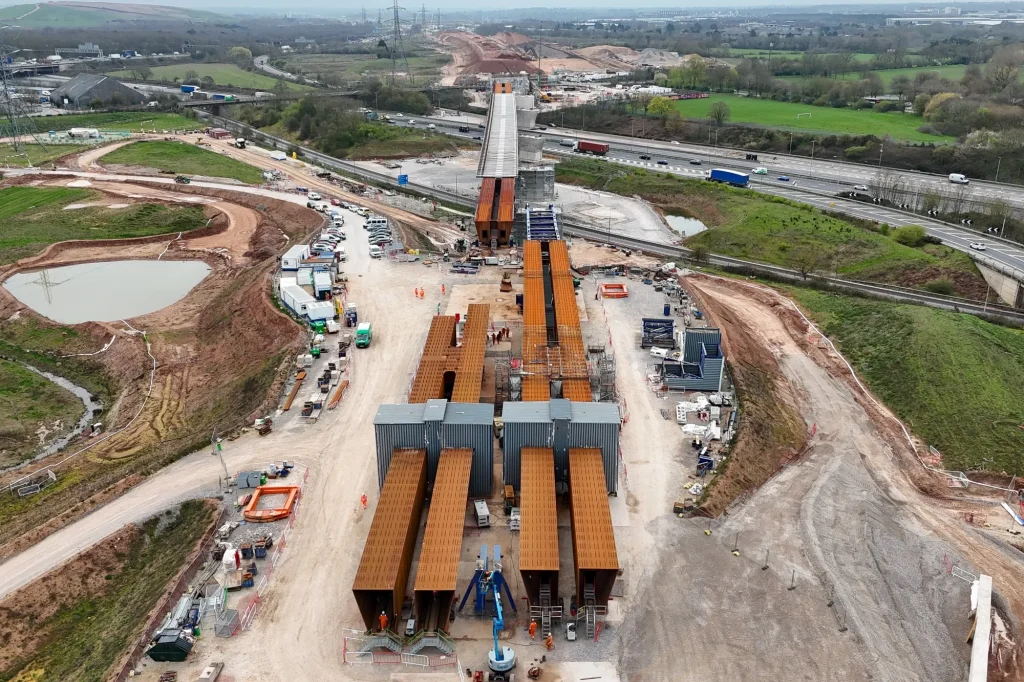
What makes this approach attractive for motorway crossings is timing. A conventional crane lift would demand full motorway closure for days. The slide method keeps the main M6 carriageway open. Only the Junction 4 southbound slip road is closed, from 5 AM Saturday to 10 PM Sunday, while a team led by BBV civil engineer Russell Luckhurst inched the deck into position and locked it down.
BBV had already proved the concept on the east deck in 2025, completing three slides, including a UK first where the main M6 carriageway remained open as a 4,600-tonne structure moved overhead. The west deck, however, brought new complications. A shorter launching platform meant less room for assembly. The curved loop road forced engineers to account for geometry that the straighter east deck did not require. And the staggered abutment required that each section be slightly different lengths.
Three more slides are scheduled through the summer, with the second expected in June 2026. Once all four sections are in place, the west deck will sit alongside its eastern twin, and the M6 South viaduct will be structurally complete, ready for track laying and systems fit-out.
Engineering Deep Dive: Sliding a Viaduct Over a Live Motorway
The incremental launch method used on the HS2 M6 viaduct has roots stretching back to the 1960s. Still, the scale and constraints here push the technique into territory unfamiliar to most A-level Physics students, even though the underlying principles are not.
Start with the forces. A 1,250-tonne deck resting on temporary bearings exerts a gravitational force of roughly 12.3 meganewtons. To move it horizontally, the hydraulic jacks must overcome static friction between the deck and its sliding bearings. Engineers use PTFE (polytetrafluoroethylene) pads, the same polymer found in non-stick cookware, to reduce the friction coefficient to around 0.03. That means the horizontal pulling force needed is approximately 370 kilonewtons, or about 37 tonnes-force. Still substantial, but manageable for a bank of synchronised hydraulic jacks.
The launching nose is a critical piece of the puzzle. As the deck advances, its leading edge is unsupported until it reaches the next pier. Without the nose, the cantilevered section would experience bending moments that could exceed the steel’s yield strength. The nose is lighter and tapered, reducing the bending moment at the root by shifting the centre of gravity backwards. It also deflects downward as it spans the gap, so engineers pre-camber it, building in an upward curve that flattens under load to land precisely on the next pier bearing.
Weathering steel, the material chosen for the deck, deserves attention. Unlike conventional structural steel, which requires painting to prevent corrosion, weathering steel forms a stable rust layer, called a patina, that protects the metal beneath. This is an application of passivation, a concept that A-level Chemistry students may recognise in the context of aluminium oxide layers. The advantage of a motorway viaduct is a dramatic reduction in maintenance: no need to close lanes every few years for repainting. The trade-off is that weathering steel cannot be used in marine or heavily polluted environments where chlorides prevent the patina from stabilising.
Coordination between the sliding operation and live traffic adds another layer of complexity. The main M6 carriageway carries roughly 120,000 vehicles per day. National Highways required BBV to demonstrate that the structure could be arrested mid-slide in the event of an emergency, with contingency plans to reopen the motorway within hours. This meant that every hydraulic jack had to be independently controllable and reversible, a requirement that drove the propulsion system’s design toward redundancy. Multiple jacks operated in parallel, each capable of holding the load if another failed.
For students studying A-level Design and Technology or Further Maths, the geometry of the curved loop road presents a real-world application of coordinate geometry and arc calculations. The west deck sits on a slight horizontal curve, which means the slide path is not perfectly straight. Engineers used laser-guided positioning systems, referenced to survey control points established by total stations, to keep the deck aligned to within a few millimetres across the 102-metre travel distance. The acceptable tolerance was less than the width of a pencil line on a technical drawing.
The choice to split the west deck into four sections, rather than three, illustrates a common engineering trade-off: more operations mean more setup time and cost, but smaller sections reduce peak bending moments, require a shorter launching platform, and are easier to control during the slide. The decision was driven not by the steel’s capacity but by the available space on site, a reminder that real engineering constraints are often spatial and logistical rather than purely structural.
The HS2 M6 viaduct project sits within a wider programme now budgeted at £43.6 billion. Whether the remaining three west-deck slides proceed as smoothly as the first will depend on weather, traffic management approvals, and the continued precision of a technique that leaves almost no margin for error. If they do, the M6 South viaduct will stand as one of the most complex motorway crossing structures built in the UK.
- Balfour Beatty VINCI slid a 1,250-tonne HS2 viaduct section over the M6 near Birmingham in 41 hours
- Hydraulic jacks pulled the weathering steel deck across PTFE bearings onto concrete piers, keeping the main motorway open
- The west deck is split into four sections due to site constraints including a curved loop road and staggered abutments
- Three more slides are planned through summer 2026 to complete the 320-metre west deck
- The technique builds on a successful 2025 east deck installation that included a UK-first live-carriageway crossing