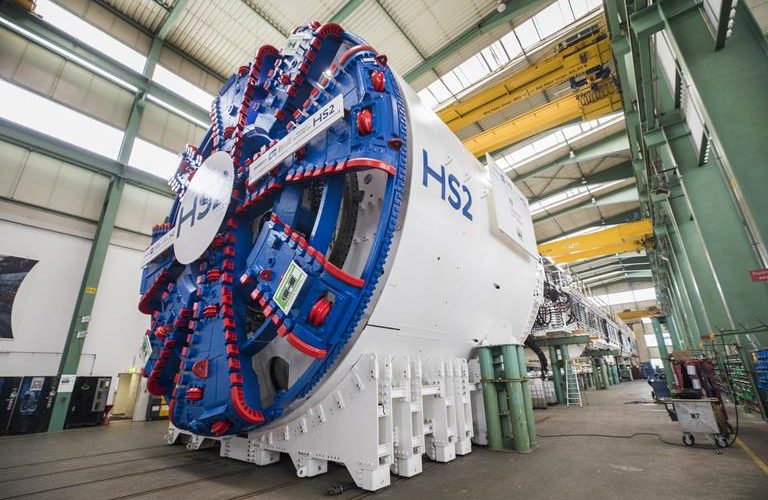
Somewhere beneath the mudflats of Tilbury, a 271-tonne machine named Caroline is chewing through chalk. The tunnel boring machine, lowered piece by piece into a shaft nearly 50 metres deep, began its drive under the River Thames this month as part of National Grid’s plan to replace a power tunnel that has carried electricity beneath the estuary since 1969.
The new Thames power tunnel will stretch 2.2 kilometres between Tilbury in Essex and Gravesend in Kent, running roughly 15 metres below the riverbed. When finished, it will house higher-capacity transmission cables, upgrading a link in the electricity network that connects the Isle of Grain power complex to the national grid. Energy minister Michael Shanks attended the launch ceremony, a signal of how seriously the government takes the project’s role in long-term energy security and decarbonisation.
How engineers are building the Thames power tunnel
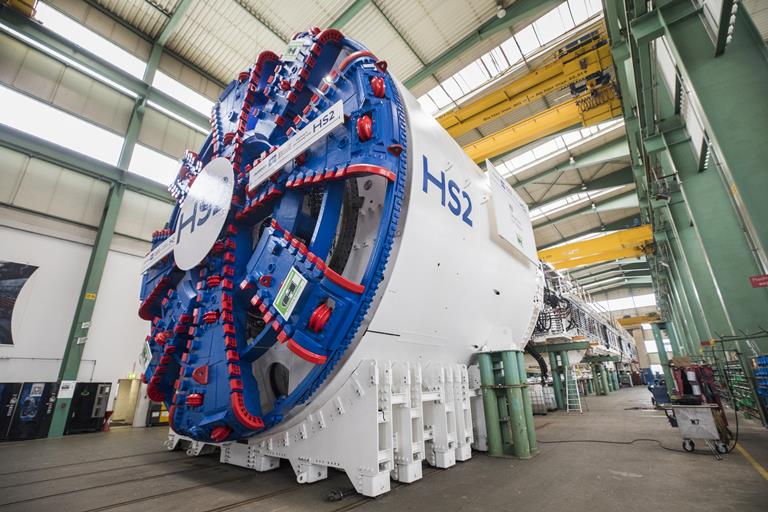
Caroline is no ordinary TBM. Built by German manufacturer Herrenknecht specifically for this project, the machine will eventually reach 100 metres in length. But the 15-metre diameter shaft at Tilbury is far too narrow to fit the whole thing at once. So engineers devised what they call an “umbilical launch,” a technique where a short 12-metre section of the TBM begins cutting into the chalk face while still tethered to temporary power and services in the shaft. Additional gantries and machine sections are then bolted on one by one using a steel portal frame and jacking system, as first reported by New Civil Engineer. The full assembly will not be complete until August 2026.
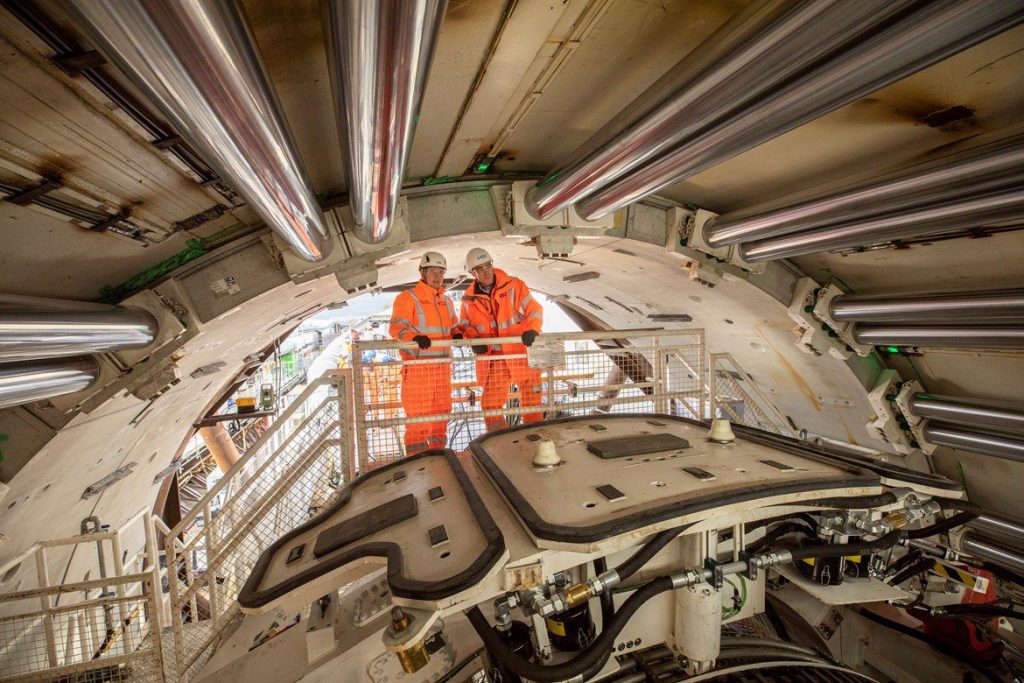
During this build-up phase, Caroline crawls at roughly 0.9 metres per day. Once she reaches her full 100-metre length, engineers expect her to accelerate to around 23.3 metres per day, completing the remaining drive between August and November. The 4-metre diameter bore will then be lined and fitted with new transmission infrastructure ahead of a planned completion in 2028.
Both shafts, at Tilbury and Gravesend, were excavated using a Vertical Shaft Sinking Machine, also manufactured by Herrenknecht. The Tilbury shaft reaches 48.7 metres below ground, while the Gravesend reception shaft extends to 46.3 metres. Contractor Ferrovial Bemo Joint Venture is delivering the scheme, with 76 workers on site and 15 local businesses already engaged in the supply chain.
Engineering Deep Dive: Boring through chalk beneath a tidal estuary
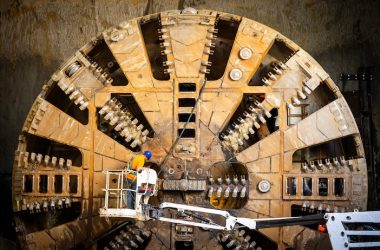
Tunnel boring machines are among the most complex pieces of engineering equipment ever built. At the front of Caroline sits a rotating cutterhead studded with cutting tools. As it turns, the tools scrape and crush the chalk ahead, while a pressurised slurry of bentonite (a clay mineral mixed with water) is pumped into the gap between the cutterhead and the rock face. This slurry serves two purposes: it stabilises the ground ahead of the machine, preventing collapse, and it carries the excavated material, or spoil, back through pipes to the surface for separation and disposal.
The geology here is relatively forgiving. Chalk is a soft sedimentary rock, scoring just 1 to 3 on the Mohs hardness scale (compared to 7 for granite). For A-level students familiar with sedimentary rock formation, this chalk was laid down during the Cretaceous period from the compressed shells of microscopic marine organisms called coccolithophores. Its softness makes it easier to cut, but chalk can also be unpredictable. It contains flints, bands of harder material that can damage cutting tools, and its porosity means groundwater management is a constant concern when tunnelling beneath a tidal river.
The “umbilical launch” technique used here is worth understanding in detail, because it solves a genuine geometric problem. A standard TBM launch requires a reaction frame, a massive steel structure bolted into the back of the shaft that the machine pushes against as it begins to cut. Once the TBM has advanced far enough, it pushes off the tunnel lining rings it has already installed. But when the shaft diameter is smaller than the TBM’s full length, there is no room to assemble the complete machine before launch. The solution is to start with just the cutting head and front shield, then extend the machine section by section as it advances into the tunnel. Each new section is lowered down the shaft, connected, and the machine advances a little further. Think of it like adding carriages to a train while it is already moving.
The tunnel’s 4-metre internal diameter might sound modest, but it is tube-train sized, large enough for workers and equipment to access the full length during fit-out. The finished tunnel will carry high-voltage electricity cables encased in protective ducts, replacing infrastructure that has been operating continuously for over 55 years. The original 1969 tunnel was an engineering achievement in its own right, but it was designed for the power demands of a different era. The upgrade will support significantly higher transmission capacity, a necessity as the UK connects more renewable generation to the grid.
The Vertical Shaft Sinking Machines used to create the launch and reception shafts are themselves impressive pieces of kit. A VSM works by mechanically excavating soil and rock from the base of a descending cylinder, which sinks under its own weight as material is removed. The technique is faster and less disruptive than traditional shaft-sinking methods such as caisson sinking or diaphragm wall construction. For students studying forces and equilibrium, a VSM is an elegant example of a system where the driving force (gravity acting on the cylinder’s mass) is carefully balanced against the resisting forces (friction from the surrounding ground and the mechanical resistance of the rock being cut).
Herrenknecht, the German firm that built both the TBM and the VSMs, is one of only a handful of companies in the world capable of manufacturing machines at this scale. Each is custom-designed for the specific geology and project requirements, making tunnel boring one of the most bespoke branches of heavy engineering.
The project, part of National Grid’s wider Grain to Tilbury upgrade, is one of several major tunnelling schemes underway across the UK. As the country’s electricity network adapts to accommodate offshore wind, nuclear, and solar generation, the need for upgraded transmission infrastructure has become pressing. Whether Caroline can maintain her 23-metre daily pace through the Thames chalk will be closely watched.
A 271-tonne tunnel boring machine named Caroline has begun excavating a 2.2km power tunnel beneath the River Thames, replacing a 1969-era electricity link.
The machine uses an innovative “umbilical launch” technique, starting as a 12-metre section and growing to 100 metres as it advances through chalk 15 metres below the riverbed.
Once at full length, Caroline will bore at 23 metres per day, with the new 4-metre diameter tunnel expected to carry higher-capacity transmission cables by 2028.
The project, delivered by Ferrovial Bemo JV for National Grid, is part of the UK’s push to upgrade electricity infrastructure for decarbonisation.