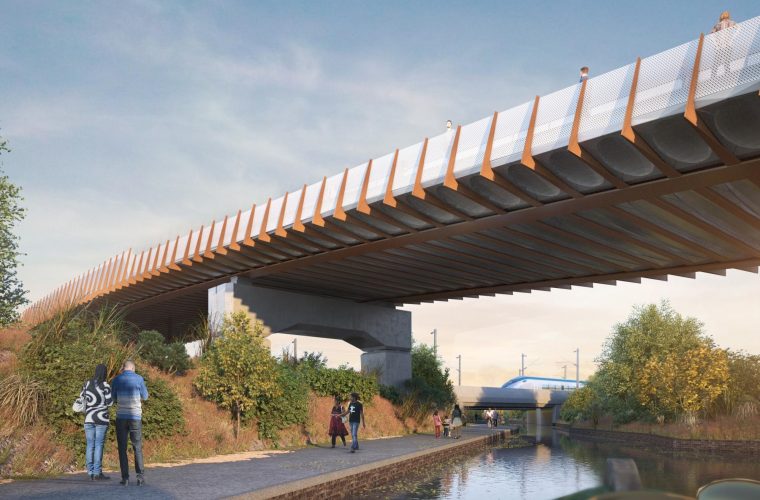
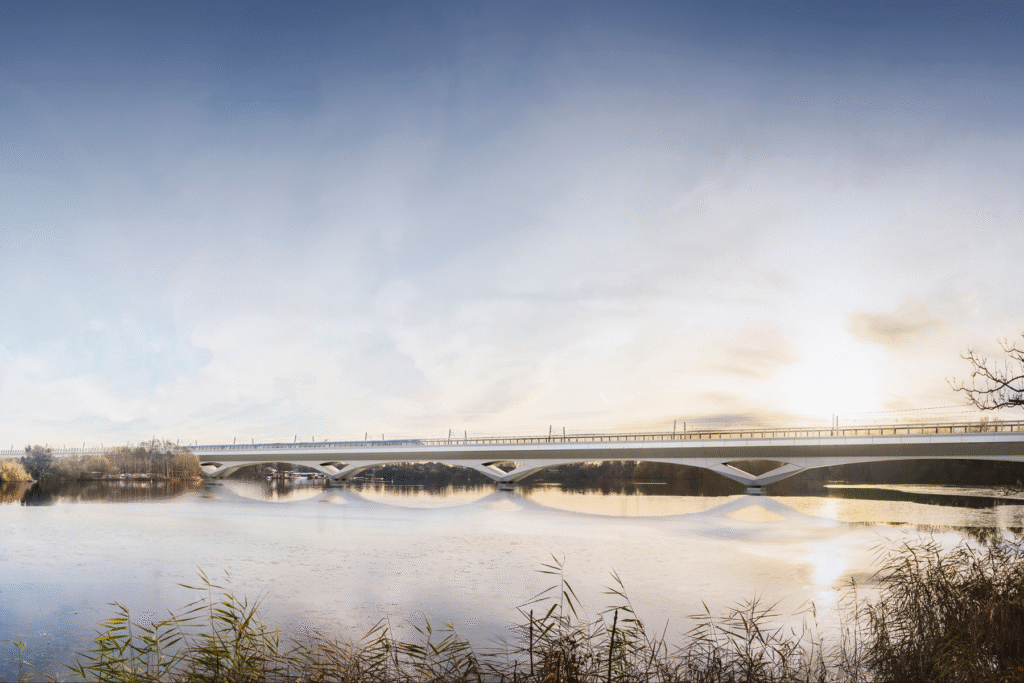
Britain’s railway infrastructure reached a new benchmark with the completion of the Colne Valley Viaduct, a 3.4-kilometre structure that demonstrates advances in precast segmental bridge construction. The viaduct, part of the High Speed 2 (HS2) railway project, surpasses the Tay Bridge’s 137-year record as the UK’s longest railway bridge.

The viaduct spans the Colne Valley northwest of London, crossing multiple obstacles including the River Colne, Grand Union Canal, several lakes, and existing road infrastructure near the M25 motorway. Designed by Grimshaw architects and constructed by Align JV-a joint venture between Bouygues Travaux Publics, VolkerFitzpatrick, and Sir Robert McAlpine-the structure comprises 1,000 individually shaped precast concrete deck segments supported by 56 piers.
Construction began in March 2021, with the final deck segment installed in September 2024. The subsequent year focused on completing auxiliary systems, including parapets, noise barriers, structural health monitoring equipment, waterproofing, and drainage infrastructure. The viaduct stands 10 meters above ground level and features a gentle curve designed to accommodate trains travelling at 320 kilometres per hour.
Engineering Deep Dive: Advanced Precast Segmental Bridge Construction
The Colne Valley Viaduct exemplifies modern precast segmental construction, a method that addresses efficiency, quality control, and environmental considerations in large-scale infrastructure projects. This construction approach divides the bridge superstructure into manageable segments, which are manufactured off-site before assembly.
Match-Casting Technology
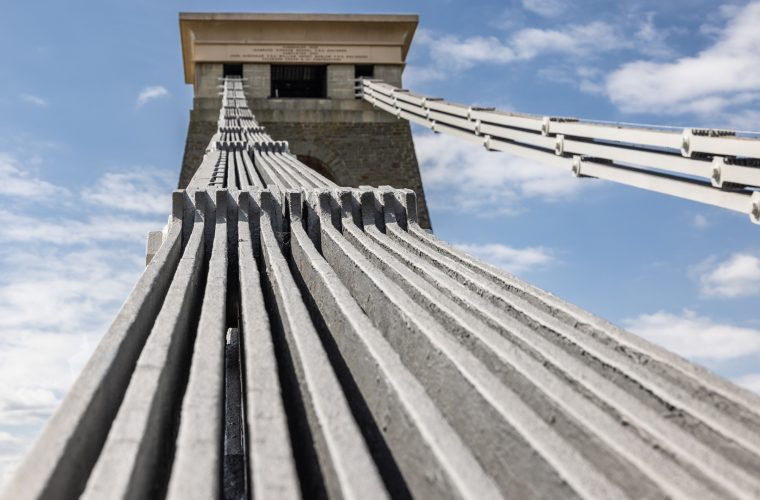
Central to the viaduct’s precision is match-casting, where each segment’s face serves as the formwork for its adjacent piece. This technique creates unique ridge patterns on connecting surfaces, ensuring millimetre-level accuracy in segment alignment. The increased surface area at joints enhances load transfer between segments when they are post-tensioned together, creating a monolithic structure despite their segmental nature.
The match-casting process requires careful sequencing. Segments are cast against their neighbours in the order they’ll be erected, maintaining geometric control throughout the 1,000-piece assembly. Temperature-controlled curing environments and precise formwork systems prevent dimensional variations that could compound across the structure’s length.
Balanced Cantilever Method
The viaduct’s constr employed the balanced cantilever method using a 160-meter launch girder. This self-supporting system places segments symmetrically on either side of each pier, creating balanced cantilevers that minimise bending moments during construction. The method proceeds as follows:
Pier segments are placed directly above supports. The launch girder then positions segments progressively outward from the pier in both directions, maintaining equilibrium. Each cantilever extends until meeting the adjacent span’s cantilever at mid-span, where a closure pour connects the two halves. Post-tensioning cables thread through ducts cast within the segments, applying compression that transforms the individual pieces into a continuous beam.
This technique offers several advantages for crossing the Colne Valley’s water bodies and infrastructure. Ground-level access requirements are minimal, reducing environmental impact on the lakes and wetlands below. The method also eliminates the need for temporary supports in water, simplifying construction logistics and reducing costs.
High-Speed Rail Design Considerations
Designing for 320 km/h operations introduces specific engineering requirements. Dynamic loading from high-speed trains generates different stress patterns than conventional rail traffic. The viaduct’s stiffness must control deflections to maintain ride quality and track geometry. Resonance effects require careful attention-the structure’s natural frequencies must avoid coinciding with excitation frequencies from regular train passages.
The deck’s continuous design and substantial mass help dampen vibrations. Noise barriers integrated into the parapets address acoustic requirements for nearby communities. The structural health monitoring system uses accelerometers, strain gauges, and displacement sensors to track the viaduct’s response to traffic and environmental loads throughout its 120-year design life.
Precast Advantages
The on-site casting facility produced segments in controlled conditions, ensuring consistent concrete quality and dimensional accuracy. This approach reduced weather-related delays and improved worker safety compared to cast-in-place construction. The facility completed segment production three months ahead of schedule, providing flexibility in the construction requirements.
Quality control benefits include consistent concrete mix designs, optimised curing conditions, and systematic inspection before installation. Defects identified during production can be remedied before segments reach their final position-a significant advantage over in-situ concrete work, where repairs prove more complex.
The Align team’s execution strategy centred on the purpose-built segment casting facility established near the viaduct site. This facility operated as a production line, with each segment requiring specific formwork adjustments to achieve the bridge’s horizontal and vertical alignment. The manufacturing process was completed ahead of schedule, providing buffer time for the construction sequence.
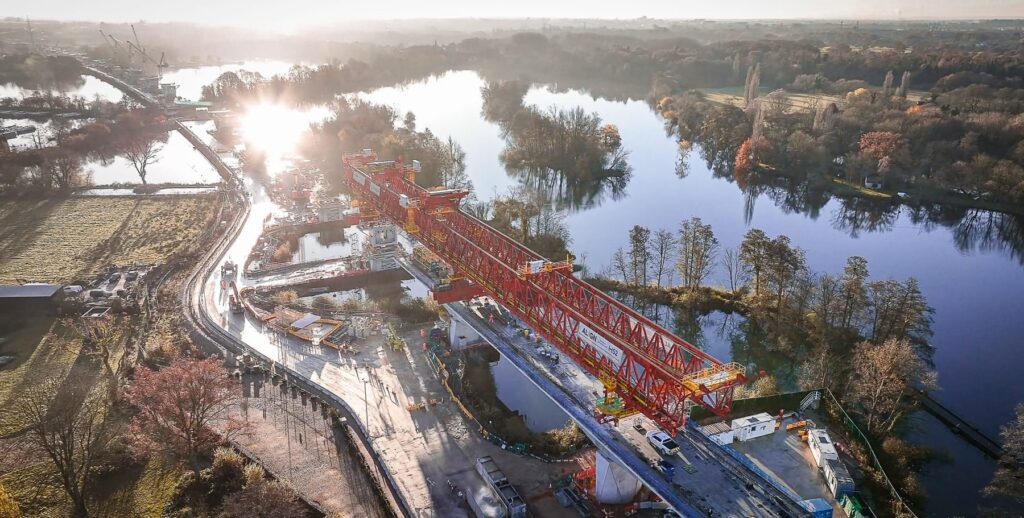
The launch girder represented a significant capital investment but proved essential for the project’s success. Its 160-meter span allowed efficient movement between piers while maintaining stability during segment placement. The equipment’s capacity to handle the unique geometry of each segment-necessary for the viaduct’s curve-demonstrated the sophistication required for modern infrastructure construction.
Environmental considerations influenced construction methodology throughout the project. The balanced cantilever approach minimised ground disturbance in the ecologically sensitive Colne Valley. Upon completion of structural work, Align will remove the casting facility and restore the site as part of HS2’s green corridor initiative, creating chalk grassland and woodland habitats.
The Colne Valley Viaduct connects two major tunnelled sections: the 13.5-kilometre Northolt Tunnel running beneath west London and the 16-kilometre Chiltern Tunnel through the Area of Outstanding Natural Beauty. This positioning makes the viaduct a critical link in HS2’s Phase One route between London and Birmingham.
If the broader HS2 program succeeds in its objectives, the viaduct will form part of a high-speed network, reducing journey times between major cities. However, the project continues to face ongoing scrutiny regarding costs and timelines. Transport Secretary Heidi Alexander acknowledged a “litany of failure” in the program’s delivery, with completion dates extending beyond 2033. The cancellation of northern routes to Leeds and Manchester has further complicated the project’s business case.
Despite program-level challenges, the completion of the Colne Valley Viaduct demonstrates that individual work packages can achieve technical success. The structure joins 158 bridges and viaducts under construction for HS2, though civil engineering works across the route remain approximately half complete.
The viaduct’s construction methods offer lessons for future projects. Match-cast segmental construction proved viable for structures of this scale, with the on-site production facility model potentially applicable to other major bridges. The balanced cantilever method’s minimal environmental footprint during construction addresses growing concerns about the infrastructure’s ecological impact.
Structural health monitoring systems embedded during construction represent an evolution in asset management. Real-time data on structural behaviour will inform maintenance strategies and validate design assumptions over the viaduct’s service life. This information contributes to the engineering knowledge base for high-speed rail infrastructure.
If high-speed rail expansion continues in the UK or elsewhere, the Colne Valley Viaduct provides a reference point for crossing environmentally sensitive areas. The construction techniques demonstrated here-particularly the combination of precast production and balanced cantilever construction-offer a template for similar challenges.
The project also highlights the importance of construction sequencing and supply chain coordination. Completing segment production ahead of schedule created flexibility that proved valuable when addressing site-specific challenges. This approach to risk management through strategic scheduling could benefit other infrastructure programs.