French floating solar developer HelioRec has secured Approval in Principle (AiP) Level II certification from Bureau Veritas Marine & Offshore, advancing the deployment of offshore renewable energy in challenging marine environments.
The certificate legally validates the company’s engineering approach to withstanding extreme weather conditions, including wind speeds exceeding 99 mph and wave heights up to 6.5 feet.
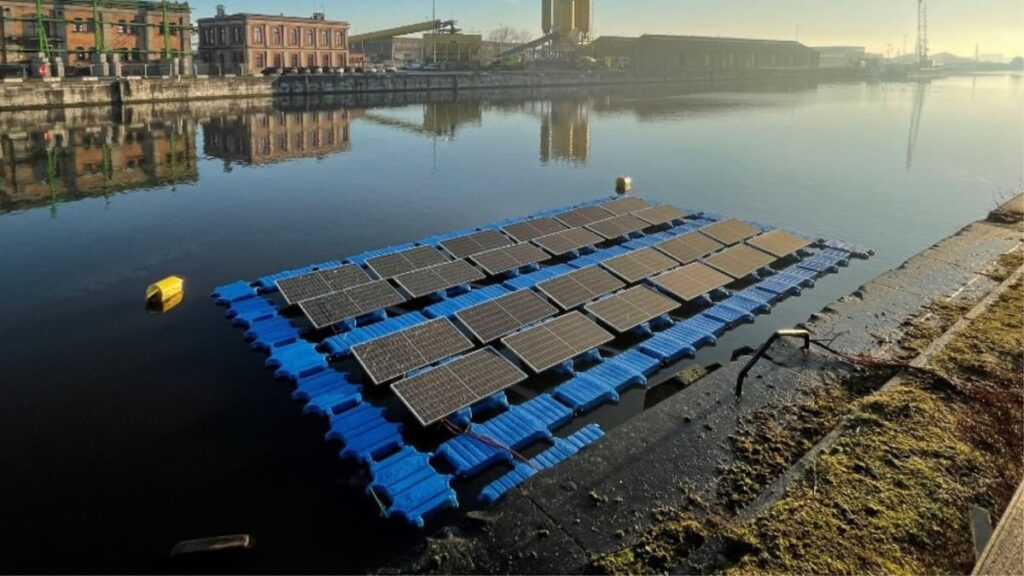
The AiP Level II certification encompasses critical marine design requirements outlined in Bureau Veritas’ offshore and mooring regulations. The approval includes the design of floating structures, material and welding standards, mooring systems, and fatigue testing of components, including top chain lines.
HelioRec described the certification as confirming that its core design choices and system architecture meet marine classification requirements “in principle.”
If the technology scales successfully, this approval could enable deployment across ports, coastal municipalities, and offshore infrastructure where traditional solar installations face space constraints.
The certification process examined the technical feasibility and structural integrity of HelioRec’s marine energy system through rigorous engineering analysis. Bureau Veritas evaluated the platform’s ability to maintain operational integrity under the dynamic loading conditions typical of aquatic environments.
HelioRec’s floating platforms have undergone real-world testing in challenging maritime conditions. During recent storms, the company’s pilot project at the Port of Oostende in Belgium withstood wind gusts of up to 71 mph without sustaining any damage. The system was designed to handle wind loads up to 99 mph.
The Port of Brest installation in France continues operating under conditions with high tidal variation and wind speeds exceeding 93 mph. These operational results provide engineering validation for the platform’s resilience under actual maritime conditions.
Testing data indicate that the system demonstrates 3.5 times greater stability under extreme wind conditions compared to conventional blow-moulded plastic floating solar structures, according to the company’s analysis.
Engineering Deep Dive: Marine Floating Solar Platform Design
Floating solar installations face unique engineering challenges that differ significantly from terrestrial photovoltaic systems. Marine environments are subject to dynamic loading from wind, waves, and currents, requiring specialised design approaches to maintain structural integrity and operational efficiency.
HelioRec’s patented hydro-lock design represents a departure from conventional floating solar ballast methods. Traditional floating solar platforms typically rely on concrete or metal ballast for stability, which increases material costs and deployment complexity. The hydro-lock system allows floating units to retain water within their hollow structural elements, creating dynamic ballast that responds to environmental conditions.
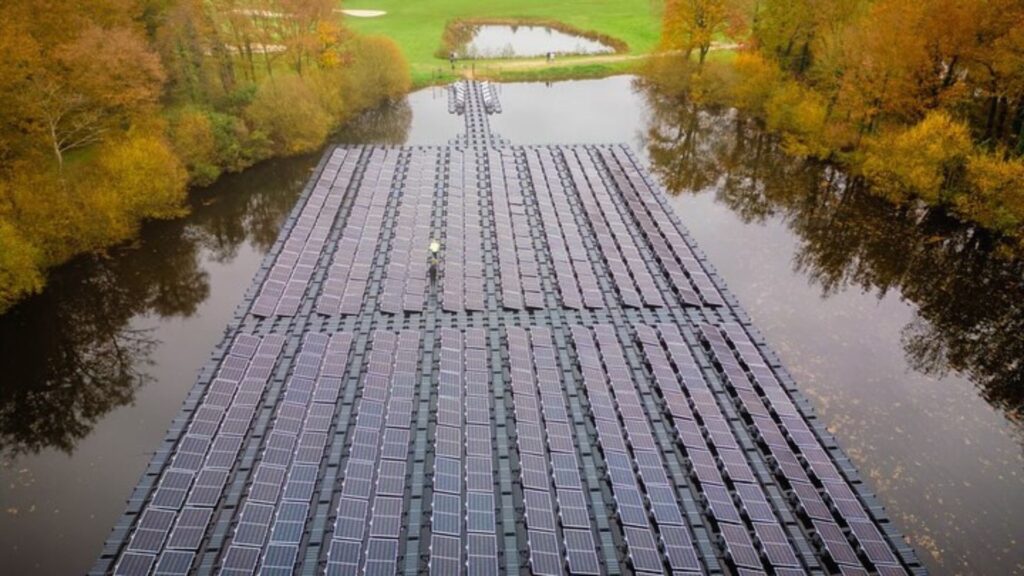
This approach offers several engineering advantages. Water ballast provides density similar to concrete (approximately 1,000 kg/m³) while maintaining the ability to adjust loading conditions during installation and maintenance. The system reduces the need for heavy lifting equipment during deployment, as units can be transported with minimal ballast and filled on-site.
The hollow structure design also creates inherent redundancy. If one compartment is compromised, adjacent compartments maintain buoyancy and stability. This distributed ballast approach reduces single-point failure risks common in conventional floating platforms.
Marine floating structures must withstand complex loading patterns from multiple environmental forces. Wind loading creates both steady-state pressure and dynamic oscillations that can induce resonance in flexible structures. Wave action generates heave, pitch, and roll motions that stress mooring connections and structural joints, thereby putting them under stress.
Computational fluid dynamics (CFD) modelling allows engineers to analyse these interactions before physical testing. CFD simulations model airflow patterns around solar panels and support structures, identifying areas of high pressure differential and turbulent flow that could create destructive forces.
Finite element analysis (FEA) complements CFD studies by examining structural response to calculated loads. FEA models predict stress concentrations, deflection patterns, and fatigue life under cyclic loading conditions. These analyses guide material selection and joint design to ensure adequate safety factors are incorporated.
Floating solar platforms require mooring systems that maintain position while allowing controlled movement in response to environmental forces. Rigid mooring creates excessive loads during storm conditions, while insufficient restraint allows excessive platform motion that can damage electrical connections and reduce energy output.
Catenary mooring using chains or synthetic ropes provides a compromise between restraint and flexibility. The catenary curve naturally absorbs energy from platform motion while maintaining position. Chain selection requires analysis of breaking strength, corrosion resistance, and fatigue life under cyclic loading.
Mooring loads vary significantly with water depth, current patterns, and storm frequency. Shallow-water installations face different challenges than deep-water deployments, necessitating site-specific engineering analysis.
Electrical connections between floating solar modules must accommodate platform motion while maintaining power transmission efficiency. Rigid connections fail under the cyclic stress of wave action, while excessive flexibility can create electrical resistance or connection failures.
UV- and saltwater-resistant flexible connectors distribute mechanical stress across the floating array. These connections must maintain electrical integrity while accommodating relative motion between platforms. Cable management systems prevent chafing and ensure adequate service loops for anticipated motion ranges.
Power conditioning equipment requires protection from salt spray and humidity while remaining accessible for maintenance and service. Sealed enclosures with appropriate ingress protection ratings protect sensitive electronics from the marine environment.
Marine environments accelerate corrosion through exposure to salt, temperature cycling, and UV radiation. Material selection requires careful consideration of corrosion resistance, mechanical properties, and lifecycle costs.
High-density polyethene (HDPE) offers excellent chemical resistance and UV stability for float structures. Aluminium alloys provide strength-to-weight advantages but require appropriate surface treatments for marine service. Stainless steel fasteners and hardware prevent galvanic corrosion in mixed-material assemblies.
Regular inspection and maintenance protocols ensure long-term structural integrity. Access provisions must be designed into platforms to enable safe inspection and component replacement during the installation’s operational life.
HelioRec employs advanced engineering simulations to validate its platform design. The development process involves finite element analysis and computational fluid dynamics modelling to predict the structural response under extreme conditions.
These simulation tools enable engineers to optimise platform geometry, material distribution, and connection systems before physical testing. The modelling approach reduces development costs while ensuring performance meets marine classification requirements.
Real-world validation occurs through instrumented testing at operational sites. Environmental monitoring systems track wind speeds, wave heights, and platform response during storm events. This data validates simulation models and informs design improvements for future installations.
HelioRec recently completed maintenance operations on its 250-kilowatt installation at Domaine de Cicé-Blossac in western France. The company has also signed a memorandum of understanding with Shoreham Port in the UK to develop a floating solar array that supports the port’s decarbonisation strategy.
Founded in 2019, HelioRec focuses on utilising underutilised water surfaces near urban areas and industrial sites for renewable electricity generation. The marine certification opens potential markets in offshore environments where land-based solar installations are not feasible.
If the technology proves commercially viable at scale, floating solar platforms could address renewable energy needs in space-constrained coastal regions. Ports and coastal cities face increasing pressure to reduce emissions while maximising land use efficiency.
The news positions HelioRec for potential expansion into more demanding offshore applications; however, real-world performance data from extended deployments will ultimately determine the market acceptance of the technology.