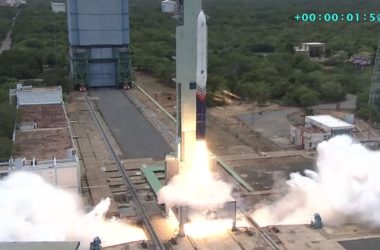
The Starship V3 test flight lit up the Texas coastline on 22 May 2026 as SpaceX sent its tallest, most powerful rocket yet into the sky above Starbase. Standing 407 feet (124 metres) from base to tip, this third-generation Starship dwarfs every launch vehicle in history. Thirty-three Raptor 3 engines ignited at once, hammering over 9,200 metric tons-force of thrust into the launch mount and shaking the ground for miles around.
It was the twelfth test flight in the Starship programme, and the first to fly the V3 hardware. The differences from earlier models are visible even from a distance. The grid fins are fewer in number but substantially larger and stronger, built to steer a vehicle that weighs more at liftoff than any rocket before it. A wider fuel transfer line runs between the Super Heavy booster and the upper-stage spacecraft, designed to handle the propellant throughput needed for orbital refuelling. And tucked around the nose are docking cones, structural provisions for the day Starship meets another vehicle in orbit or descends to the lunar surface.
The real headline from this flight, though, was what went wrong and how the rocket handled it. Roughly partway through the ascent burn, one of the three vacuum-optimised Raptor engines on the upper stage shut down prematurely. In an older generation of rockets, that might have meant a failed mission. Starship’s flight computer had other ideas. It recalculated the trajectory in real time and extended the burn duration on the remaining five engines, compensating for the lost thrust without any ground intervention.

SpaceX has built Starship from the start with enough thrust margin that losing an engine does not doom the flight. The 22 May launch was the first time V3 proved that margin in practice. For the engineers who will one day certify this vehicle to carry astronauts, that data point is worth more than a dozen clean flights.
The booster stage, having done its job, was directed to a controlled splashdown in the Gulf of Mexico. SpaceX has previously caught a Super Heavy booster with the launch tower’s mechanical arms, but for this flight, the priority was testing V3 systems rather than attempting a booster catch. The spacecraft continued on a suborbital arc, carrying 20 mock Starlink satellites in its payload bay, before re-entering the atmosphere and coming down in the Indian Ocean.
NASA is watching these flights closely. Under the Artemis programme, Starship is contracted to serve as the Human Landing System, carrying astronauts from lunar orbit to the Moon’s surface. That mission, Artemis IV, is pencilled in for 2028. But before any crew boards a Starship, NASA needs confidence that the vehicle can perform reliably, and that its propellant transfer system works in microgravity. Each test flight adds to the evidence base.
The V3 upgrades are particularly important for the lunar mission profile. The larger fuel transfer line is not just plumbing. Starship will need to be refuelled multiple times in Earth orbit before it can carry enough propellant to reach the Moon and return. Faster, more reliable propellant transfer shortens the time the vehicle spends in orbit between tanker flights, reducing boil-off losses and scheduling complexity. The docking cones signal that SpaceX is already integrating lunar-mission hardware into the production line.
There is also the question of payload. Starship’s cavernous cargo bay is designed to carry far more mass to orbit than any existing launcher. The 20 mock Starlink satellites on this flight were a modest demonstration of that capacity. Future flights are expected to carry operational satellites and, eventually, the hardware needed to build infrastructure beyond Earth.
Engineering Deep Dive: How 33 Engines Talk to One Computer
The Raptor 3 engine is a full-flow staged-combustion engine that burns liquid methane and liquid oxygen. In this cycle, both propellants are fully gasified before entering the main combustion chamber, which produces higher efficiency and cleaner exhaust than the gas-generator cycle used by most rockets. Each Raptor 3 produces roughly 280 metric tons-force of thrust at sea level.
Arranging 33 of these engines on a single booster creates a control problem that would have been unthinkable a generation ago. The Super Heavy’s thrust vector control system must coordinate gimbal angles across all 33 engines simultaneously, adjusting for differences in individual engine performance, aerodynamic loads, and trajectory commands. The flight computer runs these calculations at rates measured in hundreds of hertz, issuing updated commands to each engine’s actuators many times per second.
Redundancy is layered throughout the design. The 33-engine count is not simply about total thrust. It means the vehicle can lose multiple engines and still complete its mission, provided the failures do not cluster in a way that makes the vehicle uncontrollable. The flight computer maintains a model of the vehicle’s current capabilities and continuously replans the trajectory to account for any engine dropping offline. On the V3 test flight, this system responded to the vacuum Raptor shutdown by extending the burn time of the five remaining upper-stage engines, a manoeuvre that traded flight time for completed delta-v.
The grid fins on V3 are another case study in scaling. Grid fins act as aerodynamic control surfaces during atmospheric flight, generating large forces at transonic and supersonic speeds. Earlier Starship versions used four smaller grid fins. V3 reduces the count but increases each fin’s area and structural strength. Larger fins are more effective per unit of drag, and fewer actuator systems mean fewer potential points of failure. The fins are made from forged steel alloy, and each one must withstand enormous thermal and mechanical loads during re-entry and booster flyback.
The fuel transfer line upgrade addresses one of the most challenging engineering problems in the Starship programme: orbital refuelling. Transferring cryogenic propellant between two vehicles in microgravity requires managing fluid dynamics without gravity to settle the propellant in the tanks. The wider line increases the flow rate, which reduces the total time each tanker vehicle must remain docked at the depot Starship. SpaceX has not yet demonstrated propellant transfer in orbit, but the plumbing is now sized for the job.
Thermal protection on the V3 spacecraft uses the same hexagonal heat-shield tiles as in earlier versions. Still, the attachment system has been revised after several flights showed tiles detaching during re-entry. The tiles are made from a silica-based ceramic that can withstand temperatures above 1,400°C. Gaps between tiles are filled with a flexible ablative material that chars during re-entry, protecting the underlying steel structure. Getting this system to survive repeated flights without refurbishment remains one of the programme’s open engineering challenges.
Twelve flights in, Starship is no longer a concept vehicle. The V3 test flight demonstrated a machine capable of losing an engine and continuing to fly, carrying a meaningful payload, and incorporating hardware for missions beyond Earth orbit. The pace of iteration is remarkable by any aerospace standard. Whether the 2028 target for Artemis IV will hold depends on many factors beyond SpaceX’s control, but the rocket, at least, is getting closer to being ready with every launch.
- SpaceX launched Starship V3 on its 12th test flight from Starbase, Texas — standing 124m tall
- 33 Raptor 3 engines produced over 9,200 metric tons-force of thrust
- One vacuum Raptor shut down mid-ascent but the flight computer compensated automatically
- V3 features fewer but bigger grid fins, larger fuel transfer line, and docking cones for Moon missions
- Carried 20 mock Starlink satellites; booster went to Gulf of Mexico, spacecraft to Indian Ocean