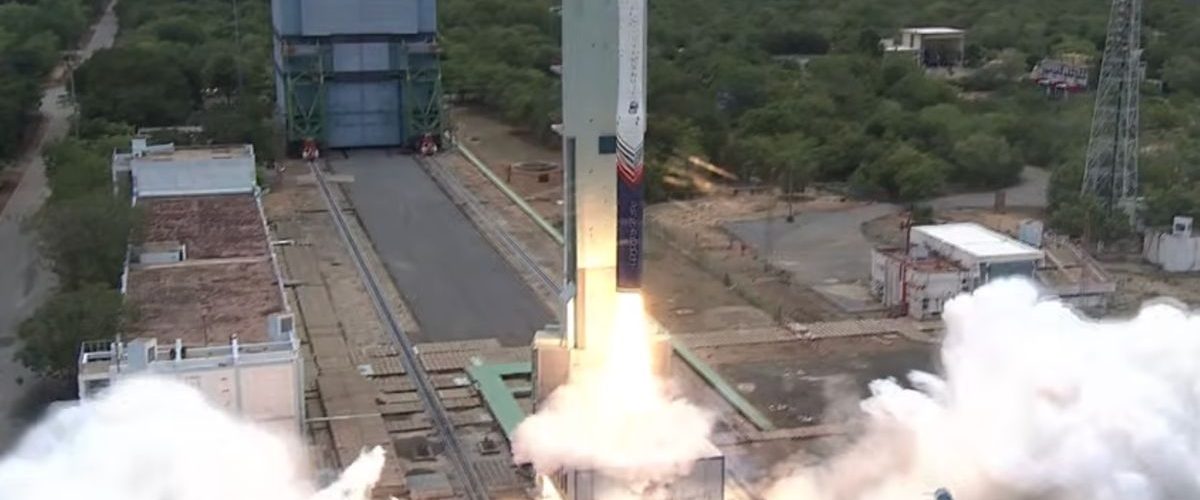
At 12:05 on a July Saturday, a blue-and-white rocket launched from the Satish Dhawan Space Centre on Sriharikota, India’s southeast coast. Seventeen minutes later, the Vikram-1 private orbital rocket deployed multiple payloads into a 450-kilometre low Earth orbit, prompting celebrations among engineers in Hyderabad. India is now the third country, after the United States and China, where a private company has placed satellites in orbit.
Skyroot Aerospace, founded in 2018 by former ISRO engineers Pawan Kumar Chandana and Naga Bharath Daka, developed the Vikram-1 private orbital rocket. The company is named after Vikram Sarabhai, founder of India’s space programme. Skyroot’s first vehicle, the suborbital Vikram-S, reached space in 2022, making it the first Indian private firm to achieve this milestone. The orbital Vikram-1 represents the next step. Its test flight, Aagaman (Sanskrit for “Arrival”), aimed to demonstrate the rocket’s capabilities.
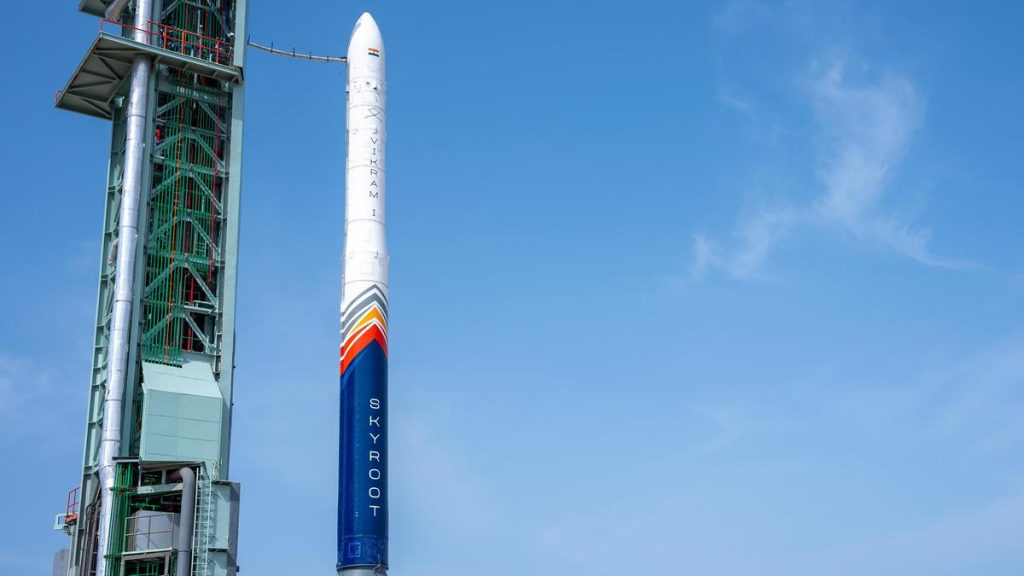
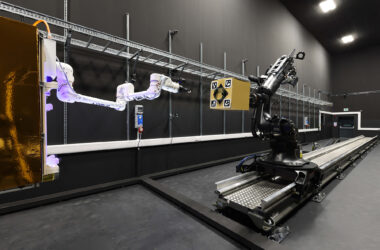
Vikram-1 stands seven storeys tall and has four stages. Its first stage uses a solid rocket motor. Vikram- 1 is seven storeys tall with four stages. Its first stage uses a solid rocket motor, producing the bright flash and rapid acceleration seen during launch. The rocket can carry about 350 kilograms to low Earth orbit, placing it in the small-satellite launcher category with vehicles such as Rocket Lab’s Electron and China’s Ceres-1 - performance data. The German company DCUBED sent a technology demonstrator. Grahaa Space, an Indian startup, flew its Solaras S3 nanosatellite pathfinder. And Cosmoserve Space contributed Embrace, a robotic arm designed to capture space debris, testing whether a compact mechanism could eventually grapple with defunct satellites tumbling through orbit.
All payloads deployed as scheduled. The mission director summarised the Vikram-1 Aagaman mission as a grand success.
The small satellite launch market is expanding faster than available rocket supply. Thousands of satellites are planned for communications, Earth observation, and research, but often must wait for ride-share slots on larger vehicles or for limited dedicated small launchers. Chandana addressed this gap: “The small satellite launch market is deeply constrained on the supply side,” he said before the flight.
Skyroot plans at least two more test flights before starting commercial operations in 2027. The company operates from its Infinity Campus in Hyderabad, which can accommodate multiple vehicles simultaneously. Since 2020, when the Government opened the space sector to private companies, India’s regulatory environment has become more supportive. Skyroot is among the first to progress from suborbital tests to orbital capability.
Lt. Gen. AK Bhatt, Director General of the Indian Space Association, called the launch “a defining milestone” demonstrating India’s domestic industry can manage end-to-end space missions. For a company founded only eight years ago by two ISRO engineers, this progress is remarkable.
Engineering Deep Dive: How the Vikram-1 private orbital rocket reaches orbit
Reaching orbit requires more than altitude. A satellite at 450 kilometres must travel at about 7.6 kilometres per second to remain in orbit; otherwise, gravity will pull it back to Earth. The rocket must convert chemical energy from its propellant into the kinetic energy needed for this velocity, overcoming gravity and atmospheric drag.
Vikram-1 uses four stages, each optimised for a specific flight phase. The first stage is a solid rocket motor burning a rubber-like composite propellant, typically hydroxyl-terminated polybutadiene with ammonium perchlorate as oxidiser and aluminium powder as fuel. Solid motors are simple, reliable, and produce high thrust relative to their weight. They cannot be throttled or shut down once ignited, but this is acceptable for the initial phase, where rapid ascent through the lower atmosphere is the priority.
The Tsiolkovsky rocket equation explains how a rocket’s velocity change (delta-v) depends on its propellant’s exhaust velocity and the ratio of initial to final mass. A single stage cannot achieve the 9 to 10 km/s delta-v needed for orbit due to the dead weight of empty structure. Staging addresses this: after the first stage burns out and is jettisoned, the next stage ignites with a reduced mass, improving efficiency. Each stage benefits from a better mass ratio.
Vikram-1’s upper stages likely use different propellants optimised for space, where atmospheric drag is absent, and specific impulse (engine efficiency) is more important than thrust. Solid motors typically provide a specific impulse of 240 to 280 seconds, while liquid-fuelled engines can reach 300 to 450 seconds, depending on the propellant. The transition from high-thrust solids to efficient upper stages balances launch thrust and in-space fuel efficiency.
The payload fairing, which protects satellites during ascent, is jettisoned once the rocket passes the densest air layers. It must withstand aerodynamic heating and vibration at maximum dynamic pressure (max-Q) but remain lightweight to conserve energy. Fairing separation typically uses pyrotechnic bolts or pneumatic pushers and must operate reliably.
Deploying multiple payloads at one altitude requires precise attitude control. After the final burn, the upper stage must orient itself for each deployment, releasing satellites sequentially to avoid collisions. Reaction control thrusters, using cold gas or hypergolic propellants, adjust orientation between deployments. The SCOPE satellite on Vikram-1 gathered telemetry on the rocket’s performance during these manoeuvres.
For those interested in aerospace business, the economics of small launchers are significant. A dedicated launch to a 450 km orbit may cost 5 to 12 million US dollars for this class of vehicle. Ride-sharing on a SpaceX Falcon 9 is cheaper per kilogram but requires customers to accept another provider’s orbit, schedule, and deployment sequence. Dedicated launchers offer flexibility, but their business viability depends on how many customers require orbits not served by ride-share options.
Skyroot’s upcoming flights will test the vehicle’s reliability across various mission profiles. If the company demonstrates consistent performance, it will enter commercial service in a market currently marked by high demand and limited supply. Other Indian startups are closely watching the opportunity that began over Sriharikota in July.
- Skyroot Aerospace’s Vikram-1 rocket reached orbit on 18 July, making India the third country with private orbital launch capability
- The four-stage rocket carried 350kg of payloads to 450km altitude in just 17 minutes
- Payloads included a space debris capture arm, a nanosatellite and a German tech demo
- Founded in 2018 by two ex-ISRO engineers, Skyroot plans commercial operations from 2027