NASA’s Jet Propulsion Laboratory, in partnership with AeroVironment, has developed the Skyfall mission concept, which could deploy six autonomous helicopters directly onto Mars without the need for traditional landing platforms.
If successful, the mission would launch by 2028 and advance site reconnaissance for future human exploration of Mars.
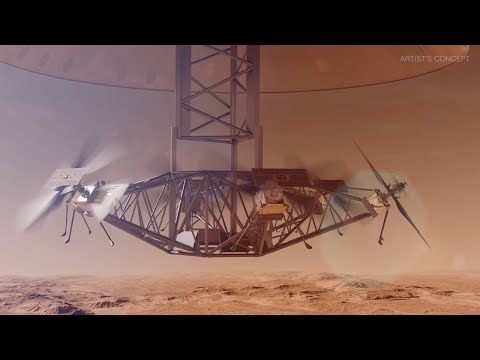
The Skyfall concept eliminates conventional landers by releasing helicopters mid-flight during atmospheric entry. The entry capsule will deploy all six aircraft while descending through Mars’ thin atmosphere, allowing each helicopter to navigate to predetermined exploration zones autonomously.
This approach is designed to tackle both the cost and difficulty that have historically constrained Mars missions.
Traditional landing systems require extensive engineering for precise touchdown capabilities, heat shields, and deployment mechanisms. The Skyfall method reduces these requirements by distributing reconnaissance across multiple autonomous platforms.
William Pomerantz, Head of Space Ventures at AeroVironment, stated the mission “offers a low-cost solution that multiplies the range we would cover, the data we would collect, and the scientific research we would conduct.”
Each helicopter will conduct parallel reconnaissance operations across regions selected by NASA for potential human landing sites. The aircraft will capture high-resolution surface imagery and collect subsurface radar data to assess terrain stability, resource availability, and landing feasibility.
The mission targets areas with significant water ice deposits and other essential resources for sustaining a human presence. This data collection approach enables simultaneous multi-site evaluation rather than sequential exploration methods used in previous missions.
Autonomous Flight Systems in a Martian Atmosphere
Mars presents unique engineering challenges for rotorcraft operations that differ substantially from Earth-based flight systems. The planet’s atmospheric density is approximately 1% that of Earth’s, requiring specialised rotor designs and control systems to generate sufficient lift.
Mars’ thin atmosphere requires larger rotor diameters relative to aircraft mass compared to those of Earth helicopters. The reduced atmospheric density decreases rotor efficiency, requiring higher rotational speeds to maintain flight stability. Engineers must balance rotor size against structural weight constraints while ensuring adequate lift generation.
Temperature variations on Mars range from -80°C to 20°C, which affects material properties and the performance of electronic components. Battery systems face particular challenges, as lithium-ion cells experience reduced capacity in frigid temperatures. Thermal management systems must maintain operational temperatures for avionics while minimising power consumption.
Mars helicopters operate with communication delays of 4-24 minutes to Earth, making real-time control impossible. Autonomous flight systems must process sensor data, make navigation decisions, and execute flight manoeuvres without ground intervention.
Inertial measurement units (IMUs) provide acceleration and rotational velocity data for flight control algorithms. GPS navigation is unavailable on Mars, requiring alternative positioning methods, including visual odometry systems that track ground features and terrain-relative navigation using pre-loaded maps.
Solar panels provide primary power generation, but dust accumulation reduces efficiency over time. Power management systems must balance energy consumption between flight operations, data collection, communication, and survival heating during Martian nights.
Energy storage requirements include capacity for multiple flight cycles, overnight heating, and peak power demands during takeoff and landing. Thermal regulation of battery systems prevents capacity degradation while maintaining operational readiness across a wide range of temperature extremes.
Each helicopter requires independent communication capabilities to relay collected data to orbiting satellites or transmit directly to Earth. Data compression algorithms optimise transmission efficiency given bandwidth limitations and power constraints.
Antenna design considerations include omnidirectional coverage for varying flight orientations and sufficient gain for long-distance communication. Signal processing systems must account for atmospheric interference and Doppler effects during flight operations to ensure accurate data collection.
In addition, Mars’ lower gravity (38% of Earth’s) affects rotor dynamics and structural loading patterns. While reduced gravitational forces decrease power requirements for lift generation, they also alter flight control responses and landing impact characteristics.
Dust storm conditions can persist for months on Mars, necessitating protective measures for moving components and sensor systems. Sealing technologies must prevent fine dust infiltration while maintaining component accessibility for thermal cycling and operational requirements.

The Skyfall mission will use components and technologies validated by NASA’s Ingenuity helicopter, which completed 72 flights over nearly three years of operations. Initially designed for five test flights, Ingenuity demonstrated the viability of powered flight in Mars’ atmosphere and provided operational data for future missions.
NASA will transfer proven avionics, flight software, and modelling techniques from Ingenuity to the Skyfall program. This technology transfer reduces development risks and accelerates mission readiness by building on tested systems rather than developing entirely new platforms.
The extended operational life of Ingenuity provided valuable data on component durability, battery performance degradation, and maintenance requirements for Mars helicopter operations. These insights inform design decisions for the six Skyfall aircraft and their expected mission duration.
Skyfall’s primary objective is to identify and characterise the resources necessary for human Mars missions. The helicopters would simultaneously map water ice deposits, mineral compositions, and terrain features across multiple candidate landing sites.
Subsurface radar systems aboard each helicopter will penetrate surface layers to detect buried ice deposits and assess soil composition. This capability extends beyond surface observation to provide three-dimensional resource mapping, which is essential for mission planning.
High-resolution imaging will document surface hazards, boulder distributions, and slope characteristics that affect landing site safety. The comprehensive data collection approach enables comparative analysis across multiple sites, optimising selection for human missions.
AeroVironment has initiated internal investments and coordination with JPL to support the 2028 launch target. The partnership combines AeroVironment’s expertise in uncrewed aircraft with JPL’s experience in planetary exploration.
Current development phases include component testing, flight software validation, and refinement of the mission architecture. The accelerated timeline relies on proven technologies from Ingenuity, while incorporating improvements to enhance capability and reliability.
If the development schedule progresses as planned, Skyfall could provide critical reconnaissance data several years before planned human missions to Mars, enabling informed site selection and resource utilisation planning.
The successful implementation of the Skyfall mission would push forward NASA’s human Mars exploration timeline by providing detailed site data. The mission directly supports crew landing site selection and resource utilisation planning for maintaining a sustained human presence.
The cost-effective reconnaissance approach demonstrated by Skyfall could establish a model for future Mars exploration missions. Multiple autonomous platforms provide redundancy and expanded coverage compared to single-point missions while reducing overall mission costs.
If Skyfall achieves its objectives, the mission will contribute to NASA’s research on the habitability of Mars and the availability of its resources. This scientific data supports both robotic and human exploration planning while advancing understanding of Martian environmental conditions.
The mission could be a significant step toward distributed exploration methodologies that could scale to support expanded human operations on Mars. Success would prove the concept of multiple platforms working in coordination to achieve complex exploration objectives.