Eurostar has announced plans to introduce double-decker high-speed trains through the Channel Tunnel, marking a significant engineering milestone for UK rail infrastructure. The operator has signed a €2 billion deal with manufacturer Alstom for up to 50 new Celestia trains, with the first units expected to enter service in 2031.
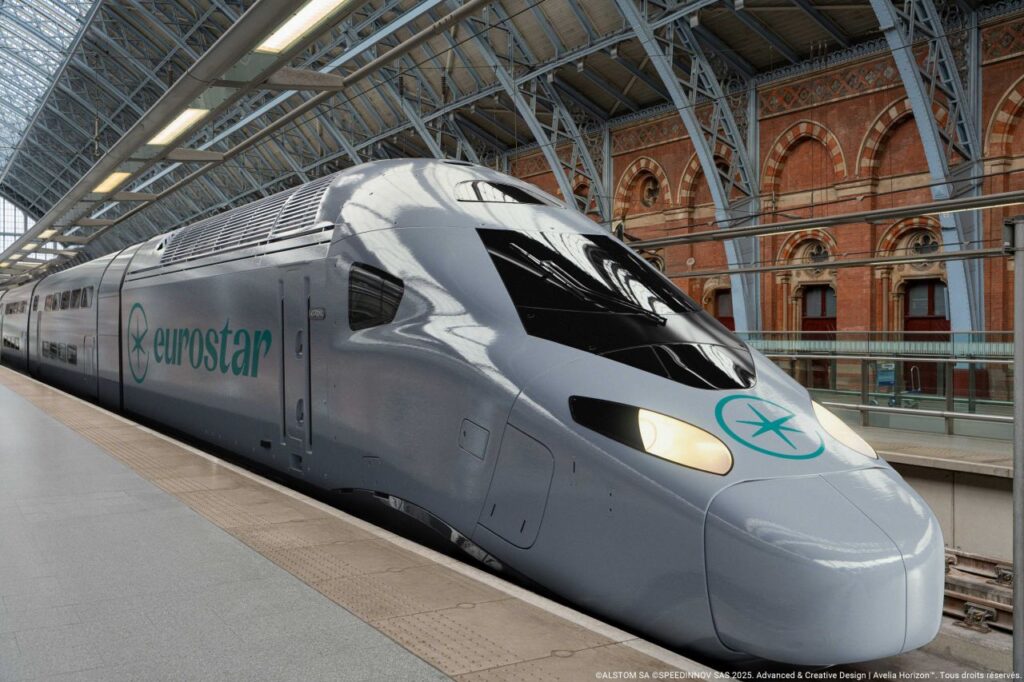
The new trains will be the first double-decker high-speed rail vehicles to operate on UK mainland tracks, each capable of carrying more than 1,000 passengers when two 200-meter units are coupled together. At 4.33 meters in height, the Celestia trains stand just 16 centimetres taller than current E320 models, yet provide approximately 20 percent more seating capacity through their innovative two-level design.
This engineering achievement addresses the growing demand for international rail travel while working within the strict dimensional constraints of the Channel Tunnel. The tunnel’s original design specifications, established during its construction in the late 1980s, set precise limits on train heights to ensure safe clearance and proper ventilation within the underwater passage. Engineers at Alstom have maximized passenger capacity while maintaining compatibility with existing infrastructure, achieving what previous generations of railway designers considered technically unfeasible.
The development comes as Eurostar seeks to expand its passenger numbers from 19.5 million annually to 30 million, part of an ambitious growth strategy that includes new routes to Geneva and Frankfurt. The company plans to maintain its expanded fleet at the Temple Mills depot in northeast London, investing an additional €80 million in facility upgrades and creating 350 jobs.
Understanding the Engineering Behind Double-Decker High-Speed Rail
The introduction of double-decker trains through the Channel Tunnel represents a complex engineering challenge that combines aerodynamics, structural design, and safety systems. For engineering students, this development offers insights into how modern rail technology pushes boundaries while respecting infrastructure limitations.
The fundamental challenge lies in the relationship between train cross-section and tunnel diameter. The Channel Tunnel has an internal diameter of 7.6 meters for the running tunnels, with trains operating within a carefully calculated envelope that ensures adequate clearance for aerodynamic effects and emergency evacuation. When trains travel at speeds up to 300 kilometers per hour through confined spaces, they create significant pressure waves that propagate through the tunnel. Engineers must account for these pressure variations, which can cause passenger discomfort and structural stress if not properly managed.
The Celestia trains achieve their double-decker configuration through advanced lightweight materials and optimized structural design. Traditional rail vehicles use steel construction throughout, but modern high-speed trains incorporate aluminum alloys and composite materials to reduce weight while maintaining structural integrity. This weight reduction becomes critical in double-decker designs, where the center of gravity rises compared to single-level trains. Engineers compensate for this higher center of gravity through sophisticated suspension systems that maintain stability during high-speed cornering and crosswind conditions.
The aerodynamic design of these trains involves computational fluid dynamics modelling to minimise drag and manage airflow patterns. The nose cone shape, critical for reducing aerodynamic resistance, must be optimized for both forward and reverse operation while accommodating the taller profile. Engineers use parametric design techniques to iterate through thousands of potential configurations, balancing aerodynamic efficiency with interior space utilization.
Power distribution presents another engineering consideration. Double-decker trains require careful planning of electrical systems to serve both levels efficiently. The overhead catenary system that supplies 25,000 volts AC must feed power converters and traction motors capable of accelerating the increased passenger load while maintaining schedule reliability. Engineers typically position heavy components like transformers and power electronics in the lower level to keep the center of gravity as low as possible.
The structural design must also accommodate emergency evacuation requirements. European rail safety standards mandate that all passengers must be able to evacuate within specified timeframes, requiring engineers to design stairways and doors that prevent bottlenecks while maximizing seating capacity. The internal layout uses advanced crowd flow modeling to ensure passengers from the upper deck can reach exits quickly and safely.
The technical specifications reveal careful attention to operational compatibility. The trains will undergo extensive certification processes across multiple countries, as each national rail authority maintains distinct safety and operational standards. This certification process, expected to take several years, will validate everything from electromagnetic compatibility with signaling systems to crashworthiness standards that protect passengers in collision scenarios.
Temple Mills depot in London will require significant modifications to accommodate the new fleet. The facility must be equipped with specialized maintenance platforms that allow technicians to access the upper deck for inspection and repairs. Overhead gantries and lifting equipment need reconfiguration to handle the increased height, while maintaining efficiency in routine maintenance operations.
The economic engineering of this project extends beyond the trains themselves. By increasing capacity without requiring additional train paths through the tunnel, Eurostar can improve revenue per service while potentially reducing per-passenger operating costs. The fixed costs of train operation-driver wages, track access charges, and energy consumption-remain relatively constant whether a train carries 800 or 1,000 passengers, creating economies of scale that could influence ticket pricing.
However, the broader application of double-decker technology across Britain’s rail network faces significant infrastructure constraints. Much of the UK rail system dates back to the Victorian era, with thousands of bridges, tunnels, and station canopies built to accommodate the loading gauge established in the 1840s. The high-speed line between St Pancras and the Channel Tunnel was constructed to European loading gauge standards, allowing it to accommodate taller trains. However, retrofitting the conventional network would require extensive and costly infrastructure modifications.
The ventilation dynamics within the Channel Tunnel add another layer of complexity. The tunnel’s ventilation system was designed with specific assumptions about train cross-sections and speeds. Engineers must verify that the slightly taller trains won’t adversely affect air circulation patterns or emergency smoke extraction capabilities. Computational modelling and scale testing in wind tunnels help validate these critical safety parameters before the trains enter service.
Looking ahead, the success of these double-decker trains could influence future high-speed rail projects. If the technology proves effective in increasing capacity without proportionallygrowingg operational costs, other operators might consider similar solutions for congested rail corridors. The engineering lessons learned from integrating taller trains into existing infrastructure could inform design standards for future rail projects, potentially establishing new benchmarks for passenger capacity and operational efficiency.
The Celestia trains represent an evolution in rail engineering that strikes a balance between innovation and practicality. While the fundamental physics of rail transport remain unchanged, engineers continue to find ways to optimise within existing constraints, demonstrating that significant capacity improvements remain possible even in mature transportation systems.
TLDR
- Eurostar orders 50 new Alstom Celestia double-decker trains in €2 billion deal, operational by 2031
- First double-decker high-speed trains on the UK mainland, carrying 1,000+ passengers per coupled unit
- Trains are only 16cm taller than current models but offer 20% more seating capacity
- Engineering breakthrough overcomes Channel Tunnel’s strict dimensional constraints
- Part of the expansion plan to grow from 19.5 million to 30 million passengers annually
- €80 million investment in Temple Mills depot upgrades, creating 350 jobs
- Complex engineering challenges include aerodynamics, structural design, and safety systems
- Extensive multi-country certification process required before service entry