Three hundred and three seconds. Just over five minutes of continuous burn from a combustion chamber the size of a small suitcase, with no mechanical compressor, no turbine-driven air intake, and no fossil fuel. That is the new world record for a compressorless hydrogen gas turbine, set by engineers at Karlsruhe Institute of Technology (KIT) in Germany, and it represents a quiet but substantial shift in how we might generate clean electricity.
NASA held the previous record of 250 seconds. KIT’s team, led by Professor Daniel Banuti at the Institute of Thermal Energy Technology and Safety, did not just edge past it. They redesigned combustion physics from first principles, building a system that generates the high pressures needed for efficient combustion without any moving parts.
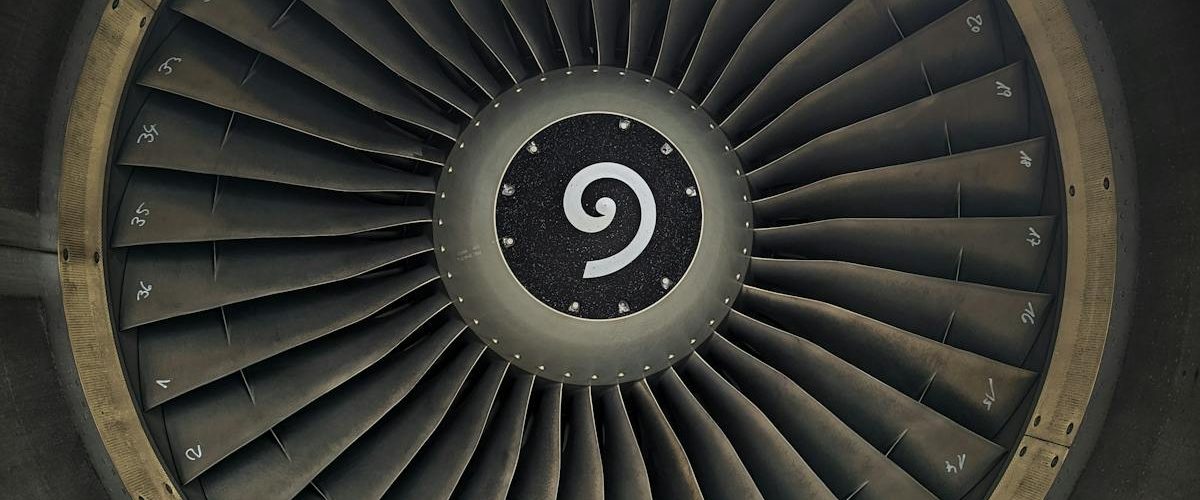
A conventional gas turbine, the kind bolted under a Boeing 737’s wing or inside a power station, devotes roughly half its output to compressing incoming air. That compression is necessary because combustion is more efficient at high pressure, but it means that a huge proportion of the energy produced never reaches the grid or the propeller. It is consumed internally, spinning the compressor blades that feed the cycle.
Banuti’s team eliminated that entire stage. Their system uses pressure-gain combustion, a process in which detonation waves within the chamber generate the high pressures themselves. These waves form through a fluid-mechanical instability, patterns of vortices and pressure fronts that arise naturally in the hydrogen-air flow. No pistons. No compressor blades. No mechanical compression of any kind. The result is a lighter, simpler machine with dramatically fewer moving parts and a fundamentally higher ceiling for thermal efficiency.
Earlier this year, the KIT team coupled a turbine to the combustion chamber and, for the first time, generated electricity from the process. That step sounds straightforward, but it is anything but. The intense, rapid detonation cycles inside the chamber make stable energy transfer to a turbine fiendishly difficult. “We are the first to successfully operate such a turbine and generate electricity in the process,” Banuti said. The team presented the compressorless hydrogen gas turbine at Hannover Messe in April 2026.
Engineering Deep Dive: Gas Turbines
To understand why this matters, start with the thermodynamic cycle that governs every conventional gas turbine: the Brayton cycle. Air enters the compressor, where its pressure and temperature rise. It then enters the combustion chamber, mixes with the fuel, and ignites. The hot, high-pressure exhaust gases expand through a turbine, which drives both a generator and, critically, the compressor itself. The work extracted by the turbine minus the work consumed by the compressor equals the net useful output. In practice, compression eats between 40 and 60 per cent of the turbine’s gross output.
Pressure-gain combustion sidesteps this penalty entirely. Instead of burning fuel at roughly constant pressure (as in a conventional gas turbine), the hydrogen-air mixture detonates. A detonation wave travels supersonically through the gas, compressing and igniting it simultaneously. The pressure behind the wave front is significantly higher than the pressure ahead of it, which means the combustion process itself generates the high-pressure conditions needed for efficient energy extraction. No external compressor is required.
The specific type of pressure-gain combustion used by the KIT team relies on rotating detonation waves. Inside a cylindrical or annular chamber, one or more detonation waves spin continuously around the circumference. Fresh hydrogen and air are injected at one end, the wave front detonates the mixture as it passes, and the high-pressure exhaust exits at the other end. The wave sustains itself through the continuous supply of reactant gas.
A-level Physics students will recognise some of the principles at work here. The distinction between deflagration (subsonic burning, like a candle flame) and detonation (supersonic combustion, like an explosion) appears in the study of wave mechanics and pressure. The concept of thermodynamic efficiency, the ratio of useful work to heat input, connects directly to the Carnot cycle taught at A-level. However, gas turbines use the Brayton cycle rather than the idealised Carnot cycle.
One reason previous attempts at pressure-gain combustion lasted only fractions of a second was the need for thermal management. The detonation waves produce extreme localised temperatures that can melt conventional combustion chamber materials in moments. The KIT team’s engineering solution involved advanced cooling strategies and chamber geometries that manage heat distribution without quenching the detonation process. Extending the runtime from fractions of a second to over five minutes required solving a materials science problem as much as a combustion physics one.
Hydrogen is particularly suited to this approach because it has the highest laminar flame speed of any fuel, roughly 2.5 metres per second in air at standard conditions, and detonates more readily than hydrocarbon fuels. Its low molecular weight also means higher exhaust velocities, which improve turbine performance. Because hydrogen can be produced from water using renewable electricity via electrolysis, the entire system can, in principle, operate without any carbon emissions.
The coupling challenge, connecting a turbine to the pulsating exhaust of a detonation chamber, is an active area of research worldwide. The pressure and temperature fluctuations at the chamber exit are extreme and rapid, resulting in cyclic loading that conventional turbines are not designed for. KIT’s success in generating electricity from this arrangement, even at a laboratory scale, is a meaningful step toward practical machines.
Plenty of engineering distance remains between a five-minute laboratory demonstration and a commercial power plant. The materials need to survive thousands of hours, not hundreds of seconds. The turbine coupling needs to scale up. And the economics of hydrogen production must continue to improve. But the underlying physics is now proven at a level that no previous group had achieved, and the potential prize, gas turbines that convert a far greater share of their fuel energy into electricity, is large enough to keep the engineering effort moving.
- KIT engineers ran a compressorless hydrogen gas turbine for 303 seconds, beating NASA’s 250-second record
- The system uses pressure-gain combustion with detonation waves instead of a mechanical compressor
- Conventional gas turbines waste up to 50% of output on air compression, which this design eliminates
- The team generated electricity from the turbine for the first time
- The technology was presented at Hannover Messe in April 2026