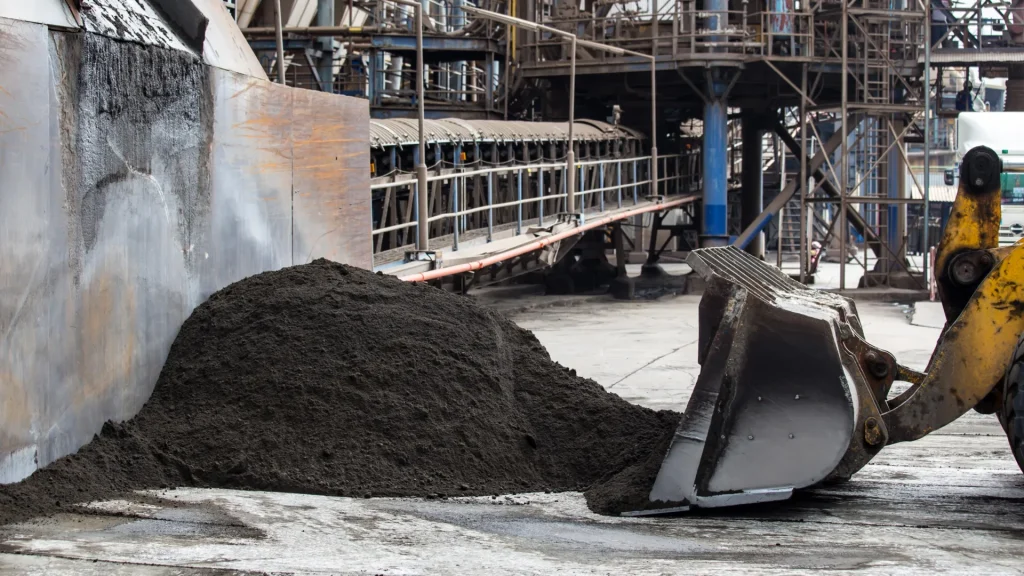
You wouldn’t normally think of coal ash when considering the future of high-technology supply chains since it is grey, powdery, slightly toxic, and is stored in huge impoundments located near power stations all over the United States. About 100 million tonnes of it are produced each year by coal-fired power stations, and most of it remains there, presenting a difficult waste management problem with the only profitable use being its incorporation into concrete.
There is one thing that coal ash contains which is valuable. Spread throughout the entire amount of that grey powder are rare earth elements, such as neodymium, dysprosium, lanthanum, cerium, and a dozen more. These elements are what enable the production of permanent magnets for wind turbines and electric vehicle motors, act as catalysts in the refining of petroleum, serve as phosphors in LED lighting, and are essential parts of defence systems. Although the United States currently imports the vast majority of its rare earth elements from China, American coal ash stores are estimated to contain about 11 million tonnes of rare earth elements worth $8.4 billion; that amount is eight times the value of the country’s known domestic reserves which have up until now been regarded as rubbish.
A New Approach to Rare Earth Recovery from Coal Ash
A project with a budget of $3.3 million and lasting five years, which is being carried out at Worcester Polytechnic Institute, is attempting to achieve something that conventional chemical engineering has had difficulty with. The group, with Mingjiang Tao as its principal investigator, is not pursuing the usual methods of dissolving the ash in acid or roasting it at very high temperatures, since these methods may work in principle but are too energy-intensive and produce their own waste streams. Instead, they are considering the use of organisms.
They are particularly looking into how the process of recovering rare earth elements from coal ash could make use of mechanisms found in living organisms that have already worked out the problem of extracting specific minerals from dilute and messy mixtures. Diatoms, which are single-celled algae having highly structured silica shells, extract silicon from seawater at ordinary temperatures and then form it into structures that would need a laboratory furnace at 1,000°C. Sea sponges produce their spicules from silica by means of enzymatic processes at ocean temperatures, and there are also certain plants, known as hyperaccumulators, which are able to selectively absorb metals from soil that contains only trace amounts.
In short, nature has taken billions of years to evolve molecular machinery capable of selectively extracting minerals; the aim of the WPI project is to understand that machinery and then carry out a synthetic replication of it.
Engineering Deep Dive: How Biomolecules Might Sort Rare Earths at the Atomic Level
The main difficulty involved in recovering rare earth elements from coal ash is not locating the elements in question since analytical chemistry can give you a precise account of what is present. The problem lies in selectivity; the rare earth elements are chemically very similar to one another, which is in fact the reason for their being placed in the same group on the periodic table, and they are mixed in with much larger amounts of aluminium, silicon, iron and calcium. It is extraordinarily difficult to separate neodymium from cerium and from lanthanum when all three have almost identical behaviour in solution.
The usual method of hydrometallurgical separation is solvent extraction: you dissolve all the materials in acid and then pass the solution through a series of organic solvents which have slightly different affinities for each element. This method does work, but it needs huge quantities of both acid and organic solvents, produces wastewater that must be treated, and uses a great deal of energy. In the case of high-grade ores containing concentrated rare earth elements, the economic feasibility holds up; for coal ash, where the concentrations are as low as a few hundred parts per million, it generally does not.
The bio-inspired method is fundamentally different since, rather than dissolving all the components and then separating them, it aims to selectively bind the desired elements directly from the ash by using molecules capable of recognising specific atomic geometries.
Proteins and peptides are able to tell the difference between atoms that vary by just one proton. Bacteria produce iron-binding molecules known as siderophores, the binding affinity of which is so great that they effectively remove iron atoms from rust. The reason for this selectivity lies in geometry: the binding site of a siderophore has oxygen atoms positioned at the correct distances and angles so as to coordinate an iron(III) ion; if the geometry is altered even slightly the molecule will bind a different metal or nothing at all.
The WPI group is applying computational modelling and AI in order to design synthetic peptides with binding sites that are tailored to specific rare earth ions. The ionic radii of the rare earth elements decrease gradually throughout the series (this is known as the ‘lanthanide contraction’), ranging from 1.03 angstroms for lanthanum(III) to 0.86 angstroms for lutetium(III). Although this is a small range, biomolecules are capable of telling the difference between ions that differ by hundredths of an angstrom.
The AI aspect speeds up what would normally be an extremely slow process of trial and error. By using machine learning models that have been trained on data regarding protein-metal binding it is possible to predict the amino acid sequences that will have a high affinity and selectivity for a particular rare earth ion. The team then produces the most promising of these candidates, tests them using actual coal ash leachates and feeds the results back into the model. After each cycle the range of possible options becomes smaller.
Taking the approach from something that is just a laboratory curiosity into an industrial process brings with it its own set of problems. The synthetic biomolecules have to be stable enough to work in the acidic and high-ionic-strength conditions of ash leachate. They must be recoverable and reusable, since it would be far too expensive to synthesise new peptides for each batch. Also, the kinetics are important: a molecule which binds neodymium with excellent selectivity but takes a week to reach equilibrium is not suitable for processing millions of tonnes of ash.
The five-year timetable of the project shows these difficulties in scaling up. In the first stage the focus is on the basic binding chemistry. During the intermediate stage prototype extraction systems are developed by using biomolecules immobilised on solid supports, that is to say columns through which the leachate can flow. In the last stage pilot-scale demonstrations will be carried out using real coal ash from power stations.
The idea as a whole has a certain elegance about it. Coal ash is produced since we have used ancient plant material as a source of energy. The rare earth elements in that ash were originally spread out in the soils where those plants grew, had become concentrated through geological processes over millions of years, and were then re-distributed when the coal was burned and the residue collected. The present plan is to make use of biological principles, which have developed alongside the same geological processes, in order to concentrate the elements once again. It is, in a way, a cycle. It is not yet clear whether or not the cycle will close on an industrial scale, but with $3.3 million in funding and five years in which to try, the WPI team has the opportunity to find out.