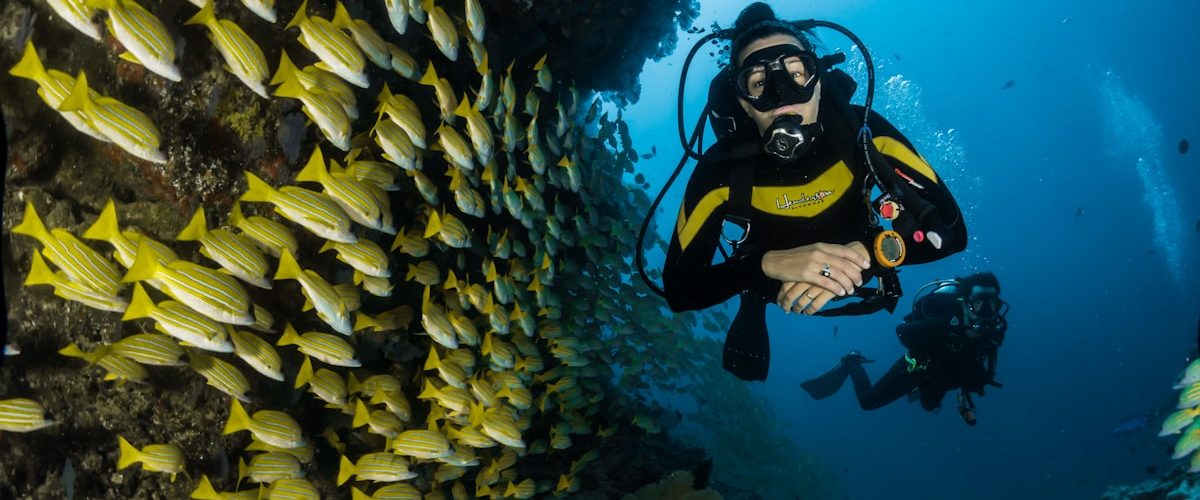
Every scuba diver knows the arithmetic of air. A standard 12-litre cylinder at 200 bar holds about 2,400 litres of breathing gas. At a depth of 20 metres, where ambient pressure triples, a moderately fit diver burns through that supply in roughly 40 minutes. Anything that reduces oxygen consumption extends bottom time, and bottom time is the currency of every commercial dive operation, every naval clearance mission, every underwater survey.
A team at the Shenzhen Institutes of Advanced Technology has built a device that changes the arithmetic. Their underwater diving exoskeleton, a wearable robotic system that assists the diver’s leg movements, reduced oxygen consumption by 40 per cent in controlled testing. If the figure holds in open-water conditions, it could transform how long divers stay submerged, as reported by Interesting Engineering.
The system mounts motors at the waist, with cable-driven actuators running down to the knees. Sensors track leg position and motion in real time. The critical innovation is an algorithm called the Ultra-Robust Adaptive Oscillator, or URAO, which monitors the diver’s kick cycle, determines its speed and phase, and applies assistive torque at precisely the right moment. The diver does not need to learn how to use the system. The system learns the diver.
That last point matters more than it might seem. Previous underwater exoskeletons required calibration for each user, or worked only with a specific kick style. The URAO algorithm adapts on the fly to both freestyle (flutter) and breaststroke kicks, and adjusts instantly when the diver changes speed or direction. The researchers describe it as “plug and play,” and the test data support the claim: quadriceps and calf muscle activation dropped by more than 20 per cent alongside the 40 per cent reduction in oxygen consumption, with the assistance described by divers as “nearly imperceptible.”
Engineering Deep Dive: Adapting to a Moving Target in a Viscous Medium
Building an exoskeleton for land is hard. Building one for water is harder. On land, the primary forces acting on a walking human are gravity and inertia, both predictable. Underwater, the dominant force is hydrodynamic drag, which is proportional to the square of velocity and depends on the orientation and shape of the limb at every instant. A diver’s legs do not move in a simple pendulum arc. They flex, rotate, and change profile continuously, generating drag forces that shift in magnitude and direction with each kick phase.
The URAO algorithm addresses this by treating the diver’s leg motion as a periodic oscillation and estimating its fundamental frequency and phase in real time. For A-level Maths students, this is an application of Fourier analysis: any periodic motion can be decomposed into a sum of sinusoidal components. The algorithm does not need the full Fourier series. It tracks the dominant frequency and phase of the kick, which is sufficient to determine when to apply assistive torque (during the power stroke) and when to back off (during the recovery stroke).
The “ultra-robust” part of URAO refers to its handling of non-stationary signals. A diver does not kick at a constant frequency. They speed up, slow down, pause, and change stroke entirely. Most adaptive oscillator algorithms lose synchronisation during such transitions and require several cycles to re-lock. URAO uses a convergence mechanism that re-estimates frequency and phase within a single kick cycle, fast enough that the diver never notices a lag in assistance. The mathematics behind this involves nonlinear dynamical systems, a topic that first-year engineering undergraduates encounter in control theory modules.
The cable-driven actuation is a deliberate engineering choice. Rigid geared transmissions, common in land-based exoskeletons, add bulk and create hard points that increase hydrodynamic drag. Cables are flexible, low-profile, and can route around the body’s natural contours. The trade-off is that cables can stretch under load and are susceptible to corrosion in saltwater. The Shenzhen team mitigates this with stainless steel cables in sealed conduits, a design borrowed from bicycle brake cable systems but scaled for higher forces.
The 40 per cent reduction in oxygen is the headline, but the underlying mechanism is worth understanding. Oxygen consumption in diving is driven primarily by muscular effort: the harder the muscles work, the more oxygen the body demands. By reducing quadriceps and calf activation by 20 per cent, the exoskeleton cuts the metabolic cost of swimming. The relationship is not linear, though. Metabolic rate scales with muscular force output, but also with the efficiency of the movement pattern. The exoskeleton may improve efficiency and reduce force by smoothing the diver’s kick and reducing turbulent wake structures behind the legs. Computational fluid dynamics studies are planned to investigate this.
Sealing electronics and motors against seawater is an engineering challenge in itself. The system must withstand pressures of several atmospheres at operating depth, resist chloride-induced corrosion, and remain neutrally buoyant so it does not alter the diver’s trim. The motor housings use O-ring seals rated for depths beyond 40 metres, with pressure-compensated oil-filled cavities to equalise internal and external pressure. A-level Physics students will recognise this as an application of Pascal’s principle: pressure applied to a confined fluid transmits equally in all directions.
For students interested in robotics or biomechanics, the broader lesson is that the most effective assistive devices work with the body rather than imposing a pattern on it. The URAO algorithm does not tell the diver how to kick. It observes the diver’s kicks and provides assistance accordingly. This philosophy, sometimes called “assist as needed,” is increasingly dominant in rehabilitation robotics and wearable exoskeletons for both medical and industrial applications.
The Shenzhen team plans further testing in open water with varied depths, currents, and visibility conditions. They are also investigating lighter materials and additional sensors for heart rate monitoring. The gap between a swimming pool trial and operational deployment is significant. Still, the underlying engineering, an adaptive algorithm that works without calibration in a medium that resists every movement, is the hard part. And that appears to be solved.
- Researchers at the Shenzhen Institutes of Advanced Technology built a robotic underwater exoskeleton that cuts diver oxygen use by 40%
- The system uses waist-mounted motors and cable-driven actuators to assist leg movements during diving
- An algorithm called URAO adapts to any kick style in real time without requiring diver calibration or training
- Quadriceps and calf muscle activation dropped by over 20% in testing
- Applications include commercial diving, naval operations, pipeline inspections, and search and rescue