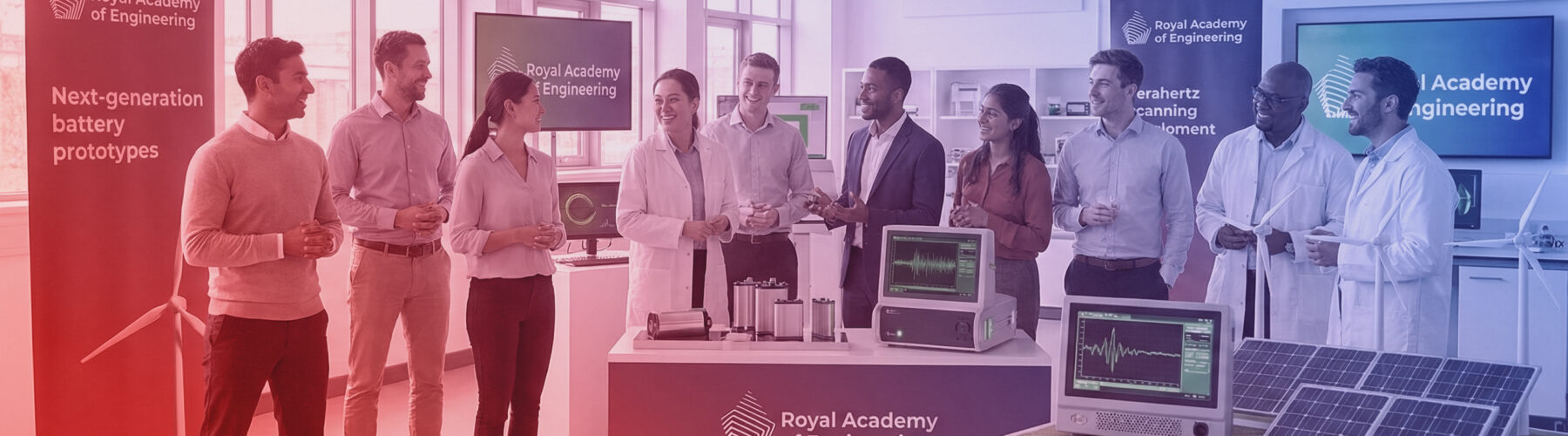
As part of the Green Future Fellowship Program, the Royal Academy of Engineering is providing a £39 million funding package to 13 engineering innovators working on climate-friendly technologies.
Each of the innovators selected for the program received £3 million. The Green Future Fellowship Program was made possible thanks to the Department for Science, Innovation and Technology. It is focused on engineering innovations with the potential to be scaled up; examples include ultra-dense batteries for aviation and terahertz-based data storage systems.
One of the 13 innovators selected to receive funding is Professor Robert House at Oxford University, who is developing battery technology that achieves four times the energy density of current lithium-ion systems. His technology could enable practical electric and hybrid aircraft by significantly reducing battery weight while either maintaining or increasing power output. One of aviation’s main issues has always been the weight-to-power ratio. Historically, this has prevented the adoption of electric flight due to the significant power required to fly an aeroplane.
Professor Laura Torrente at Cambridge University is taking a completely different approach to energy storage. She is using renewable electricity to produce ammonia from water and atmospheric nitrogen. Ammonia stores clean energy in its chemical bonds; and then can be used as a carbon-free fuel for backup power generation. The ammonia produced does not emit carbon, unlike traditional methods, which account for approximately 2% of global CO2 emissions.
The ammonia production system uses electrolysis combined with the Haber-Bosch process, but instead of fossil fuels, it is powered entirely by renewable energy. Ammonia produced can be stored indefinitely at relatively low pressure and temperature. It therefore can store seasonal energy - an ability that batteries do not have the economic capacity to provide.
How Engineering Principles Are Being Applied To Develop These Technologies
Understanding these new innovations requires an understanding of the underlying fundamental engineering principles behind each. The high-density battery technology being developed at Oxford University likely employs techniques beyond traditional lithium-ion intercalation chemistry, such as conversion reactions or multi-electron transfer processes, allowing each atom to store more electrons than conventional batteries.
Typical lithium-ion batteries store energy by having lithium ions move between electrode layers during charging and discharging. In addition, the energy density of lithium-ion batteries is limited to approximately 250 watt-hours per kilogram because each lithium atom can transfer only one electron. The new technology being developed at Oxford University likely employs materials that allow multiple electron transfers per atom, potentially employing lithium-air or lithium-sulfur chemistries. However, the latest technology faces the same engineering challenges as existing lithium-ion batteries, including electrode degradation and electrolyte stability, which the Oxford University team will need to overcome using advanced materials and cell design optimisation techniques.
The terahertz memory system being developed by Dr Rostislav Mikhaylovskiy at Lancaster University represents a paradigm shift in data storage engineering. Traditional magnetic memory generates magnetic fields using electrical currents to switch binary data represented by magnetic domains. However, the electrical resistance in the wires used to create the magnetic fields generates heat, limiting magnetic domain switching to the nanosecond range.
Terahertz radiation has frequencies between 0.1 and 10 THz and lies between microwaves and infrared on the electromagnetic spectrum. Terahertz radiation interacts with magnetic materials in ways that allow for the manipulation of electron spin on ultra-short time scales, a phenomenon known as “ultra-fast demagnetisation.” This process enables switching magnetic domains in times much shorter than those achievable with traditional magnetic switching (on the order of picoseconds). Additionally, the ultra-fast demagnetisation process produces very little heat because no electrical current flows through the material.
However, generating and controlling terahertz pulses remains a significant engineering challenge. The Lancaster University team likely employed photoconductive antennas or optical rectification in nonlinear crystals to generate terahertz radiation, and then employed metamaterial structures to focus and direct the terahertz pulses onto nanoscale magnetic domains.
For the ammonia synthesis technology, the Cambridge University team must develop a solution to couple the variable nature of renewable energy with the steady-state requirements of chemical processes. The traditional Haber-Bosch synthesis process operates at 400-500°C and 200-300 atmospheres pressure, and as such requires continuous operation for maximum efficiency. The new system likely employs plasma catalysis or electrochemical synthesis at ambient conditions and will enable rapid start-stop cycles that match the availability of renewable energy.
These technologies illustrate how modern engineering utilises a combination of materials science, thermodynamics, and electromagnetic theory to address climate-related challenges. As students study the various disciplines of engineering, they will recognise many of the concepts presented here, including electron-transfer reactions (from electrochemistry), magnetic-domain theory (from solid-state physics), and chemical equilibrium (from thermodynamics), applied to solve real-world problems.
The Green Future Fellowship Program also supported Dr Mikhaylovsky's terahertz memory technology, which could significantly decrease data centre energy consumption. Current data centres consume approximately 1% of global electricity, with cooling systems accounting for 40% of that usage. If terahertz-based systems eliminate the heat generated during data writing and reading, it should be possible to reduce cooling requirements significantly.
Some of the other fellowship recipients are approaching different aspects of the climate challenge. For example, one project uses acoustic engineering to break down per- and polyfluoroalkyl substances (PFAS), also known as “forever chemicals,” in water and soil. Acoustic engineering to break down PFAS is an alternative to high-temperature incineration, which requires temperatures above 1000°C and can produce hazardous byproducts if not adequately controlled.
Another innovation uses specially designed microbes to convert carbon dioxide into hydrogen using green electricity. This technology combines synthetic biology with electrochemistry and has the potential to provide a more efficient route to hydrogen production than traditional electrolysis, while also removing CO2 from the environment.
While the Green Future Fellowship Program provides funding to support the work of the 13 innovators, it does go further. It includes mentoring, training, and access to the Royal Academy of Engineering's network of professional engineers. The Royal Academy of Engineering intends to invest £150 million in at least 50 climate-focused engineering projects over the next 5 years to help bridge the identified funding gap for transformative climate technologies.
Like all fellowships, the Green Future Fellowship Program provides flexibility in how funds are used and allows researchers to adjust their approach to a problem as engineering challenges emerge. Unlike traditional research grants, which typically require detailed spending plans years in advance, the fellowships provided in the Green Future Fellowship Program give researchers the flexibility to pursue innovative opportunities or respond to unexpected challenges as they arise.
The selected technologies span technology readiness levels, from fundamental research breakthroughs to near-commercial systems requiring final optimisation. This diversity in technology readiness levels illustrates that the Green Future Fellowship recognises that addressing the climate crisis requires both immediate solutions and longer-term technological advancements.
Dr Hayaatun Sillem, CEO of the Royal Academy of Engineering, noted that the program focuses on commercialising innovations developed in the lab into scalable, commercially viable solutions. The focus on scaling up and commercial viability differentiates the Green Future Fellowship from purely research-based funding programs. It requires recipients to consider manufacturing processes, costs, and market-entry strategies, in addition to technical development.
The Royal Academy of Engineering is planning subsequent funding rounds to support emerging climate technologies. The experience of the current cohort of fellows will likely inform the selection criteria and support structures for future funding rounds as the organisation continues to refine its approach to accelerating climate innovation through engineering excellence.
TLDR
- Royal Academy of Engineering awards £39m to 13 climate technology innovators (£3m each)
- Key innovations include 4x energy-dense batteries for aviation and terahertz memory systems
- Oxford University is developing ultra-high-density batteries to enable electric aircraft
- Cambridge University is creating carbon-free ammonia fuel using renewable electricity
- Lancaster University is pioneering terahertz data storage to reduce data centre energy consumption
- Programme targets scalable engineering solutions from lab to commercial viability
- £150m total investment planned over 5 years for 50+ climate-focused projects
- Technologies span energy storage, data centres, manufacturing, and environmental remediation