Engineers at Zhejiang University have developed an underwater robot that swims through water using electromagnetically-driven fins rather than traditional mechanical propulsion systems. The robotic fish achieves speeds of 405 millimetres per second-approximately 1.66 body lengths per second-while maintaining the ability to turn within a radius of just 0.86 body lengths. This combination of speed and manoeuvrability approaches the natural swimming capabilities that have long inspired underwater robotics researchers.
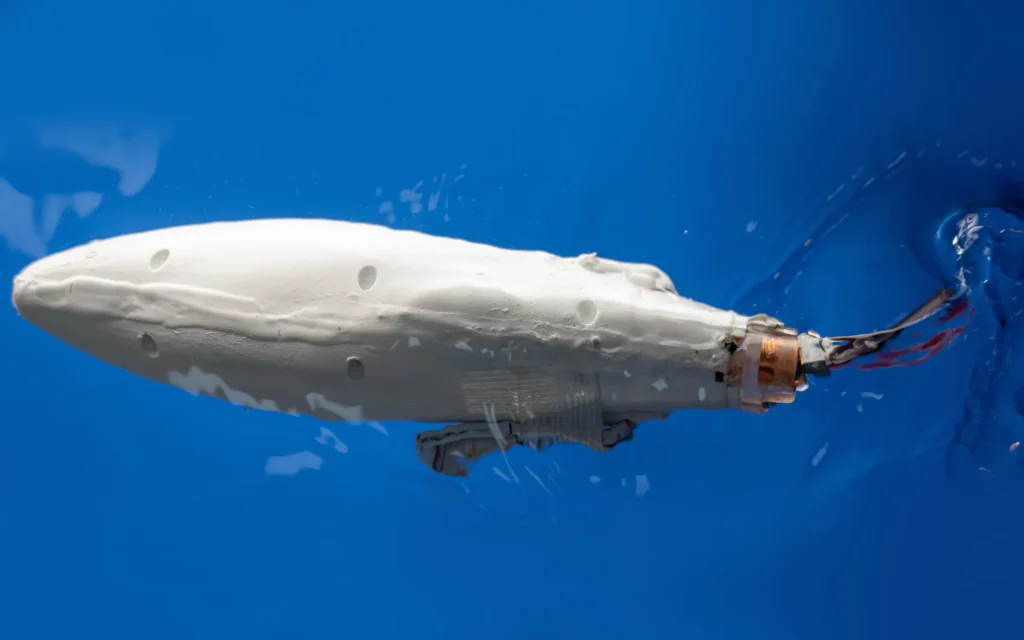
The engineering team, led by assistant professor Fanghao Zhou at the State Key Laboratory of Ocean Sensing, addressed a fundamental challenge in aquatic robotics: creating propulsion systems that combine the power of rigid mechanical systems with the flexibility of biological movement. Traditional motor-driven fins generate substantial thrust but require bulky, rigid mechanisms that limit manoeuvrability. Soft actuators offer flexibility but typically lack the power needed for practical applications. The electromagnetic fin design bridges this gap by using magnetic fields to create powerful yet flexible movement patterns.
The fin operates through an elegant electromagnetic system consisting of two small coils and spherical magnets. When alternating current flows through the coils, it generates an oscillating magnetic field that causes the fin to flap back and forth, mimicking the tail movement of a fish. The elastic joint at the fin’s base allows smooth, friction-free movement, while the absence of mechanical linkages reduces complexity and weight. When the current stops, the fin naturally returns to its neutral resting position.
Understanding the Engineering Behind Electromagnetic Fin Propulsion
The electromagnetic fin represents a convergence of several engineering disciplines, including electromagnetics, fluid dynamics, and biomechanics. At its core, the system exploits fundamental electromagnetic principles that engineering students encounter in introductory physics and electrical engineering courses.
The propulsion mechanism relies on the interaction between electric current and magnetic fields, specifically utilising the Lorentz force principle. When alternating current passes through the coils, it creates a time-varying magnetic field. This changing field interacts with the permanent spherical magnets embedded in the fin structure, generating forces that oscillate in direction. The frequency and amplitude of the alternating current directly control the fin’s flapping frequency and stroke amplitude.
From a mechanical engineering perspective, the elastic joint serves as a compliant mechanism-a single-piece flexible structure that replaces traditional multi-part assemblies. This approach eliminates friction between moving parts, reduces wear, and simplifies manufacturing. The joint’s material properties, including its elastic modulus and damping characteristics, must be carefully selected to strike a balance between flexibility and the ability to transmit forces effectively through the water.
The fluid dynamics involved present exciting challenges. As the fin moves through the water, it creates vortices that generate thrust through a process known as vortex shedding. The fin’s oscillation frequency must be tuned to optimise the formation and shedding of these vortices. Too slow, and insufficient thrust develops; too fast, and the vortices interfere destructively with each other. Engineers determined the optimal operating parameters through computational fluid dynamics simulations, which were validated against experimental measurements.
The mathematical modelling achievement deserves special attention. The research team developed equations that directly relate electrical input parameters-current amplitude, frequency, and waveform-to hydrodynamic outputs, such as thrust and efficiency. This predictive capability, rare in soft robotics applications, enables engineers to design control systems without the need for extensive trial-and-error testing. The model incorporates electromagnetic field equations, structural mechanics of the elastic joint, and fluid-structure interaction dynamics.
Material selection played a crucial role in achieving the system’s performance. The coils require conductors with minimal electrical resistance to reduce power losses, while the elastic joint material must maintain its mechanical properties when submerged in water for extended periods. Spherical magnets require a sufficient magnetic field strength while remaining compact and corrosion-resistant in aquatic environments.
During testing in a laboratory pool, the research team employed high-speed cameras and precision force sensors to characterise the fin’s performance. The measurements revealed that, despite weighing only 17 grams, the fin generated a peak thrust of 0.493 newtons-a thrust-to-weight ratio that exceeds that of many conventional underwater propulsion systems. The mathematical model developed in conjunction with the physical prototype accurately predicted these performance metrics based solely on electrical input parameters, thereby validating the theoretical framework underlying the design.
Energy Challenges and Future Developments
The current design faces significant challenges in terms of energy consumption, which limit its operational duration. The electromagnetic coils draw substantial current to generate the required magnetic field strength, depleting batteries more quickly than desired for extended missions. Engineers are exploring several approaches to improve efficiency, including optimising coil geometry to reduce resistance, implementing energy recovery circuits that capture and reuse magnetic field energy during each oscillation cycle, and developing control strategies that maintain thrust while minimising continuous power draw.
The scalability of the electromagnetic fin design offers intriguing possibilities for multi-fin configurations. Unlike mechanical systems that require complex transmission mechanisms to coordinate multiple actuators, electromagnetic fins can be synchronised through electrical control signals alone. This simplified coordination could enable robotic fish with multiple fins to work in concert, producing more complex swimming behaviours and improved manoeuvrability.
PhD student Zhe Wang, who contributed to the research, emphasises that the mathematical modelling achievement extends beyond this specific application. The ability to predict underwater behaviour from electrical inputs provides a framework for designing diverse aquatic robots without extensive physical prototyping. This predictive capability could accelerate development cycles and reduce costs for future underwater robotics projects.
Potential applications for the technology span underwater exploration, ecological monitoring, and infrastructure inspection. The soft, flexible nature of the electromagnetic fins makes them particularly suitable for operating in delicate environments, such as coral reefs, where rigid mechanical systems might cause damage. The quiet operation compared to propeller-driven systems also reduces disturbance to marine life during ecological surveys.
The research team continues to develop the technology, focusing on multi-fin coordination for more complex swimming behaviours. If energy efficiency improvements prove successful, electromagnetic fin propulsion could enable a new generation of underwater robots that combine the agility of biological swimmers with the endurance needed for practical applications. The integration of advanced control algorithms could further enhance performance, allowing robots to adapt their swimming patterns to different water conditions and mission requirements.