Engineers at the University of Virginia have developed a new technique that could enable tiny robots to traverse water surfaces much like insects, potentially opening up new applications in environmental monitoring and disaster response.
The method, called HydroSpread, allows researchers to construct soft, flexible machines directly on water surfaces. This capability circumvents fragile transfer processes that have previously limited attempts to create water-walking robots.
This new approach works by exploiting a simple physical phenomenon: when droplets of liquid polymer come into contact with water, they naturally spread into ultrathin sheets. By precisely controlling this spreading and using laser cutting to shape the resulting films, the research team can create complex robotic structures without ever lifting them from the water surface. This produces films with exceptional smoothness and uniform thickness-qualities that traditional solid-surface manufacturing struggles to achieve.
The process kicks off when researchers deposit small droplets of polydimethylsiloxane (PDMS), a flexible silicone polymer, onto the surface of ater. Within minutes, these droplets spread into circular films thinner than a human hair. The spreading occurs because the polymer seeks to minimise its surface energy, much like oil spreading on water, but in a controlled and predictable manner.
Once the polymer cures into a solid film, the team employs laser engraving to cut precise patterns. The water substrate provides an unexpected advantage here: it rapidly dissipates heat from the laser, preventing the overheating and material damage that often plague laser cutting on solid surfaces. This enhanced heat transfer allows the creation of intricate features with sharp corners and smooth edges that would be impossible to achieve through conventional methods.
Engineering Deep Dive: The Science Behind HydroSpread
The HydroSpread technique leverages fundamental principles of surface chemistry and fluid mechanics that engineering students encounter in their coursework. When a polymer droplet contacts water, its spreading behaviour depends on the balance between surface tensions at three interfaces: polymer-air, water-air, and polymer-water. This relationship, known as the spreading coefficient, determines whether and how far the droplet will spread.
The spreading dynamics follow a mathematical relationship that balances energy release from creating new interfaces against viscous dissipation within the spreading droplet. Engineers can predict the final film dimensions using equations that account for droplet volume, polymer viscosity, density differences between the polymer and water, and interfacial tensions. By adjusting these parameters-for instance, by adding ethanol to the water to alter its surface tension-engineers can precisely control film thickness, ranging from hundreds of nanometers to several micrometres.
The laser patterning phase presents its own engineering challenges. When cutting materials, excess heat typically causes unwanted melting or burning around cut edges. The HydroSpread method solves this through the unique thermal properties of the water substrate. Water’s high specific heat capacity (4,182 J/kg·K, compared to silicon’s 700 J/kg·K) and its ability to convect heat away from the cutting zone create a highly localised temperature field. Finite element analysis reveals that the temperature drops to safe levels within millimetres of the laser spot, compared to centimetres in solid substrates.
To create motion, engineers exploit differential thermal expansion in bilayer structures. By combining pure PDMS with PDMS containing carbon nanotubes, they make films where the two layers expand at different rates when heated. This mismatch generates internal stresses that cause bending or buckling, depending on the material’s geometry. The critical parameter determining which deformation mode occurs is the ratio of the thermal-induced bending moment to the resistance provided by water’s surface tension.
The buckling mechanism follows beam theory (just modified for liquids). Unlike beams on solid supports, where boundary conditions are fixed, the water surface provides a compliant foundation with resistance proportional to the vertical displacement. This creates a unique stability landscape where specific geometries naturally transition from flat to buckled states at particular temperatures. Engineers can predict these transitions using energy minimisation principles, comparing the elastic energy stored in deformation against the work required to deform the water surface.
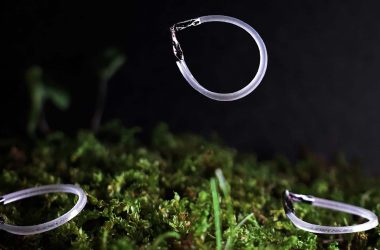
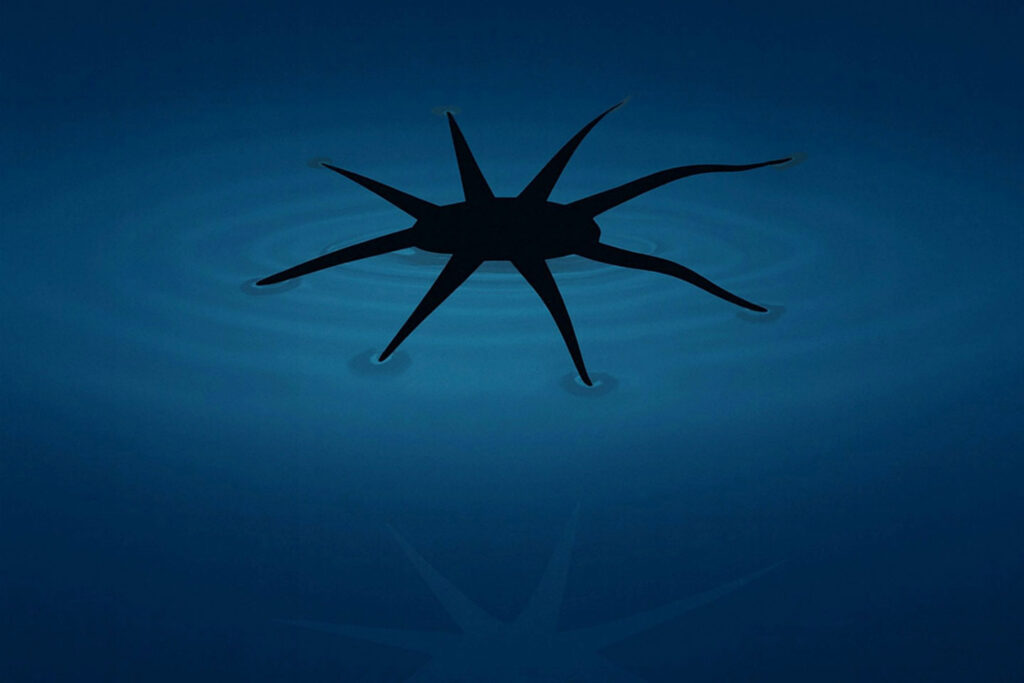
The researchers created two distinct robot designs to demonstrate the capabilities of their technique. The first, HydroFlexor, utilises triangular fins that bend and twist when heated, creating a paddling motion similar to that of some aquatic insects. The second design, HydroBuckler, employs multiple thin legs that buckle upward when warmed, then snap back to their original position when cooled, producing a walking-like gait on the water surface.
Both designs rely on bilayer films composed of pure PDMS and PDMS mixed with carbon nanotubes. When heated from above using infrared radiation, the two layers expand at different rates, causing the structures to deform predictably. The water surface provides just enough support to maintain the robots’ position while allowing controlled movement through these deformations.
The robots demonstrated remarkable control capabilities in laboratory tests. The HydroFlexor design achieved speeds up to 0.6 centimetres per second, while the HydroBuckler showed similar performance with its walking mechanism. Both designs could execute straight-line trajectories or programmed turns based on their geometric configuration.
Temperature control proved crucial for modulating the robot’s behaviour. At 70 degrees Celsius, the devices followed their designed paths with high fidelity. Higher temperatures increased both speed and manoeuvrability as greater thermal expansion produced more pronounced deformations. The researchers found that they could control the turning radius by adjusting the relative dimensions of the ins or legs on each side of the robot body.
The propulsion mechanism generates forces on the order of microNewtons-tiny by everyday standards but sufficient to overcome water’s viscous drag at these scales. The robots’ movement relies on asymmetric interactions with the water surface during their deformation cycles, pushing against the water more effectively in one phase than in the other.r
If the HydroSpread technique proves scalable, it could address several engineering challenges in miniature robotics. Current methods for creating soft robots require building components on rigid substrates, then carefully transferring them to their operational environment-a process that often results in the tearing or deformation of many delicate structures. By eliminating this transfer step, HydroSpread could enable the mass production of water-surface robots.
The technique’s materials compatibility extends beyond PDMS to other polymers and composites, suggesting engineers could tailor robots for specific applications. Environmental monitoring represents one promising avenue, where swarms of tiny robots could sample water quality across large areas. The robots’ soft construction would minimise disruption to aquatic ecosystems while their low cost could enable deployment of hundreds or thousands of units simultaneously.
Several technical hurdles remain before practical deployment becomes feasible. The current prototypes require external heating, limiting their autonomy. Engineers are exploring alternative actuation methods, including embedded heating elements, magnetic particles that respond to external fields, or materials that react to sunlight. Power storage presents another challenge-at millimetre scales, traditional batteries become impractical, pushing researchers toward energy harvesting approaches.
The manufacturing process itself, while simpler than alternatives, still requires refinement for commercial viability. Precisely controlling film thickness across large areas, ensuring consistent material properties in composite films, and scaling laser patterning to higher throughput all require additional development.
Perhaps most significantly, the robots currently lack onboard sensing and control systems. Future iterations might incorporate flexible electronics directly into the film structure during fabrication, enabling autonomous navigation and data collection. The HydroSpread process’s compatibility with various materials suggests such integration should be achievable, though it will require careful engineering to maintain the structures’ mechanical properties.
The research demonstrates how understanding fundamental physical phenomena-such as surface tension, thermal expansion, and fluid mechanics-enables engineers to create innovative solutions to complex problems. By working with, rather than against, water’s properties, the team has paved the way for practical water-surface robotics that could find applications ranging from pollution monitoring to search and rescue operations.
TLDR
- Engineers at the University of Virginia developed the HydroSpread technique for building water-walking robots directly on water surfaces
- Method uses polymer droplets that spread into ultrathin films on water, then laser-cuts them into robotic structures
- Two robot designs demonstrated: HydroFlexor (paddling motion) and HydroBuckler (walking motion)
- Robots move via thermal actuation using bilayer films that deform when heated
- Achieved speeds up to 0.6 cm/second with precise control and turning capabilities
- Eliminates fragile transfer processes that limited previous water-walking robot attempts
- Potential applications include environmental monitoring, disaster response, and water quality sampling
- Technical challenges remain: external heating requirement, power storage, and lack of onboard sensors