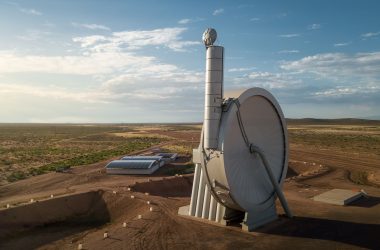
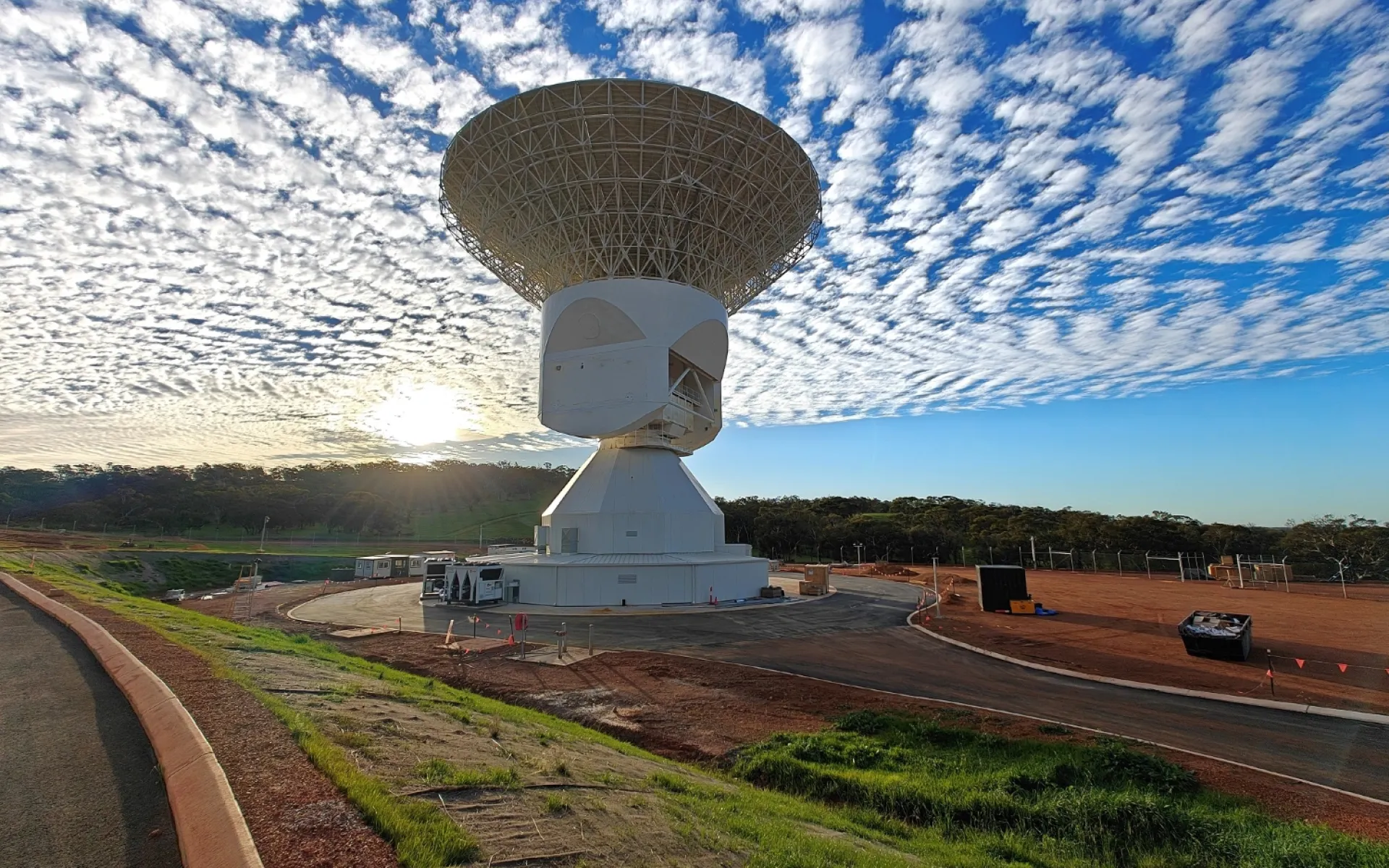
The European Space Agency has activated its fourth deep space antenna at the New Norcia ground station near Perth, Australia, marking a significant expansion in Europe’s ability to communicate with spacecraft exploring the solar system. The NNO-3 antenna, a 35-meter diameter dish engineered by the European Deep Space Antenna Alliance, represents the latest advancement in ultra-sensitive radio frequency technology designed to maintain contact with missions millions of kilometers from Earth.
The engineering achievement addresses one of space exploration’s fundamental challenges: detecting and amplifying incredibly weak signals traveling vast distances through space. When a spacecraft like the Euclid telescope transmits data from its position studying dark matter and energy, that signal loses strength exponentially as it travels. By the time these electromagnetic waves reach Earth, they measure mere fractions of a watt-comparable to the power output of a smartphone’s Bluetooth signal attempting to communicate from the Moon.
Signal Detection and Amplification Engineering
The NNO-3 antenna operates across multiple frequency bands-X-band (8-12 GHz), K-band (18-27 GHz), and Ka-band (26-40 GHz)-each optimized for different communication needs. Lower frequencies like X-band penetrate atmospheric interference more effectively, while higher frequencies such as Ka-band enable faster data transmission rates when atmospheric conditions permit. This multi-band capability allows mission controllers to adapt their communication strategy based on weather conditions, spacecraft distance, and data priority.
The antenna’s 35-meter parabolic reflector collects incoming radio waves and focuses them onto a feed horn positioned at the focal point. This concentration increases signal strength by a factor of approximately 50,000 compared to an omnidirectional antenna. The precision required in this focusing mechanism is extraordinary-the entire structure must maintain its shape within millimeters despite temperature fluctuations, wind loads, and the constant motion required to track spacecraft across the sky.
Understanding Deep Space Antenna Engineering
Deep space antennas like NNO-3 employ several sophisticated engineering principles that students encounter in electromagnetics, signal processing, and mechanical engineering courses. The fundamental challenge involves the inverse square law-as distance doubles, signal strength decreases by a factor of four. For a spacecraft at Mars’ average distance of 225 million kilometers, this results in signal attenuation of approximately 280 decibels.
The antenna system compensates through three primary engineering approaches. First, the large parabolic reflector acts as a gain amplifier, with gain proportional to the square of the diameter divided by the wavelength squared. A 35-meter dish operating at Ka-band frequencies achieves theoretical gains exceeding 70 dBi (decibels relative to an isotropic radiator).
Second, cryogenically cooled low-noise amplifiers reduce thermal noise that would otherwise overwhelm faint signals. These amplifiers operate at temperatures near 20 Kelvin (-253°C), where molecular motion-and thus thermal noise-approaches minimum levels. The engineering challenge involves maintaining these extreme temperatures while ensuring the amplifier components remain functional. Closed-cycle helium refrigerators achieve this cooling without requiring constant replenishment of cryogenic fluids.
Third, the antenna employs sophisticated pointing systems combining mechanical and electronic beam steering. The mechanical system uses precision motors and encoders to position the antenna within 0.001 degrees of the target spacecraft’s predicted position. This accuracy requirement stems from the antenna’s narrow beamwidth-at Ka-band frequencies, the 3-dB beamwidth measures approximately 0.06 degrees, smaller than the apparent diameter of the Moon as seen from Earth.
The structural engineering presents equally complex challenges. The antenna must maintain its parabolic shape under varying gravitational loads as it tilts from horizon to zenith. Engineers use finite element analysis to predict deformations and compensate through strategic placement of counterweights and support structures. The backing structure employs a space frame design that maximizes stiffness while minimizing weight, similar to principles used in bridge engineering but adapted for rotational rather than static loads.
Signal processing within the antenna system demonstrates practical applications of Fourier transforms and digital filtering techniques. Incoming signals undergo multiple stages of frequency conversion, moving from radio frequencies to intermediate frequencies where filtering and amplification prove more manageable. Digital signal processors implement matched filters that maximize signal-to-noise ratio by correlating received signals with known transmission patterns.
The consortium responsible for NNO-3’s development-comprising Thales Alenia Space, Schwartz-Hautmont, and mtex antenna technology-divided engineering responsibilities according to each company’s specialization. Thales Alenia Space handled systems integration and radio frequency subsystems, ensuring all components work together to achieve required sensitivity levels. Schwartz-Hautmont engineered the mechanical structure capable of supporting the massive reflector while maintaining precise positioning. mtex antenna technology managed the complex procurement and testing processes that verify performance specifications.
Thermal Management and Environmental Considerations
One often-overlooked aspect of deep space antenna engineering involves thermal management. The antenna operates in Western Australia’s harsh environment, experiencing temperature swings exceeding 40 degrees Celsius between day and night. These temperature variations cause thermal expansion and contraction that, if uncontrolled, would distort the parabolic surface beyond acceptable tolerances.
Engineers addressed this through careful material selection and thermal isolation strategies. The reflector panels use aluminum alloys chosen for their favorable strength-to-weight ratio and predictable thermal expansion coefficients. Strategic placement of expansion joints accommodates dimensional changes without compromising surface accuracy. The pedestal and elevation bearings incorporate temperature-compensated designs that maintain alignment despite thermal cycling.
The facility’s cooling systems extend beyond the cryogenic amplifiers to encompass the high-power amplifiers used for transmission. When sending commands to distant spacecraft, these amplifiers generate kilowatts of radio frequency power, with substantial waste heat requiring dissipation. Liquid cooling systems circulate coolant through heat exchangers, maintaining component temperatures within operational limits while minimizing thermal gradients that could affect signal phase coherence.
Environmental protection also factors into the engineering design. The antenna must withstand wind speeds exceeding 100 kilometers per hour while maintaining pointing accuracy for critical communications passes. The control system continuously monitors wind loading and compensates through servo adjustments, though extreme conditions may require stowing the antenna in a protective position.
The successful reception of signals from the Euclid spacecraft demonstrates the antenna’s immediate operational capability. This spacecraft, studying the universe’s dark matter and dark energy from a position 1.5 million kilometers from Earth at the second Lagrange point, transmits scientific data that helps astronomers understand cosmic structure formation. The ability to reliably receive these transmissions enables continuous scientific observation without data gaps that could compromise research objectives.
As the European Space Agency prepares for upcoming missions like the Plato exoplanet observatory scheduled for launch next year, the NNO-3 antenna adds crucial redundancy and capacity to the ESTRACK network. This expansion reflects growing demands for deep space communication infrastructure as space agencies undertake increasingly ambitious exploration programs. The engineering principles demonstrated in NNO-3’s design and construction provide a foundation for future antenna systems that may support human missions to Mars or robotic explorers venturing even deeper into the solar system.
- ESA activated its fourth deep space antenna (NNO-3) at New Norcia ground station near Perth, Australia
- The 35-meter dish amplifies incredibly weak signals from spacecraft millions of kilometers away by a factor of 50,000
- Operates across X-band, K-band, and Ka-band frequencies for adaptive communication strategies
- Uses cryogenically cooled amplifiers at -253°C to reduce thermal noise interference
- Maintains millimeter precision despite temperature swings of 40°C and high wind loads
- Successfully receiving data from Euclid spacecraft studying dark matter 1.5 million km from Earth
- Built by consortium of Thales Alenia Space, Schwartz-Hautmont, and mtex antenna technology
- Adds crucial capacity for upcoming missions like the Plato exoplanet observatory