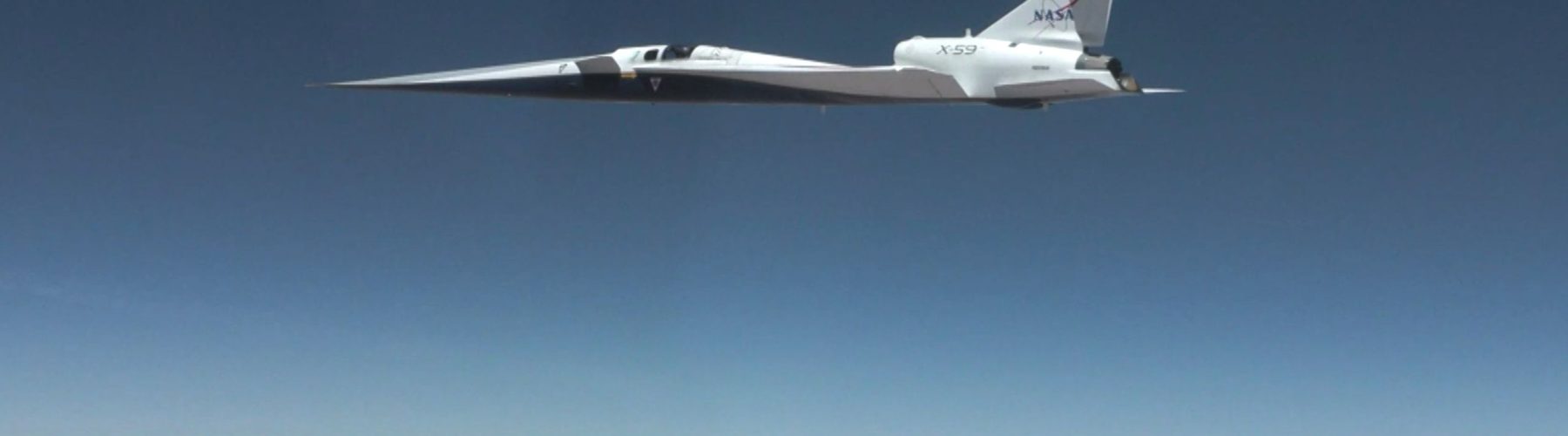
At 11:08 on a Friday morning in the California desert, test pilot Jim Less pulled back on the yoke of an aircraft that looked more like a flying needle than a conventional jet. Eighty-one minutes later, he touched down at Edwards Air Force Base having done something no pilot has managed in this particular machine: pushed past Mach 1.
The X-59 quiet supersonic jet reached Mach 1.1 on 5 June 2026, topping out at 713 mph and 43,400 feet. That number alone would be unremarkable. Military jets do it routinely. What makes this flight different is not the speed but the silence, or rather, the near-silence. The X-59 is engineered to replace the thunderclap of a sonic boom with something closer to the sound of a distant car door shutting.
Supersonic commercial flight died in 1973 when the US Federal Aviation Administration banned it over populated areas. Concorde could cross the Atlantic in three and a half hours, but the shock waves it trailed shattered greenhouse panes in Somerset. The physics was unforgiving: any object punching through the sound barrier compresses air into cone-shaped pressure waves that reach the ground as a sharp double bang.
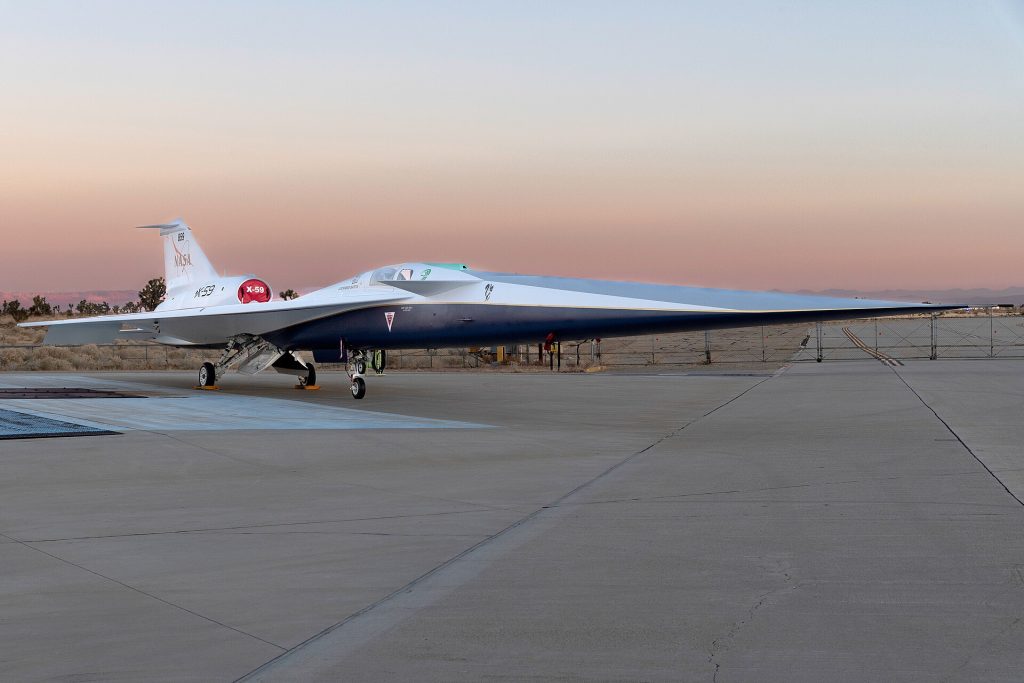
NASA’s approach, developed over more than a decade with Lockheed Martin’s Skunk Works division, is to reshape those pressure waves before they merge. The X-59 stretches 30 metres long but stands barely four metres tall, with a razor-thin nose that accounts for roughly a third of its total length. There is no forward-facing windscreen. The pilot sees through an external vision system, a combination of cameras and cockpit displays that stitch together a synthetic view of the sky ahead.
The shape distributes pressure changes along the aircraft’s length rather than letting them coalesce into a single sharp front. By the time these weaker waves reach the ground, the boom has dissipated into what NASA calls a “thump”, a sound roughly as loud as a neighbour closing a car boot.
An F-15 chase plane flew alongside during Friday’s test, generating its own conventional sonic booms. Ground sensors recorded both signatures. According to NASA, the F-15’s booms masked any sound the X-59 produced, precisely the result the engineering team was hoping for.
Within days, the team plans a “mission conditions” flight at Mach 1.4 and 55,000 feet, the profile the aircraft will eventually fly over US communities. Those community overflights will gather public perception data that NASA intends to share with regulators worldwide, building the case for new noise standards that could reopen the skies to supersonic passenger travel.
Engineering Deep Dive: Shaping Shock Waves from the X-59 Quiet Supersonic Jet
The core engineering challenge here sits at the intersection of aerodynamics and acoustics, two fields that A-level Physics students will recognise from wave theory and fluid mechanics.
When an object travels faster than sound, it continuously generates pressure disturbances that cannot propagate ahead of it. These disturbances stack into oblique shock waves trailing from the nose, wings, engine inlets, and tail. In a conventional supersonic aircraft, these individual shocks coalesce as they travel toward the ground, merging into two strong fronts that arrive as the characteristic “N-wave” double bang of a sonic boom.
The X-59’s designers attacked this problem geometrically. The elongated fuselage, with a length-to-diameter ratio far exceeding that of any conventional fighter, spreads the pressure rise over a longer distance. Each feature that would normally generate a distinct shock (the nose tip, the canopy line, the wing leading edge, the engine nacelle) is positioned so that its individual pressure signature arrives at the ground at slightly different times. Instead of two sharp peaks, the ground-level waveform becomes a series of small, spread-out pressure rises, none strong enough to register as a boom.
Think of it as the difference between dropping a brick into a bath and lowering it in slowly: same displaced volume, radically different splash.
The external vision system is itself an engineering solution born from aerodynamic necessity. A conventional cockpit canopy would create a blunt discontinuity in the fuselage profile, generating exactly the kind of localised shock the designers were trying to eliminate. Removing the windscreen allowed the nose to taper smoothly. The system uses two high-definition cameras, a forward-looking infrared sensor, and terrain data to render a real-time synthetic display.
Students studying mechanics at A-level will recognise that the speed of sound depends on temperature. At 43,400 feet, where the ambient temperature sits around minus 57 degrees Celsius, Mach 1 is approximately 660 mph, well below its sea-level value of 761 mph. This is why the X-59’s ground speed of 713 mph translated to Mach 1.1 at altitude, a number that would not reach Mach 1 at ground level.
Structural engineering is equally demanding. At Mach 1.4, aerodynamic heating raises skin temperatures by tens of degrees, and the airframe must withstand both the compressive loads of supersonic flight and the cyclic fatigue of repeated test campaigns. Lockheed Martin’s Skunk Works, the same division that built the SR-71 Blackbird, used advanced composite materials alongside conventional aluminium alloys to balance weight, stiffness, and thermal performance.
The broader regulatory challenge connects engineering to policy. Current international noise standards, set by the International Civil Aviation Organisation, effectively ban supersonic flight over land by specifying maximum permissible boom levels that no aircraft could meet. NASA’s Quesst programme aims to replace these blanket bans with data-driven thresholds based on perceived loudness, measured in decibels of perceived noise level (PLdB). If the community overflight data shows that people find the X-59’s thump acceptable, regulators could establish a PLdB ceiling that future commercial aircraft would need to meet, opening a design space that has been legally closed for over fifty years.
The next milestone, community overflights across several US cities, will test whether the engineering holds up where it matters most: in how ordinary people react to the sound overhead. If those tests go well, the first generation of quiet supersonic airliners could enter service within the next fifteen years, cutting transatlantic travel times in half without rattling a single window.
- NASA’s X-59 reached Mach 1.1 on 5 June 2026, its first supersonic flight
- The jet’s elongated shape converts sonic booms into a quiet thump
- Test pilot Jim Less flew from Edwards Air Force Base in California
- Community overflight tests will gather noise perception data for new regulations
- Could enable supersonic commercial passenger flight over land within 15 years