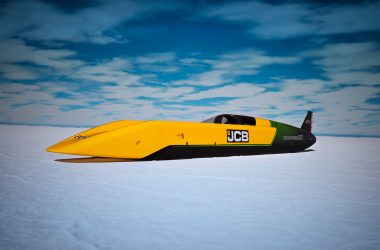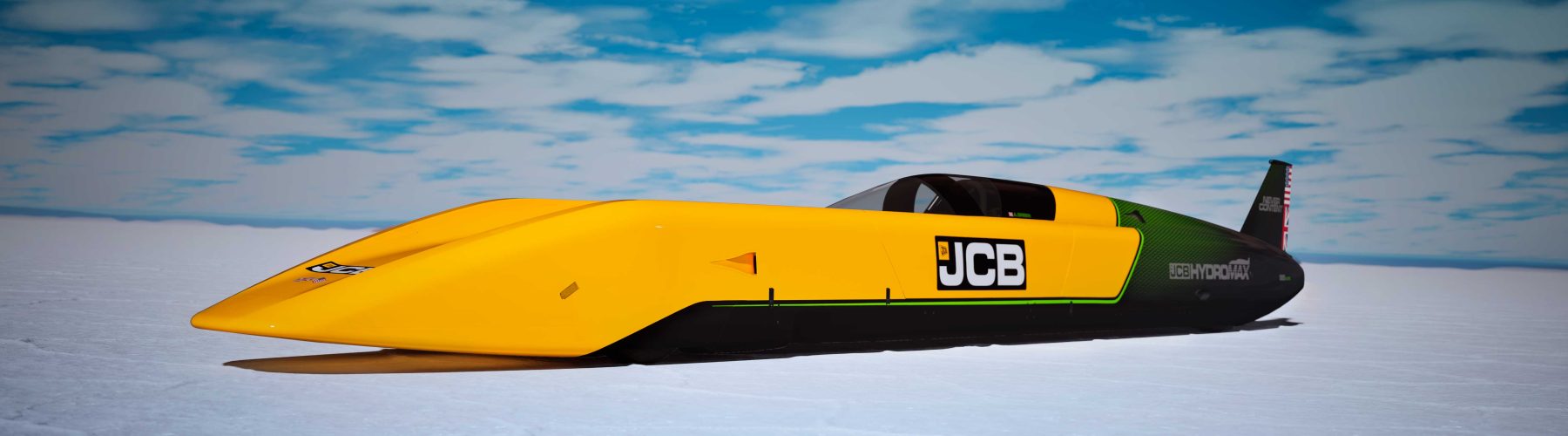
On an old runway in Cambridgeshire, a 32-foot hydrogen-powered streamliner waited in the rain. The car, called JCB’s Hydromax, had just reached 335 km/h, or about 208 mph. That’s fast, but the team wants more.
The JCB team is aiming for 350 mph. If they succeed, the Hydromax will almost double the current hydrogen internal combustion engine record of 187.62 mph, set by BMW’s H2R twenty years ago. The attempt will take place at the Bonneville Salt Flats in Utah in August 2026, with the FIA overseeing the event.
The Hydromax uses two modified JCB diesel engines that have been redesigned to run on hydrogen, producing a combined 1,600 horsepower. The driver, Andy Green, set the diesel land speed record at 350.092 mph in 2006. He has spent months at RAF Wittering, gradually increasing the car’s speed while engineers studied data from every run.
The Hydromax project has taken over 150,000 engineering hours. This includes years spent using computer simulations to design the body, months testing metal parts to handle extreme forces, and weeks adjusting the fuel injection system for hydrogen, which acts very differently from diesel.
Hydrogen burns much faster than regular fuels. Its flame speed is about six times higher than petrol, which can cause pre-ignition and backfiring. To solve this, the engineers redesigned the combustion chambers, valve timing, and fuel delivery to control these issues and still get the most power. They also had to deal with hydrogen’s low energy density, so the car uses high-pressure tanks that add extra weight and complexity.
The streamliner’s aerodynamics presented their own challenges. At 350 mph, air resistance increases with the square of velocity: every surface, every seal, every joint in the bodywork matters. The team used wind tunnel testing alongside CFD simulations, iterating through dozens of body shapes before settling on the final design. The result is a vehicle that looks more like a wingless aircraft than anything you would see on a construction site.
Today, most attention goes to battery electric vehicles, so hydrogen engines might seem unusual. But JCB’s chairman, Lord Bamford, believes hydrogen engines have benefits for heavy machines that batteries can’t match. They can refuel in minutes, work in extreme temperatures, and use existing engine technology.
The Bonneville run is also meant to show what the technology can do. If hydrogen can push a car past 350 mph, it should be able to power machines like backhoe loaders or telehandlers. The lessons learned from this project will help JCB develop hydrogen engines for their commercial vehicles.
Andy Green is calm about the risks. He has already driven faster than the speed of sound in the Thrust SSC. For him, driving a hydrogen streamliner on salt is a careful challenge. Still, salt surfaces can be unpredictable. Moisture, texture, and bumps change every day. The chance to set a record at Bonneville is short, often just a few days with the right conditions.
Engineering Deep Dive
Turning a diesel engine into one that runs on hydrogen requires major changes to how it burns fuel. Diesel engines use compression to ignite fuel, heating air above the fuel’s autoignition point. Hydrogen needs a much higher temperature - 585°C compared to about 210°C for diesel - so the same compression ratio does not work. The JCB team solved this by changing the compression ratio and adding a spark ignition system, creating a hybrid way of burning fuel.
Fuel injection timing was another big challenge. Hydrogen can burn over a wide range of concentrations in air - 4 to 75 percent, compared to 1 to 6 percent for petrol - so the engine can run on very lean mixtures. This lowers NOx emissions and improves efficiency, but running too lean reduces power. The Hydromax engines use mixtures closer to the ideal ratio for the most power, which means injection timing must be very precise to avoid knocking and pre-ignition.
Each engine uses direct injection at pressures over 300 bar. The injectors are custom-made to handle hydrogen’s low viscosity and its tendency to make metals brittle over time. Because hydrogen molecules are so small, they can leak through seals and joints that would hold other fuels. The engineers created new sealing methods and chose materials that work well with hydrogen, using standards from the aerospace industry.
Cooling the engine was another challenge. Burning hydrogen creates more water vapor than burning regular fuels, and the exhaust temperatures are different from diesel engines. The team had to redesign the cooling system to control both the engine block temperature and the exhaust, which can be hotter or cooler than diesel depending on how the engine is running.
The Hydromax stores fuel in Type IV composite tanks rated for 700 bar, like those used in hydrogen fuel cell cars. These tanks are made from carbon fiber-reinforced polymer, lined with a dense polyethene barrier, and covered by a protective shell. At 700 bar, hydrogen has an energy density of about 5.6 MJ per litre, much less than diesel’s 34.2 MJ per litre. So, the Hydromax needs much larger tanks to go the same distance, which affected the car’s size.
At these speeds, the streamliner’s aerodynamics become more complex. At 350 mph (Mach 0.46), there are no shock waves, but the way air moves over the car changes compared to lower speeds. The team used advanced computer models to study the airflow, focusing on how the boundary layer changes from smooth to turbulent. A turbulent layer creates more drag but is less likely to separate from the surface, so the team had to find the right balance.
The Hydromax’s stability at high speed relies on the placement of its aerodynamic surfaces. Unlike regular race cars that use downforce to grip the track, a streamliner needs to stay balanced. Too much downforce adds resistance on the soft salt, while too little makes the car unstable. The Hydromax uses small adjustable surfaces, set before each run depending on the expected crosswinds.
If all goes well in August, the Hydromax will reach a speed on the salt flats that no hydrogen-powered vehicle has ever achieved. Once set, this record will be the fastest for a hydrogen internal combustion engine in the world. JCB’s engineers are already thinking ahead, as the technology proven at Bonneville will help design the next generation of hydrogen-powered construction equipment in Staffordshire.
- JCB’s Hydromax streamliner targets 350mph at Bonneville in August 2026, aiming to nearly double the hydrogen ICE record of 187.62mph
- Twin modified JCB hydrogen engines produce 1,600hp, with testing at RAF Wittering reaching 208mph
- Over 150,000 engineering hours invested, with technology feeding back into commercial hydrogen construction equipment