At 10:54 on the morning of 20 March, a long, white aircraft with an improbably pointed nose lifted off from Edwards Air Force Base in California. Nine minutes later it was back on the ground, its second flight cut short by a warning light in the cockpit. The early landing was, by any reasonable measure, a non-event. The pilot, Jim “Clue” Less, described the experience as “just like the simulator,” which is exactly what the engineering team wanted to hear. But the aircraft itself, NASA’s X-59, is anything but ordinary. It is designed to fly faster than the speed of sound without producing the thunderous sonic boom that has banned supersonic commercial flight over land for more than five decades.
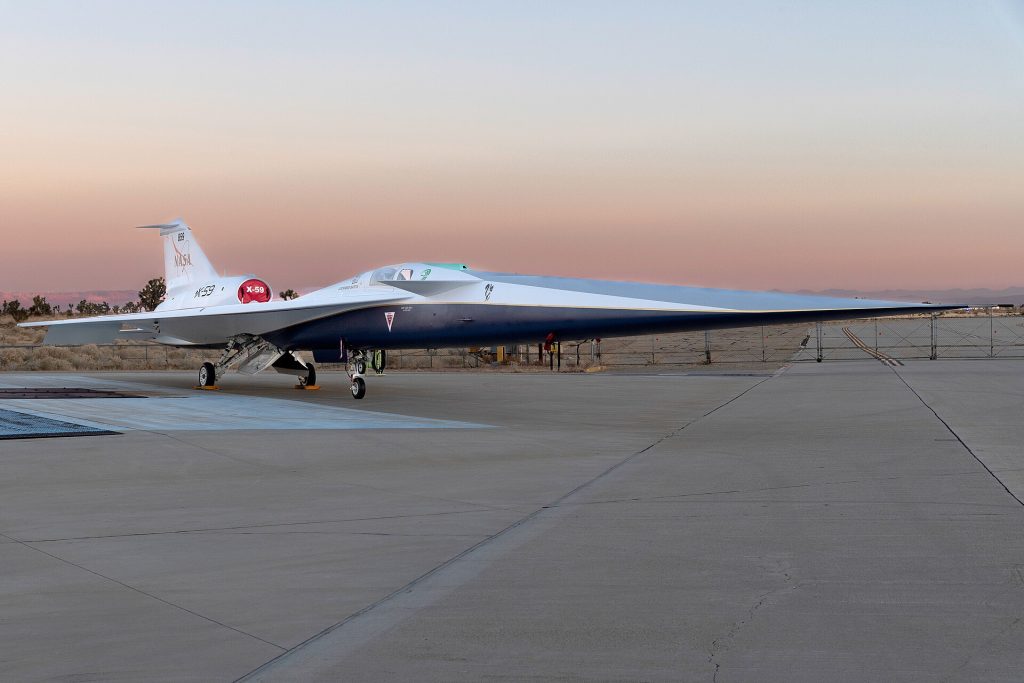
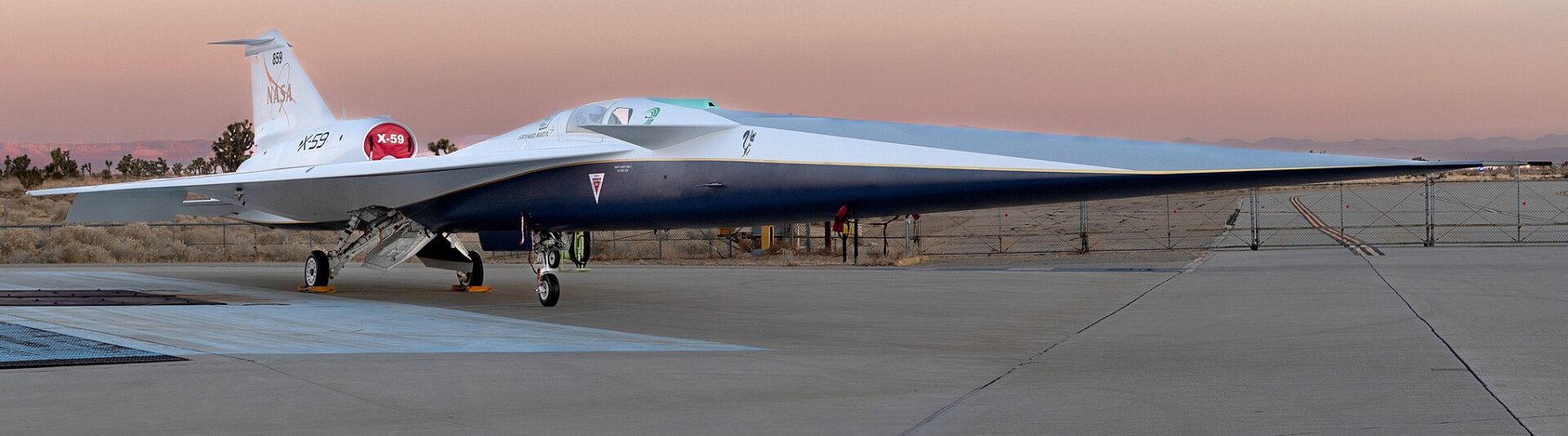
NASA's X-59 quiet supersonic research aircraft sits on the ramp at Lockheed Martin Skunk Works in Palmdale, California during sunrise, shortly after completion of painting. With its unique design, including a 38-foot-long nose, the X-59 was built to demonstrate the ability to fly supersonic, or faster than the speed of sound, while reducing the typically loud sonic boom produced by aircraft at such speeds to a quieter sonic "thump". The X-59 is the centerpiece of NASA's Quesst mission, which seeks to solve one of the major barriers to supersonic flight over land, currently banned in the United States, by making sonic booms quieter.
The X-59 is the centrepiece of NASA’s Quesst mission, a programme that aims to prove quiet supersonic flight is physically achievable and then measure whether communities on the ground find the reduced noise acceptable. If they do, the data could persuade regulators to lift the overland supersonic ban, opening the door to a new generation of commercial aircraft that could halve transatlantic flight times. The aircraft is built by Lockheed Martin’s Skunk Works division, the same outfit that produced the SR-71 Blackbird and the F-117 stealth fighter.
Shaping the boom away
The key to the X-59’s design is its shape. A conventional supersonic aircraft produces a pair of strong shockwaves, one at the nose and one at the tail, that merge as they travel to the ground and arrive as a double crack loud enough to rattle windows and alarm livestock. The X-59’s elongated fuselage, measuring roughly 30 metres from tip to tail, is sculpted so that the shockwaves it generates remain separated and weakened as they descend. By the time they reach the surface, what was a bang has become what NASA describes as a “thump”, comparable in volume to a car door closing as heard from inside a house.
The nose is the most striking feature. It extends roughly a third of the aircraft’s total length, tapering to a point so fine that the pilot cannot see directly ahead. Instead, the cockpit uses the eXternal Vision System, or XVS, a high-resolution camera mounted on the fuselage that feeds a display inside the cockpit, replacing the forward window entirely. This is not just an aesthetic choice. The long nose is structurally necessary to manage the pressure distribution along the aircraft’s body, ensuring that shockwaves form gradually rather than abruptly.
The aircraft is powered by a single General Electric F414 engine, the same powerplant used in the F/A-18E/F Super Hornet. The target cruise speed is around 925 mph, or Mach 1.4, at an altitude of 55,000 feet. At that height and speed, the shockwave geometry is optimised for minimum ground-level noise. The current test campaign involves dozens of flights through 2026, gradually expanding the aircraft’s speed and altitude envelope. The second flight, despite its brevity, added to the dataset that will eventually clear the aircraft for supersonic operations.
Project manager Cathy Bahm was pragmatic about the shortened sortie. “Despite the early landing, this is a good day for the team,” she said. “We collected more data, and the pilot landed safely.” Envelope expansion, the process of incrementally testing an aircraft at higher speeds and altitudes, is deliberately cautious. Each flight pushes the boundaries slightly, and the data gathered are analysed before the next flight is approved. It is engineering rigour applied to the problem of trust: trust in the airframe, trust in the systems, and trust in the models that predicted how the aircraft would behave.
Engineering Deep Dive: The Physics of Sonic Booms and How to Quieten Them
When an object moves through air faster than the speed of sound, it compresses the air ahead of it faster than the disturbance can propagate away. The compressed air accumulates into a shockwave, a thin region where pressure, temperature, and density all jump sharply. A-level Physics students encounter this concept when studying wave phenomena: the object outruns its own pressure waves, and they pile up into a cone-shaped front called a Mach cone. The half-angle of the cone is given by sin(θ) = 1/M, where M is the Mach number. At Mach 1.4, the cone half-angle is about 45.6 degrees.
A conventional supersonic aircraft produces multiple shockwaves from various surfaces: the nose, the cockpit canopy, the wing leading edges, the engine intakes, and the tail. As these shockwaves travel toward the ground, they tend to coalesce into two dominant fronts, one from the nose region and one from the tail. This produces the classic “double boom” heard on the ground, two sharp bangs separated by a fraction of a second. The overpressure at ground level from Concorde, for example, was typically around 2 pounds per square foot (psf), loud enough to startle and to crack plaster in older buildings.
The X-59’s design philosophy is to prevent this coalescence. By stretching the fuselage and carefully shaping every surface, the engineers ensure that the individual shockwaves remain separated and weak as they propagate downward. The long nose is the primary tool. It creates a very gradual pressure rise at the front of the aircraft, replacing the sharp nose shock of a conventional design with a smooth, distributed compression. Think of it as the difference between dropping a stone into a pond (sudden splash) and sliding your hand slowly into the water (gentle ripple). The physics is the same, but the rate of pressure change determines the perceived loudness.
The wing, tail, and engine nacelle are shaped to produce similarly gentle pressure signatures. The engine inlet is mounted on top of the fuselage, partly to shield the ground from inlet shockwaves and partly to keep the underside profile clean. The overall effect is that the pressure signature at ground level resembles a series of gentle undulations rather than two sharp spikes. NASA’s target is a perceived loudness of about 75 PLdB (perceived level in decibels), compared with Concorde’s roughly 105 PLdB. The PLdB scale accounts for human hearing sensitivity, so a 30 PLdB reduction represents a sound that most people would perceive as a soft thump rather than a startling crack.
The eXternal Vision System is an engineering solution to a structural constraint. The nose must be long and slender to manage the shockwave, but this blocks the pilot’s forward view. The XVS combines a forward-facing camera with terrain database overlays and synthetic vision, presenting the pilot with a composite image on a cockpit display. It is a direct application of sensor fusion, a technique students may encounter in robotics or autonomous vehicle engineering, adapted for supersonic flight.
For students studying A-level Physics, the X-59 connects several syllabus topics: wave speed and the Doppler effect, pressure and fluid dynamics, energy transformations in jet engines (the F414 is a turbofan, converting chemical energy in jet fuel to kinetic energy of the exhaust), and the relationship between frequency, wavelength, and the speed of sound. The Mach cone geometry is a direct extension of the wave diagrams drawn for moving sources.
The broader engineering question is whether quiet supersonic flight can be made economical. Concorde consumed roughly three times as much fuel per passenger-kilometre as a subsonic widebody. Modern materials, more efficient engines, and optimised aerodynamics could narrow that gap, but supersonic flight will always require more energy than subsonic cruise because of the additional wave drag created by shockwaves. The trade-off between speed and fuel burn is, at its core, a thermodynamics problem.
The Quesst mission’s next steps involve pushing the X-59 progressively faster and higher. Once the aircraft reaches its design speed and the acoustic measurements confirm the predicted ground-level noise, NASA plans to fly it over selected US communities and survey residents about what they heard. The results will feed directly into proposals for new international regulations on supersonic overland flight. If the engineering holds, and if the public agrees the noise is tolerable, the ban that has shaped commercial aviation since 1973 could finally be revisited.
• NASA’s X-59 experimental aircraft completed its second test flight on 20 March at Edwards Air Force Base, advancing the Quesst quiet supersonic mission.
• The aircraft’s elongated shape prevents sonic boom shockwaves from merging, reducing ground-level noise from a bang to a gentle thump.
• Built by Lockheed Martin’s Skunk Works, the X-59 targets Mach 1.4 at 55,000 feet, with dozens more test flights planned through 2026.
• If community noise surveys prove acceptable, the data could lead regulators to lift the 50-year ban on supersonic flight over land.